

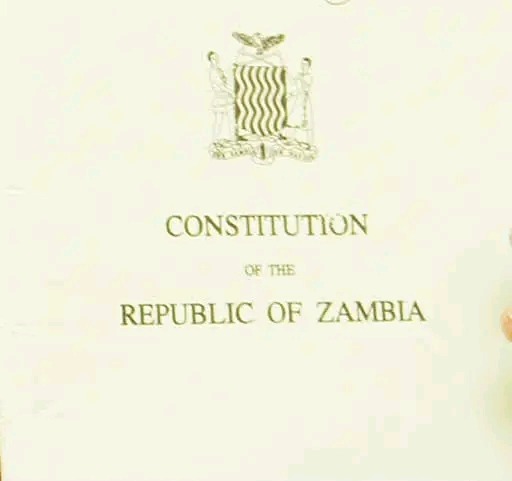
ZAMBIA NEED A NEW CONSTITUTION? FINE. BUT LET US FIRST DECIDE WHAT IT MUST FIX
By Mwanza Isaac
Zambia may soon find itself asking one of the most consequential constitutional questions since the return to multiparty democracy in 1991: should the country abandon the 1991 Constitution and begin again with an entirely new Constitution?
I am not an advocate of repealing and replacing the entire Constitution simply for the sake of producing a document with a new cover and a new name. But if Zambians, after proper consultation and sober national debate, conclude that the time has come to write a new constitutional settlement, I am game.
But there is an important qualification: if we are going to replace the Constitution, we must first answer the harder question: replace it with what?
The 1991 Constitution was born out of a particular historical moment. It ended the one-party state and provided the constitutional framework for the Third Republic. Indeed, the Constitution Review Commission itself later observed that the 1991 Constitution was conceived largely as a transitional instrument because there was insufficient time for a comprehensive constitutional review before the return to multiparty politics.
Since then, the Constitution has been amended repeatedly, notably in 1996, 2016 and most recently through the major reforms enacted in 2025 that came into operation during the 2026 electoral cycle. The latest reforms fundamentally altered aspects of Zambia’s electoral architecture, including the introduction of mixed-member proportional representation.
This history provides a legitimate basis for asking whether we are now trying to repair an old house by continuously adding new rooms.
But before we demolish the house, we should establish whether the foundations are actually defective.
THE BILL OF RIGHTS ARGUMENT
One of the strongest arguments for a new Constitution is the need for a comprehensive Bill of Rights containing enforceable economic and social rights.
This is a powerful argument. Zambians should be able to ask whether rights to health, education, housing, food, water, social security, a clean environment and other socio-economic interests should remain largely matters of policy or become enforceable constitutional rights.
But there is a problem with using this argument to justify the wholesale repeal of the Constitution: we have done this before through amendment.
The proposed constitutional reforms of 2015–2016 contemplated expanding the Bill of Rights to include civil, political, economic, social, cultural and environmental rights.
Therefore, if the objective is simply to expand the Bill of Rights, the answer is obvious: amend the Bill of Rights.
WHAT ABOUT THE CONSTITUTIONAL LACUNAE?
The same question arises concerning alleged lacunae in the Constitution.
Zambia undoubtedly has constitutional gaps. Some provisions are ambiguous. Some have produced competing interpretations. Some institutions have been given powers without sufficiently precise limitations. Some constitutional relationships between the Executive, Parliament, Judiciary and independent constitutional bodies require clarification.
But again, does every lacuna require a new Constitution? Not necessarily.
Some can be corrected by carefully drafted amendments. Others can be addressed through legislation. Still others can be resolved through constitutional litigation and authoritative judicial interpretation.
The problem, however, is that this last solution depends on the quality and stability of constitutional adjudication.
Zambia’s Constitutional Court has an important constitutional mandate. Yet there is legitimate public concern about the quality, consistency and durability of some constitutional jurisprudence. Constitutional interpretation should not leave citizens wondering whether a major principle established today will survive tomorrow’s litigation.
A Constitution is supposed to provide certainty.
Where constitutional meaning changes too easily, constitutionalism itself becomes uncertain.
This is one area where a new Constitution could provide an opportunity to do something more fundamental: redesign the constitutional adjudication architecture, clarify the relationship between the Constitutional Court and Supreme Court, establish stronger principles of precedent, and ensure that constitutional questions receive judgments of the depth, reasoning and authority expected from a supreme constitutional institution.
CONSTITUTIONS ARE ABOUT POWER
There is another reason why we should take the idea of a new Constitution seriously. Constitutions are not merely legal documents. They are instruments for managing political power.
Zambia’s own history demonstrates this with uncomfortable clarity.
Kenneth Kaunda governed Zambia for 27 years. The 1973 Constitution entrenched the Second Republic and the one-party system, concentrating enormous political power within the ruling establishment.
Then came the return to multiparty democracy.
The 1991 Constitution did not merely amend the existing constitutional order. It repealed the 1973 Constitution and established a new constitutional framework for the Third Republic.
That constitutional break mattered.
More importantly, Zambia’s experience in 1991 provides perhaps the clearest warning about what a new Constitution can do to presidential tenure.
The two-term presidential limit was introduced in the 1991 Constitution. But the Constitution also contained a transitional provision making it clear that the period served by a president before the commencement of the new Constitution would not be counted as a term under that Constitution.
That meant that Kenneth Kaunda, despite having served as President for 27 years, could enter the Third Republic as though the constitutional clock on presidential tenure had effectively been reset. Had he won the 1991 election, he could have served that first term under the new constitutional order and potentially sought another term in 1996.
This was not a minor drafting detail. It demonstrated the extraordinary power of transitional provisions.
A new Constitution can create a new constitutional starting point — and, depending on how its transitional provisions are framed, can erase or disregard periods previously served by an incumbent or former president for purposes of calculating constitutional term limits.
That lesson should be at the centre of any debate Zambia now has about replacing the 1991 Constitution.
If a new Constitution is adopted tomorrow, what happens to the presidential terms already served under the existing Constitution?
Do they count?
Are they carried forward?
Are they deemed to have been served under the new Constitution?
Or does the new constitutional order establish a fresh presidential tenure clock?
The answer cannot be left to political interpretation after the Constitution has already been adopted. A new Constitution can preserve the past, carry it forward or, through carefully drafted transitional provisions, effectively wipe the constitutional slate clean for particular purposes.
That is why term limits must not be left to implication.
BUT DO WE REALLY NEED TERM LIMITS?
There is another question we should confront honestly: *are term limits themselves a constitutional principle we believe in, or are they simply a rule we apply selectively to the Presidency?*
I am not a fan of term limits as a matter of principle. I do not believe that democracy should automatically prevent citizens from re-electing a politician simply because that person has served a certain number of terms.
If a leader remains popular, competent and accountable to the electorate, there is a respectable democratic argument for allowing voters to decide whether that person should continue in office.
Our own constitutional practice is already inconsistent on this question.
Under the recent constitutional amendments, term limits for mayors have been removed. Members of Parliament themselves have, over the years, resisted proposals to impose term limits on MPs. Yet we continue to treat presidential term limits almost as though they are an unquestionable constitutional necessity.
So, if we are serious about writing a new Constitution, perhaps the time has come to settle the question properly:
Do we want term limits for elective offices, or do we not?
And if we do, should they apply to the Presidency, Members of Parliament and mayors alike? If we do not, then why should the Presidency be treated differently?
There is, of course, a legitimate argument for presidential term limits. The Presidency concentrates enormous executive power. Limiting tenure can prevent the excessive accumulation of political power, reduce the advantages of incumbency and create opportunities for leadership renewal.
Zambia’s own history, including the 27 years of Kenneth Kaunda’s presidency, demonstrates why the concentration of political power deserves constitutional attention.
But term limits can also have unintended consequences. They can force voters to remove a leader they may still want simply because the constitutional clock has expired. They can encourage lame-duck politics during a president’s final term. And they do not, by themselves, prevent abuse of power.
A two-term president can do enormous damage to constitutional institutions in 10 years, while a one-term president can leave behind a much stronger democracy.
There is therefore another model Zambia could consider.
Some constitutional systems allow a leader to serve two consecutive terms, take a break for at least one full term, and then become eligible to return for another period in office. The principle is simple: the people retain the ultimate power to elect, but the incumbent must periodically leave office and cannot remain continuously in power indefinitely.
That model would give Zambia an opportunity to balance two competing democratic values: continuity and renewal.
A president who has completed the maximum consecutive terms would have to leave office. But the Constitution would not necessarily declare that person’s political career permanently over. After sitting out a prescribed period, the former president could, subject to the constitutional rules, return to the electorate and ask for another mandate.
That is a fundamentally different philosophy from an absolute lifetime term limit.
It would also force us to ask a broader question about political representation. If we are comfortable allowing an MP to seek re-election indefinitely, and if mayors can continue seeking electoral mandates without a fixed term limit, why should the Presidency automatically be subject to a different philosophy?
Perhaps there are compelling reasons. Perhaps there are not.
But those reasons should be debated openly rather than assumed.
And if Zambia ultimately decides to retain presidential term limits, the new Constitution must make the rules absolutely clear. This takes us back to the lesson of 1991.
A new Constitution can create a new constitutional starting point – and, depending on how its transitional provisions are framed, can determine whether previous presidential service counts towards future eligibility. The constitutional clock must therefore never be allowed to become a political instrument.
If the people decide that two terms is the maximum, the Constitution must say whether those terms mean two consecutive terms, two terms in a lifetime, or two terms followed by a mandatory break and possible return.
If the people decide that there should be no term limits, then that too should be stated clearly, with adequate safeguards against the abuse of incumbency.
What we cannot have is a Constitution that leaves the question sufficiently ambiguous for politicians to reinterpret the rules when the time comes to benefit from them.
The real democratic safeguard is not simply the number “two”. It is whether the Constitution ensures that power remains contestable, elections remain genuinely competitive, institutions remain independent and no individual can manipulate the constitutional rules to make themselves indispensable.
That is the debate a new Constitution should force us to have.
If Zambia is going to write a new Constitution, we must therefore settle this question before anyone gets to benefit from it:
Will the constitutional clock be reset?
If the answer is no, say so explicitly.
If the answer is yes, then Zambians must understand exactly whose clock is being reset and why.
There should be no room for another constitutional surprise decades later.
The history surrounding presidential tenure therefore demonstrates why constitutional transitions must be approached with extraordinary care. A new constitutional text can determine whether previous service counts, whether terms are reset, whether incumbents can benefit from transitional provisions and whether political actors can use constitutional change to extend or revive political eligibility.
That is why any proposal for a new Constitution must contain watertight transitional provisions.
We should never again create constitutional uncertainty over questions such as: Does a president’s previous term count? Does a new Constitution reset presidential tenure? Do existing officeholders continue under the new Constitution? Are constitutional appointments preserved? What happens to pending litigation? What happens to Parliament, local councils, commissions and courts?
These are not technical details.
They are the Constitution.
WHAT OF THE REINTRODUCTION OF DEPUTY MINISTER
And then there are deputy ministers
This is also where the question of the structure and cost of government must enter the constitutional debate.
There is a respectable argument for reintroducing deputy ministers.
Government ministries have become large and technically demanding institutions. A minister cannot personally supervise every policy area, parliamentary obligation, constituency concern and administrative function.
A properly designed deputy ministerial system could therefore improve ministerial capacity and provide continuity when ministers are unavailable.
But there is an obvious danger.
Deputy ministers can become nothing more than additional political jobs.
If the office is restored simply to reward political loyalists, expand the size of government and create more positions around the Cabinet table, then Zambia will have gained very little.
If we reintroduce deputy ministers, let us do it properly.
A deputy minister should not merely be a minister’s political assistant.
The law should give a deputy minister clearly defined authority to act as minister when the minister is absent, perform specified statutory functions delegated by the minister, answer parliamentary questions within an assigned portfolio, oversee particular programmes and exercise defined administrative powers.
In other words, if Zambia is going to pay for deputy ministers, they must actually deputise.
Otherwise, we should save the money.
And that brings us to the uncomfortable question: can Zambia afford them?
We have just dramatically expanded the National Assembly.
The Constitution now provides for 226 constituency MPs, 40 proportional-representation MPs and up to 11 nominated MPs, apart from the other constitutional parliamentary officeholders.
That is a substantial expansion of the political establishment.
There is nothing inherently wrong with a larger Parliament if it genuinely improves representation. The argument for the additional constituencies was that population growth and geographical changes had left some communities underrepresented.
But representation has a price.
MPs require salaries, allowances, offices, staff, vehicles, accommodation, constituency development support and administrative infrastructure.
Deputy ministers would add another layer.
So before we say that Zambia needs deputy ministers, we should publish the numbers.
What will it cost?
What functions will they perform?
How many will there be?
What will their salaries and allowances be?
How many support staff will they require?
What will be the total annual fiscal cost?
And, most importantly, what measurable improvement in government will taxpayers receive in return?
If our coffers can comfortably sustain it, let us say so. If they cannot, let us be honest.
There is nothing wrong with a government expanding the machinery of the State when the expansion improves governance.
But there is something wrong with expanding government simply because there are more political positions to distribute.
The same principle applies to Parliament.
A larger National Assembly can be justified if it brings government closer to citizens and produces better representation. But Zambia should not simply count the number of seats and declare victory.
We should measure whether those additional representatives improve legislative scrutiny, constituency representation and accountability.
Democracy should not be measured only by how many politicians we can accommodate. It should be measured by how effectively citizens are represented.
THE NEW CONSTITUTION MUST BE HARDER TO MANIPULATE
This is ultimately the test.
If Zambia writes a new Constitution, it should make it harder, not easier, for those in power to manipulate constitutional rules.
It must protect presidential succession.
It must strengthen Parliament without creating legislative paralysis.
It must protect judicial independence while demanding judicial accountability and high-quality constitutional reasoning.
It must strengthen independent commissions.
It must protect socio-economic rights.
It must clarify the powers of ministers, deputy ministers and other constitutional officeholders.
It must ensure that local government is genuinely decentralised.
And it must create electoral rules that cannot be conveniently rewritten shortly before an election to benefit whoever happens to control Parliament.
Above all, it must contain strong transitional provisions.
So, do we need a new Constitution?
Maybe.
But let us not confuse constitutional fatigue with constitutional necessity.
If an amendment can fix the problem, amend.
If legislation can fix it, legislate.
If judicial interpretation can fix it, litigate.
But if the architecture itself is fundamentally broken, then let us have the courage to replace it.
I am ready for that conversation.
But I want a Constitution that is bigger than the government of the day, bigger than the opposition of the day and bigger than the ambitions of any individual politician.
Zambia does not need another constitutional document merely because the old one has accumulated amendments.
We need a constitutional settlement that makes it difficult for any future government to change the rules of the game while it is already playing it.
That is the Constitution worth fighting for.
And if that requires replacing the 1991 Constitution, then let us replace it.
But let us first agree on what we are building.
Because the real question is not whether Zambia can write a new Constitution.
We can.
The real question is whether we have the political courage to write one that even those who hold power today cannot easily abuse tomorrow.