

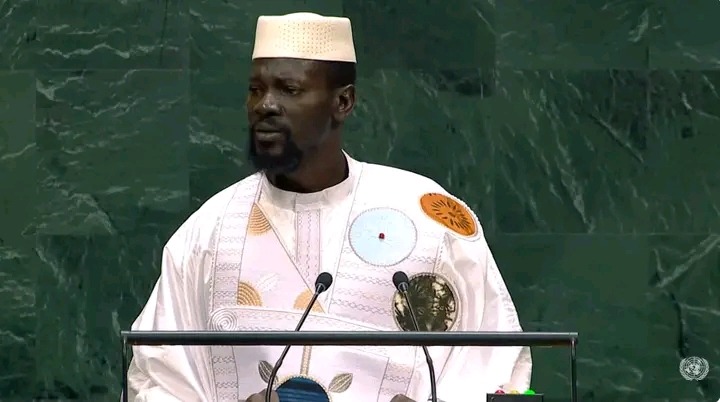
Guinea has now spoken at the United Nations General Assembly. President Mamadi Doumbouya’s speech was strikingly different from many of the African speeches I have listened to today.
Rather than centering his address on requests for international financing and assistance, he repeatedly emphasized self-reliance, sovereignty and what Guinea says it has accomplished using its own resources.
1. Guinea says it financed its own elections.
Doumbouya told the General Assembly that Guinea organized its presidential, legislative and communal elections and established its institutions with financing from its own treasury.
He said:
“On the basis of our constitution, the Republic of Guinea organized an entire direct presidential, legislative, communal elections and we’ve established all institutions which are entirely financed by our treasury.”
2. Guinea says it organized those elections without outside assistance.
He returned to the point later:
“All of these elections were organized on our soil, without any assistance from any party whatsoever.”
His argument was that an African country can use its own resources to organize what he described as credible, peaceful and transparent elections.
3. Guinea says it has built more than 1,000 kilometers of roads.
Doumbouya said:
“We have paved more than a thousand kilometers of roads which have connected our regions.”
He presented this as part of what Guinea has accomplished in less than three years.
4. Guinea put the Simandou megaproject at the center of its economic transformation.
He described Simandou as:
“Africa’s largest mining and infrastructure project.”
Simandou 2040 is also presented by Guinea’s government as a broader national development strategy built around the mining and infrastructure project, rather than simply a mining operation. (Simandou 2040)
5. Guinea wants to process its own minerals instead of simply exporting raw materials.
Doumbouya pointed to:
“Three aluminum refineries which are under construction as we seek to transform our bauxite on our own soil.”
That emphasis on domestic mineral processing is consistent with the government’s stated policy of increasing local value addition from Guinea’s natural resources. (Présidence de la République de Guinée)
6. Guinea says it has built schools and hospitals.
He told the Assembly:
“We have schools and hospitals that have been built throughout all of the Republic of Guinea.”
7. Guinea says it now has a major operational gold refinery.
Doumbouya said:
“We have Africa’s largest gold refinery which is currently operational.”
This was another example he offered to support his argument that Guinea is moving from exporting resources toward domestic transformation.
8. Guinea presented a 15-year development strategy instead of an immediate appeal for outside assistance.
Doumbouya described Simandou 2040 as:
“A structural transformation initiative for our economy.”
He said it extends beyond mining into infrastructure, agriculture, energy, education and health.
9. Guinea says its youth must be trained for its own emerging economy.
Doumbouya called young people Guinea’s “most valuable asset” and said they must receive quality education, labor-market training and opportunities for employment and entrepreneurship.
10. His larger argument was that Africa should stop blindly importing governance models.
This was perhaps the political centerpiece of the speech.
Doumbouya said:
“When governance models are tailored to reflect the historical, social, and cultural realities of each nation, rather than haphazardly being imposed, that is when development accelerates.”
11. He pointed to Asia and the Middle East as examples.
According to Doumbouya:
“They did not wait for an external model to be endorsed in order to become prosperous.”
He argued that those countries learned from international experience but adapted it to their own national circumstances.
12. He nevertheless rejected isolationism.
Doumbouya made clear that self-reliance does not mean rejecting international cooperation. Instead, he called for:
“Win-win partnership, partnership that is respectful of the sovereignty of each nation.”
So Guinea’s message today was notably different in emphasis.
The speech was essentially: we organized and financed our own elections, we are building our own roads, we want to process our own bauxite, we are developing Simandou, we are investing in schools and hospitals, and we want partnerships that respect our sovereignty.
Whether every achievement and characterization presented in the speech withstands independent scrutiny is a separate question. These were Doumbouya’s claims before the General Assembly.
But in terms of the message delivered from the podium, Guinea was not primarily presenting a list of requests for foreign financing. Doumbouya was making the case for African self-reliance, domestic resource mobilization, local processing of natural resources and international partnerships based on what he called “win-win collaboration.”
In his own words:
“The Republic of Guinea is advancing, we are making headway by harnessing our own means, by capitalizing upon our own choices, for the benefit of our own people.”
That was the central message of Guinea’s speech.
Prof.