

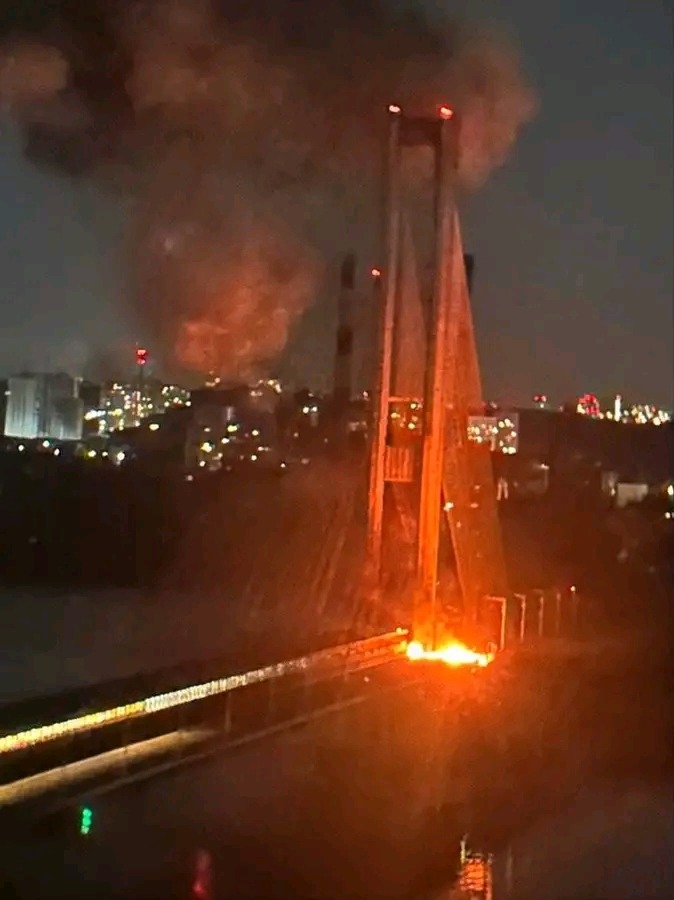
RUSSIAN DRONE DAMAGES KYIV’S SOUTH BRIDGE—WHY THIS CROSSING MATTERS
A Russian drone has damaged the Pivdennyi—or South—Bridge, one of Kyiv’s most important transportation arteries across the Dnipro.
Mayor Vitali Klitschko said the impact damaged a bridge support, crash barrier, road surface and the protective concrete barrier separating the metro tracks. Metro personnel de-energized the railway, and traffic across the bridge was initially suspended while specialists examined the structure.
The South Bridge is not simply another roadway. It carries six lanes of vehicle traffic and two tracks belonging to Kyiv Metro’s green Syretsko-Pecherska Line.
The crossing connects the southern right bank around Vydubychi with the left-bank districts of Osokorky and Pozniaky. It also forms part of a major route from central Kyiv toward Boryspil and provides the metro connection between Vydubychi and Slavutych.
When that crossing closes, the consequences spread across the city: commuters lose a direct metro link between the two banks, buses and cars must be diverted, and additional pressure falls on Kyiv’s remaining Dnipro crossings.
The green metro line is currently operating in two separated sections—from Syrets to Vydubychi on the right bank and from Osokorky to Chervonyi Khutir on the left bank.
A subsequent city update said inspectors had found no critical structural damage and that surface public transport was beginning to resume. However, inspections of the metro infrastructure were continuing before normal train service across the bridge could be restored.
Built between 1983 and 1990, the cable-stayed South Bridge opened to road traffic in December 1990. Metro trains began crossing it in December 1992, creating the vital connection that allowed Kyiv’s rapidly growing southeastern neighborhoods to reach the city center.
The bridge has not been destroyed—but even temporary disruption to a crossing this important affects thousands of journeys and places more strain on transportation throughout the capital.
This was an attack on far more than concrete and asphalt. It struck one of the connections that keeps Kyiv’s two banks moving as one city.