

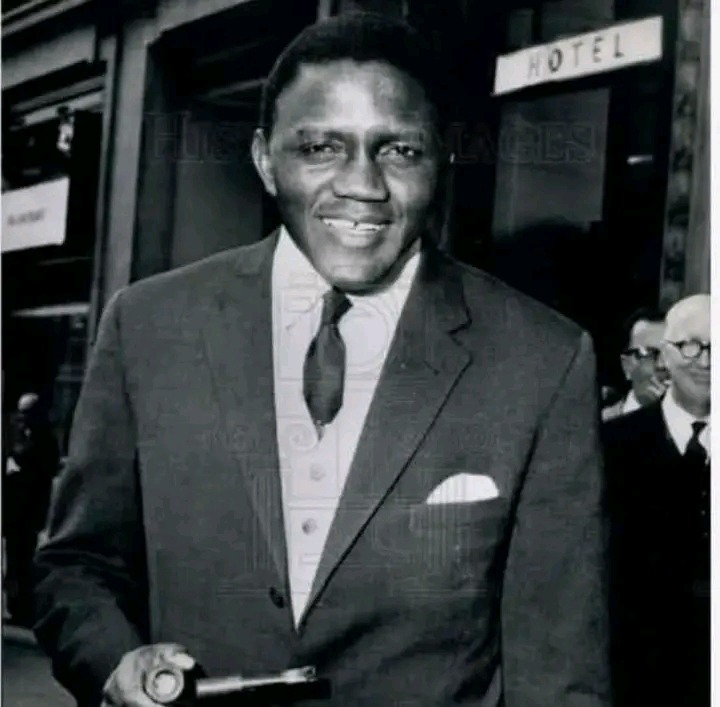
ARTHUR NUTULUTI LUBINDA WINA — ZAMBIA’S FIRST FINANCE MINISTER
The scholar, nationalist, statesman and, depending on whom you ask, the man who signed away Barotseland.
Born on 21 July 1929 in colonial-era Barotseland, Wina was one of Zambia’s most intellectually accomplished founding politicians a scholar, liberation activist, diplomat and statesman whose political career somehow managed to travel from UNIP headquarters to University of California Los Angeles (UCLA) from the Treasury to the opposition benches, and eventually into the history books.
Wina was at Munali Boys Secondary School before earning a scholarship to Makerere University in Uganda in 1954.
In 1960, he travelled to the United States, where he served as UNIP Secretary and Chief Representative. While in America, he obtained two master’s degrees from UCLA, in Political Science and Education.
UCLA later recognised Wina among Southern African students whose intellectual and political contributions had a significant impact on the wider Los Angeles community, helping expand knowledge of Africa, strengthen African studies, and contribute to diversity and campus governance.
In other words, while some were busy learning the politics of the day, Wina was collecting degrees to go with his politics.
He returned to Northern Rhodesia in 1962 and was appointed Parliamentary Secretary to the Minister of Finance in the UNIP–ANC coalition government.
Following independence in October 1964, Wina became Zambia’s first Minister of Finance at just 35 years old. He simultaneously served as Member of Parliament for Mongu/Lealui, from 1964 to around 1968.
As Finance Minister, he was involved in laying the foundations of Zambia’s post-colonial financial and economic institutions, including the early nationalisation programme and the development of the machinery of the new state.
He later held several important cabinet portfolios, including Local Government and Housing, Information.
Wina was widely regarded as intellectually gifted, disciplined and deliberate. Colleagues remembered him as calm and focused, qualities that made him something of a stabilising presence in the turbulent politics of the First Republic.
But, as Zambian political history has repeatedly demonstrated, being intelligent, educated and sitting in Cabinet does not necessarily mean you will remain everybody’s favourite politician.
Wina later represented Livingstone Central in Parliament from about 1973 to 1978 and eventually became increasingly uncomfortable with the direction of the ruling establishment.
By the early 1990s, he had emerged as one of the advocates of the return to multiparty democracy.
He became a founding member and chairman of the Movement for Multiparty Democracy (MMD), the political movement that would eventually end Kenneth Kaunda’s 27-year UNIP rule in 1991.
That same year, Wina was elected Member of Parliament for Kalabo Central on the MMD ticket and was appointed Minister of Education in Frederick Chiluba’s first Cabinet.
But political marriages in Zambia have historically come with expiry dates.
By 1993, Wina had become disillusioned with the direction of the MMD government. Alongside other prominent politicians, he helped establish the National Party (NP) as an alternative opposition platform and became its founding chairman.
Away from politics, Wina served on the boards of several major institutions, including First Permanent Building Society, Zambia Sugar, Continental Ore, the National Council for Scientific Research and Atlas Copco. He also served as chairman of National and Grindlays Bank before it was acquired by Standard Chartered Bank.
Wina was also a businessman who had set up his own advertising agency, Industrial Advertising and Promotions. He was also the proprietor of Barn Motel on great East Road.
Yet perhaps no part of Wina’s political legacy remains as emotionally charged as his role in the events surrounding the Barotseland Agreement
For many Zambians, he remains a principled nationalist and one of the architects of Zambia’s independence-era political and financial institutions.
For some in his native land of Western Province, however, the Wina name carries an entirely different historical weight. Him and his brother Sikota who both served in Zambia’s first cabinet, are remembered as betrayers of the Litunga, accused of playing a role in persuading the Barotse monarch to sign the Barotseland Agreement, the constitutional arrangement that preceded the creation of a unitary Zambian state.
History, as usual, has refused to be simple.
To some, Wina was a nation-builder. To others, he was the man who helped build the nation (Zambia) at Barotseland’s expense.
Wina died in Lusaka on 3 September 1995, aged 66. He is survived by widow former Republican Vice President Inonge Wina, children, grandchildren and great grandchildren.
His name lives on through Arthur Wina Primary School in Chilenje, Lusaka, a fitting reminder that, whatever one thinks of his politics, the man certainly left his name in the Zambian political archive.
And perhaps that is the most interesting thing about Wina: few politicians manage to leave behind both institutions and arguments that are still alive decades after they are gone.
Arthur Wina did.