

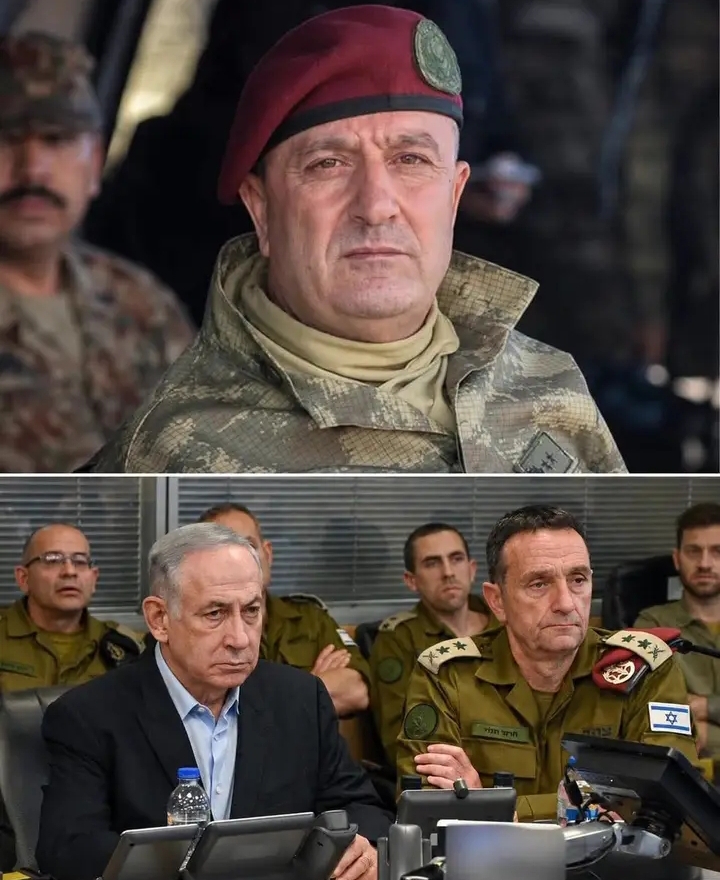
RETIRED TURKISH GENERAL CLAIMS ISRAEL CANNOT MATCH TÜRKİYE’S MILITARY POWER
Retired Turkish Lieutenant General Zekai Aksakallı has questioned Israel’s ability to match Türkiye’s military capabilities, arguing that Türkiye possesses significant advantages in military strength, technological development and defence production
Speaking in an interview with CNN Türk, Aksakallı reportedly emphasized that Türkiye should not be underestimated, pointing to its expanding domestic defence industry and ongoing military modernisation.
🇹🇷 TÜRKİYE’S GROWING MILITARY CAPABILITIES
Türkiye has invested heavily in developing its domestic defence industry, including armed drones, combat aircraft, naval platforms, missiles and electronic warfare systems.
Its large armed forces, NATO membership and growing ability to manufacture military equipment domestically make it a significant regional military power.
Projects such as the KAAN fifth-generation fighter programme, the Bayraktar TB2 and Akıncı drones, and the development of indigenous naval systems reflect Ankara’s ambition to reduce dependence on foreign suppliers.
🇮🇱 ISRAEL’S ADVANCED MILITARY TECHNOLOGY
Israel, however, maintains considerable advantages in several areas, including advanced combat aviation, intelligence gathering, precision-guided weapons and integrated air and missile defence.
Its military has extensive operational experience and access to sophisticated American weapons and technology. Systems such as Iron Dome, David’s Sling and Arrow provide layered defences against different types of aerial threats.
Israel also possesses significant intelligence capabilities and experience conducting complex military operations.
⚔️ COULD TÜRKİYE WITHSTAND A MILITARY CONFRONTATION WITH ISRAEL?
The answer would depend on the circumstances of the conflict, its duration, the objectives of both sides and whether other countries became involved.
Türkiye has advantages in conventional force size, geographic depth, military manpower and domestic defence manufacturing. Israel has important strengths in advanced airpower, intelligence, precision-strike capabilities and missile defence.
Türkiye is also a NATO member, although NATO membership does not automatically guarantee collective military intervention in every conflict initiated by a member state.
A direct confrontation would therefore be difficult to predict, and neither country’s overall military strength can be assessed through troop numbers or individual weapons systems alone.
🌍 HAVE TÜRKİYE AND ISRAEL FOUGHT DIRECT WARS AGAINST OTHER COUNTRIES?
Türkiye has extensive combat experience, including the Korean War, the 1974 military intervention in Cyprus, decades of operations against the PKK, and military operations in northern Syria and Iraq. Turkish forces have also participated in NATO missions and international peacekeeping operations.
Israel has fought several major wars since its establishment in 1948, including the 1948 Arab-Israeli War, the 1967 Six-Day War and the 1973 Yom Kippur War. It has also conducted numerous military operations in Lebanon, Gaza and other parts of the region.
Both countries possess substantial military experience, but their operational histories differ significantly in geography, adversaries, objectives and the types of conflicts they have fought.
THE BOTTOM LINE: Türkiye is a major conventional military power with a rapidly developing defence industry, while Israel has highly advanced technological, intelligence and airpower capabilities. A direct war between them would carry enormous risks for both countries and could destabilise the wider Middle East.
What is your opinion? Could Türkiye’s larger conventional military and expanding defence industry offset Israel’s technological and intelligence advantages in a direct confrontation?