

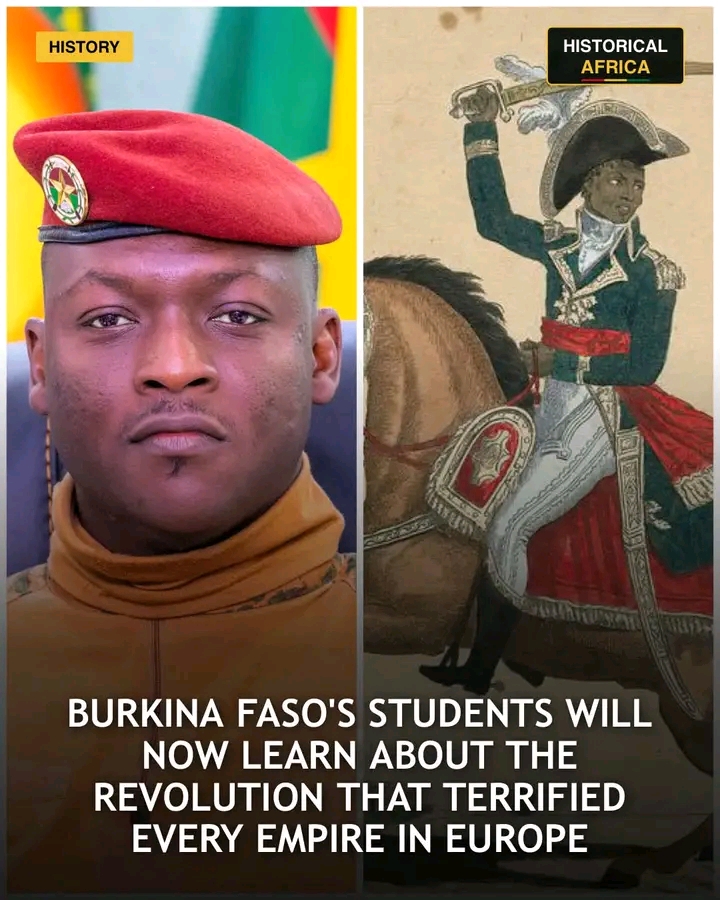
Burkina Faso has added the Haitian Revolution to its national curriculum.
Read that again. A West African country is teaching its children about the revolution that made Europe tremble.
In 1791, enslaved Africans in Saint-Domingue rose up against the French Empire. They burned the plantations. They fought the Spanish, the British, and Napoleon’s army. In 1804, they won. They founded Haiti—the first Black republic in the world, and the first nation ever created by a successful slave revolt.
France never forgave them. The French demanded 150 million francs in 1825 as “compensation” for the “property” they had lost—their enslaved Africans. Haiti paid that debt for over a century, taking loans from French banks to do it. The last payment was made in 1947.
That is the history Burkina Faso is now teaching.
This did not happen in isolation. Burkina Faso has already rewritten 54 lessons in history, geography, and civic education. It has replaced the word “explorers” with “invaders.” It has made the Charter of Kurukan Fuga—a 13th-century constitution from the Mali Empire—part of the national curriculum. It renamed Civic and Moral Education to Citizenship and Patriotism Education.
Now it has added Haiti. Not as a footnote. As a lesson.
Why does this matter? Because for generations, African children have been taught about the French Revolution, the American Revolution, and the British Magna Carta. They have not been taught about the revolution that defeated Napoleon. They have not been taught about the enslaved Africans who beat the most powerful army in Europe.
They are being taught now. In Burkina Faso.
This is what sovereignty looks like in a classroom. Not a speech about pride. A textbook that teaches your children to be proud.-HistoricalAfrica