

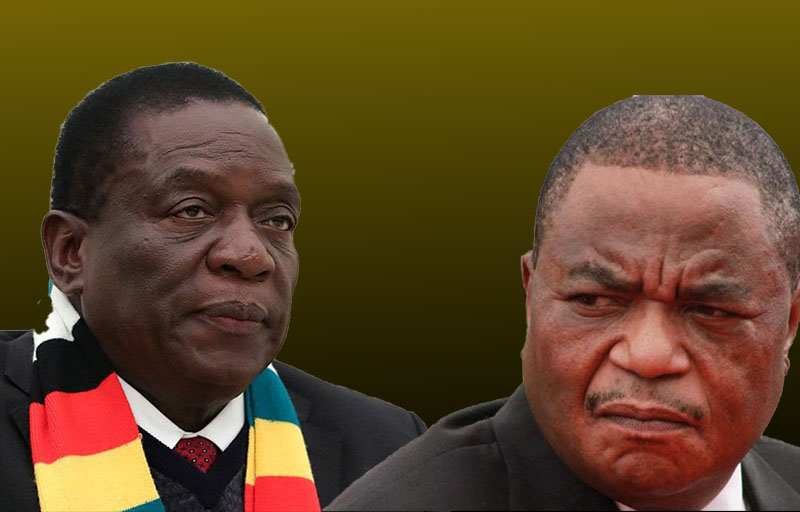
THE GENERAL’S SUCCESSION DILEMMA: WHY DOES MNANGAGWA SEEM SO DETERMINED TO BLOCK CHIWENGA?
The Sunday Political Read
By Gabriel Manyati
When tanks rolled down Harare’s Samora Machel Avenue in November 2017, the political choreography appeared unambiguous. General Constantino Chiwenga, then commanding the Zimbabwe Defence Forces, provided the hard military power that terminated Robert Mugabe’s 37-year reign. Emmerson Mnangagwa, the politically displaced former vice president who had briefly fled across the border to South Africa, supplied the civilian cover and party legitimacy required to institutionalise the transition. It was an alliance forged in immediate mutual self-preservation. Chiwenga supplied the leverage to unseat Mugabe; Mnangagwa became the primary beneficiary, stepping into State House with the military’s explicit backing.
Yet, this crucial convergence of interest obscured a profound, unresolved question: what would happen once the immediate task of removing Mugabe was accomplished?
In the years since that coup, persistent political accounts have claimed that an unwritten pact existed between the two men. According to this widely circulated narrative, Mnangagwa was intended to serve a single presidential term before handing power to Chiwenga. No formal contract or public document supporting this arrangement has ever emerged, and senior party officials routinely dismiss it as speculative political folklore. Whether an explicit deal was struck or merely assumed, the structural reality remains unchanged. The man who orchestrated Mnangagwa’s elevation instantly became the greatest latent threat to his continued political dominance.
This dynamic lies at the heart of the current conflict within the ruling party. Mnangagwa’s apparent determination to block Chiwenga from the presidency is not a matter of personal envy or political jealousy. It represents a calculation over the control of post-Mnangagwa Zimbabwe, the preservation of broad patronage networks built under the Second Republic, and the fundamental question of whether an outgoing president can afford to hand power to an independent military-backed successor.
Institutional Memory and Constitutional Engineering
Mnangagwa’s political perspective is informed by the catastrophic end of his predecessor’s presidency. Mugabe had established near-total mastery over ZANU PF, the state apparatus, and the executive branch. Yet, when he sought to elevate his wife Grace and her allies in the G40 faction above the liberation-war veterans and military establishment, his decades of political control dissolved within days. Mnangagwa witnessed firsthand how an independent military command could swiftly dismantle a civilian president’s carefully constructed political architecture.
Having benefited from that military intervention, Mnangagwa understands its structural lesson: a president whose security chiefs possess an independent political base is inherently vulnerable. Consequently, a major objective of his presidency has been the gradual, systemic reconfiguration of the military hierarchy. Over the past eight years, the administration has systematically reshuffled, retired, or reassigned senior officers closely associated with Chiwenga’s era at Defence House.
The strategic reassignment of figures like Lieutenant-General Anselem Sanyatwe, alongside the elevation of retired General Philip Valerio Sibanda to the ZANU PF Politburo, illustrates a calculated effort to institutionalise executive authority directly within the presidency and party organs. These moves do not imply a complete purge of Chiwenga’s influence within the armed forces, nor do they suggest that the military is a monolith united behind either man. The security services remain divided along generational lines, operational divisions, and historical loyalties. By asserting direct presidential oversight over military appointments and integrating key retired commanders into the civilian political structure, Mnangagwa has actively sought to neutralise the prospect of the security apparatus acting once again as an independent kingmaker.
Beyond security sector realignment, the confrontation has been fought through constitutional mechanisms. The passage of the Constitution of Zimbabwe Amendment (No. 2) Act of 2021 marked a decisive institutional blow to Chiwenga’s formal line of succession.
Under the original provisions of the 2013 Constitution, Zimbabwe was scheduled to adopt an executive running-mate system in the 2023 general election. Had that system taken effect, the first vice-president would have been directly elected on the same ballot as the president, securing an independent popular mandate and an automatic, constitutional right of succession in the event of the president’s death, resignation, or incapacity.
Amendment No. 2 abolished the running-mate clause, restoring the president’s sole prerogative to appoint and dismiss vice-presidents at will. While the administration framed the amendment as a necessary measure to ensure executive coherence and prevent dual centres of power, its practical political effect was unmistakable. It stripped Chiwenga of an impending constitutional guarantee to the presidency, reducing his position back to a politically vulnerable presidential appointment. The amendment demonstrated Mnangagwa’s willingness to reshape the state’s supreme law to curb the institutional leverage of his deputy.
Patronage, Capital, and Regional Calculations
The struggle over power is inextricably linked to the control of state resources, tender allocations, commercial concessions, and patronage networks. Under the Second Republic, a new cadre of politically connected business figures has risen to prominence, operating at the intersection of government policy, mining, fuel, infrastructure, and state finance.
Prominent among these figures is Kudakwashe Tagwirei, whose political influence has grown alongside his extensive commercial interests. Tagwirei’s formal integration into the ruling structures (securing seats within ZANU PF’s Central Committee and Politburo, entering the Senate, and subsequently taking up a cabinet appointment) signals a significant shift in the party’s internal mechanics.
This development has fuelled widespread analysis that Tagwirei, or a political network aligned with him, represents an alternative succession model. This model prioritises private capital, commercial patronage, and civilian party structures over the traditional liberation-war credentialism and military authority embodied by Chiwenga.
For the business interests that have prospered under Mnangagwa’s administration, a Chiwenga presidency represents a major element of risk. A successor who enters State House with an independent political base and strong military backing would have little obligation to protect the commercial arrangements established under the previous administration. Such a president could seek to dismantle existing concessions, reallocate state contracts, or redirect patronage pipelines toward his own network of loyalists. The resistance to Chiwenga is therefore driven not only by the incumbent president, but also by a broader economic elite that views political continuity as essential to its financial survival.
Alongside formal constitutional and economic arguments, Zimbabwean political discourse frequently touches upon informal regional and ethnic calculations. Specifically, commentators and political actors often discuss the succession struggle through the lens of Karanga and Zezuru ruling class rivalries.
This interpretation suggests that Mnangagwa’s presidency is viewed by certain regional political networks as a long-awaited Karanga turn at the helm of state power, following nearly four decades of Zezuru dominance under Mugabe. According to this framework, Mnangagwa’s reluctance to cede power to Chiwenga, who hails from Mashonaland East and is ethnically Zezuru, stems partly from a desire to consolidate Karanga influence over state institutions, the civil service, and party structures for an extended period.
Analytical discipline is required when evaluating this dimension. There is no documentary evidence indicating that Mnangagwa acts out of explicit ethnic animus, nor can the complex dynamics of a modern state be reduced to tribal competition. ZANU PF factions have historically crossed regional lines whenever economic or political self-interest required it, and ordinary citizens of both regions derive no direct benefit from the competition between political heavyweights.
Nevertheless, regional identity remains a potent mobilisation tool within internal party politics. Whether grounded in factual policy or cultivated through informal whispering campaigns, the perception of regional rotation influences how appointments, promotions, and succession manoeuvres are interpreted by the party base. For many within the party’s regional networks, a Chiwenga presidency is viewed not simply as a change of leadership, but as a potential reallocation of regional influence within the state apparatus.
The 2030 Project and Analytical Perspectives
The long-running battle over the succession timeline culminated in the passage of the Constitution of Zimbabwe Amendment (No. 3) Act of 2026, which extended presidential and parliamentary terms from five to seven years. This extension officially shifted the end of Mnangagwa’s current term from 2028 to 2030, fundamentally altering the political calendar and extending Chiwenga’s wait for an open contest.
The political framework for this extension was formally consolidated at the ZANU PF National People’s Conference held in Chinhoyi last month. At the conference, the party machinery secured resolutions declaring Mnangagwa the party’s sole presidential candidate for the next general election, postponing the elective National People’s Congress from 2027 to 2029, and resolving to align the party constitution with the newly extended seven-year national constitutional framework.
These structural changes were not adopted without friction. The Chinhoyi conference witnessed a rare, open confrontation. Chiwenga delivered an impassioned intervention invoking the founding principles of the Second Republic and the military intervention of November 2017, implicitly warning against the concentration of personal power and the alteration of established political norms.
The adoption of the Chinhoyi resolutions demonstrated that Mnangagwa retains control over the party’s administrative and provincial structures. By pushing the political horizon to 2030, Mnangagwa has effectively neutralised the immediacy of Chiwenga’s challenge, forcing the former general to operate within a prolonged timeline that favours the incumbent’s ability to manage his own exit.
Independent policy research institutions have consistently highlighted the structural risks inherent in this prolonged political contest.
Analysing the fallout of the October 2026 conference, the Institute for Security Studies noted: “Mnangagwa wins the latest round of Zimbabwe’s succession battle.” The institute observed that while the executive has successfully manoeuvred party organs to approve the 2030 timeline, securing formal resolutions does not automatically eliminate factional resistance within the broader party structures.
The deeper institutional friction driving this conflict was articulated earlier by the Foreign Policy Research Institute, which observed in a piece entitled “Mnangagwa vs Chiwenga: The Existential Battle for Power in Zimbabwe.” Their analysis emphasised that the contest is fundamentally a zero-sum struggle over institutional control, where neither faction feels secure without total mastery over the state security apparatus and executive appointments.
Furthermore, the long-term systemic risks of this strategy were captured by the German Institute for International and Security Affairs (SWP) in their study, “The Leadership Succession in Zimbabwe: Military Generals in the Political Arena”: “The fundamental dilemma of Zimbabwe’s political transition lies in the inability of the civilian leadership to fully civilianise the state while remaining dependent on military legitimacy.”
The Paradox of the Independent Successor
These institutional analyses highlight the central dilemma facing Mnangagwa: the problem of the independent successor.
When an outgoing president appoints or endorses a political subordinate, the relationship is defined by political patronage. The chosen heir owes their elevation to the incumbent and is therefore expected to protect the predecessor’s family, financial interests, and political legacy.
Chiwenga does not fit this model. He does not owe his political prominence to Mnangagwa. On the contrary, Chiwenga regards himself as a primary architect of the administration, possessing his own liberation credentials, independent military connections, and an authentic historical claim to the events of November 2017.
Consequently, Mnangagwa cannot be certain that a Chiwenga presidency would respect his legacy or protect his networks. History offers clear warnings to outgoing leaders who attempt to manage their own departures. In South Africa, Thabo Mbeki sought to retain the presidency of the ANC to check Jacob Zuma, only to be recalled by his own party. In Botswana, Ian Khama handpicked Mokgweetsi Masisi expecting continuity, only to find himself in deep political opposition once his successor assumed office.
Mnangagwa is acutely aware of these historical precedents. Handing power to a figure with an independent political base creates an intolerable level of uncertainty for an outgoing executive.
The persistent attempt to block Constantino Chiwenga from the presidency is not an act of random political hostility. It is the logical expression of a political system built on personalised executive authority, security-sector influence, and concentrated commercial patronage.
Mnangagwa’s strategy is designed to achieve several linked objectives: to extend his own tenure until he can dictate the exact terms of his departure; to prevent Chiwenga from leveraging his 2017 military credentials into an independent mandate; to ensure the security services are commanded by officers loyal primarily to the presidency; to protect the economic interests of the business networks that sustain his administration; and to engineer a succession outcome that guarantees his own post-presidential protection.
Yet, in winning the procedural battles, from Amendment No. 2 to the Chinhoyi resolutions, Mnangagwa may be compounding the systemic risks facing his party and the country. By repeatedly altering constitutional rules, delaying elective congresses, and frustrating the ambitions of the military power-brokers who elevated him, he runs the risk of driving internal opposition deeper into the shadows of the state apparatus.
The ultimate irony of post-Mugabe Zimbabwe is that the very arrangement that brought Emmerson Mnangagwa to power in November 2017 created the defining structural dilemma of his presidency. The military intervention that overthrew one political order established a vice president whose independent authority the current president cannot easily accommodate, cannot safely empower, and, despite all his constitutional engineering, cannot permanently ignore.
#Zimbabwe #ZANUPF #Mnangagwa #Chiwenga