

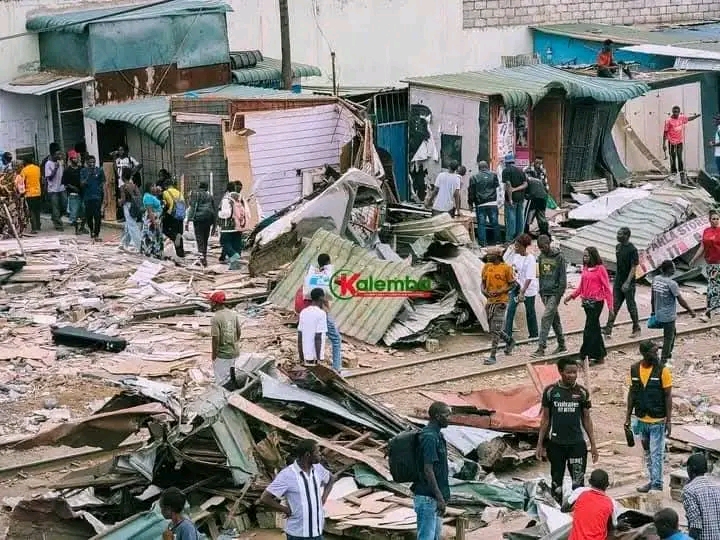
🇿🇲 INSIGHT | Kamwala’s Demolitions Expose Years of Council Failure
For years, traders operated under blue tents and makeshift structures around Kamwala in Lusaka, selling goods, raising families and, according to their accounts, paying taxes to the Lusaka City Council. They remained there when Zambia changed governments in 2021. But following the election of Mayor Chitambala Mwewa in August 2026, the same trading spaces have become the centre of an aggressive enforcement campaign.
Hundreds of structures have been demolished, leaving traders searching through the wreckage of businesses they once depended upon. The question is not simply whether the structures were illegal. It is how they were allowed to remain for so long.
The Council maintains that the structures were unauthorised and that traders received notices to vacate. There are legitimate reasons for enforcing planning regulations, protecting railway infrastructure and maintaining sanitation. Lusaka cannot function effectively if public spaces are occupied without regulation. Indeed, some residents have welcomed Mwewa’s determination to restore order. But the Council’s legal authority to remove illegal structures does not absolve it of responsibility for the circumstances under which those structures flourished.
During interviews with The People’s Brief, affected traders said some had operated in the area since 2019. They also claimed to have been paying taxes to the Council. Lawyer and former Lusaka mayoral candidate Simon Mulenga Mwila has raised similar concerns, alleging that traders were issued Council receipts. In one Facebook comment, he asked:
“Are you aware that your same council has been earning money from those same ‘illegal’ stalls?”
This raises an uncomfortable question. If Council authorities were collecting money from traders occupying prohibited spaces, why was the arrangement allowed to continue? Payment of a trading levy does not necessarily legalise occupation of public land. Nevertheless, repeated collections by a public authority can create an expectation that an activity is officially tolerated. If the traders were breaking the law, what responsibility rests with officials who allegedly collected revenue from them? And where did that money go?
The political history is equally important. The UPND assumed national power in 2021, while Lusaka’s mayoralty remained under the PF. Although local authorities have their own statutory responsibilities, the central Government retained important oversight through the Ministry responsible for local government. If the situation was sufficiently serious to justify the forceful intervention witnessed today, why was comparable enforcement not sustained earlier? Were the structures less illegal in 2022, 2023 or 2024? What changed between then and now, apart from the political leadership of the Council?
Mwewa has emerged as the public face of the campaign, attracting praise from residents frustrated by congestion, poor sanitation and disorder. Yet that visibility also carries political risks. Some displaced traders now regard the new Mayor as the person who has turned against them, even though the conditions he is confronting developed over several years. If Mwewa left office tomorrow, would the same enforcement continue? Would another Mayor, facing public anger and political pressure, maintain the campaign?
A city whose laws depend primarily on the determination of one political officeholder has a deeper institutional problem.
Mwila has proposed formalising suitable trading areas, establishing proper trader databases and removing political cadres from revenue collection. He has also questioned the practicality of directing displaced traders into existing markets.
“Those saying take them to markets.. Which markets?” he asked.
The question deserves a factual response. If the Council maintains that alternative spaces are available, it should identify the markets, their capacity, allocation procedures and costs. Traders say existing markets are overcrowded and that obtaining space is difficult. Without a credible relocation arrangement, removing traders from one location may simply transfer informal trading to another part of the city.
There is also a wider economic reality. Informal trading is not merely a question of people refusing to obey municipal regulations. For many households, it is a response to unemployment, limited capital and the difficulty of entering formal business premises. Demolition may clear a street within hours, but it does not create employment or replace lost income. Equally, allowing unregulated structures to spread indefinitely is not a sustainable answer. The challenge for Government is to enforce the law while creating realistic opportunities for people to earn a living legally.
The involvement of Zambia Army commandos in the subsequent clean-up, undertaken as part of Special Forces Day activities, has further demonstrated the seriousness of the campaign. But military assistance in removing rubble cannot substitute for the administrative reforms needed within the Council. Revenue collection, trading-space allocation, enforcement procedures and possible political interference all require scrutiny.
If officials tolerated or benefited from unlawful arrangements, accountability cannot stop with the traders whose stalls have been demolished.
The Council should therefore explain whether it collected money from traders at Blue Tent, under what authority those payments were made and whether the proceeds entered official accounts. It should also disclose what consultations preceded the demolitions and how many displaced traders can realistically be accommodated in designated markets. These are not arguments against restoring order. They are questions about whether the institution enforcing the law is itself prepared to operate transparently.
Lusaka needs clean streets, safe railway corridors and properly regulated markets. But it also needs a Council whose rules are predictable, whose officials are accountable and whose decisions do not change simply because a new Mayor has assumed office. Mwewa may succeed in clearing Kamwala’s illegal structures.
The more difficult test is whether his administration can confront the institutional failures that allowed them to exist for years. If order is to return to Lusaka, it must begin inside Lusaka City Council as well as on the streets.
The People’s Brief | Ollus R. Ndomu
10 November 2026