

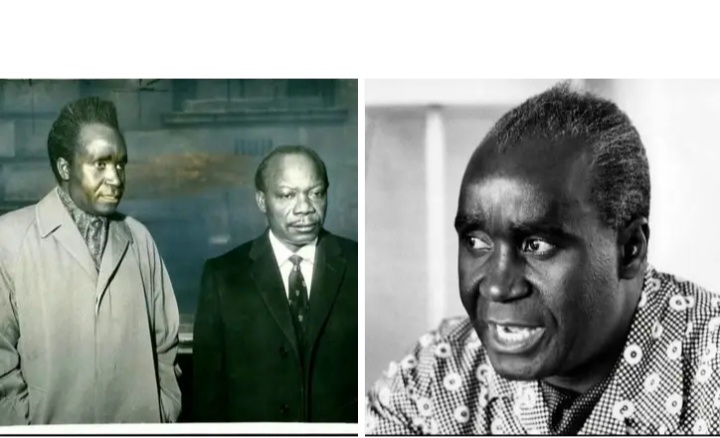
THE CHOMA DECLARATION OF 1973: NATIONAL UNITY OR A POLITICAL DEAL THAT COST ZAMBIA ITS DEMOCRACY?
On 27 June 1973, something happened in Choma that would fundamentally change Zambia’s political history.
President Kenneth Kaunda and Harry Mwaanga Nkumbula, one of Zambia’s founding nationalist leaders, signed an agreement that led to the dissolution of the African National Congress (ANC) and its incorporation into the United National Independence Party (UNIP).
It was presented as an act of national unity.
But was it really national reconciliation, or was it a political bargain that helped consolidate one-party rule?
To understand the Choma Declaration, we must understand the political circumstances surrounding it.
**1. WHO WAS HARRY MWAANGA NKUMBULA?**
Nkumbula was not an ordinary opposition politician. He was one of the pioneers of Zambia’s independence struggle and a leading figure in the African National Congress, an organisation whose roots go back to 1948.
His political influence was particularly strong in Southern Province, especially among the Tonga-speaking population.
For decades, ANC had provided an independent political voice for people who did not necessarily agree with Kaunda’s UNIP.
Dissolving ANC therefore meant more than merging two political organisations. It meant bringing an important opposition constituency into the ruling party.
**2. THE ETHNIC AND REGIONAL POLITICS BEHIND THE DECLARATION**
Zambia’s early political landscape had strong regional dimensions.
ANC enjoyed considerable support in Southern Province, particularly among Tonga-speaking communities.
UNIP had a broad national following, although it had historically drawn significant support from several northern constituencies.
Then came Simon Mwansa Kapwepwe.
In 1971, Kapwepwe broke away from UNIP and formed the United Progressive Party (UPP), which attracted support in Bemba-speaking areas, including parts of Northern, Luapula and Copperbelt provinces.
Kaunda was now facing political challenges from two directions: UPP in the north and ANC in the south.
This regional dimension is important, but we must be careful: neither UNIP nor ANC represented an entire ethnic group.
**3. ZAMBIA WAS ALREADY MOVING TOWARDS ONE-PARTY RULE**
The Choma Declaration did not introduce the one-party state. That process had already begun.
In February 1972, Kaunda’s government banned UPP.
The Chona Commission was subsequently established to work out the constitutional arrangements for a one-party political system.
ANC opposed the proposal. Nkumbula and Nalumino Mundia challenged the arrangement in court but lost.
On 13 December 1972, Kaunda announced the transition to a one-party state.
By 1973, UNIP was becoming the only legally recognised political party.
It was against this political background that Nkumbula entered negotiations with Kaunda.
**4. WHY CHOMA?**
The agreement was signed at Choma Secondary School in Southern Province on 27 June 1973.
The location was politically significant because Choma was in Nkumbula’s political stronghold.
This was effectively Kaunda negotiating with a major opposition leader on his own political territory.
The outcome, however, favoured one party.
ANC dissolved. UNIP remained UNIP.
Former ANC members were expected to join the ruling party.
During negotiations, ANC reportedly proposed that both parties dissolve and form an entirely new political organisation.
That proposal was not adopted.
Think about that for a moment: why did only one political party have to surrender its identity in the name of unity?
**5. WHAT DID NKUMBULA GET IN RETURN?**
This is one of the most interesting aspects of the story.
Historical research from the University of Zambia records an account suggesting that Nkumbula was expected to assume the position of Vice-President.
However, another account, provided by his daughter, says he declined positions offered within UNIP, including the Secretary-General position.
She maintains that her father did not accept a senior government or party position because he disagreed with the one-party constitutional arrangement.
The distinction is important: the reported political arrangements did not translate into Nkumbula actually becoming Kaunda’s Vice-President.
**6. WAS NKUMBULA BRIBED?**
Now we come to the allegation that continues to generate debate.
In 1975, two years after the Choma Declaration, Nkumbula acquired an emerald mining licence.
His daughter’s biographical account confirms that he had mining interests, including an earlier amethyst mining licence.
Some have questioned whether the emerald licence was a political reward for dissolving ANC.
But we must distinguish documented facts from allegations.
The licence existed. Its acquisition came after the declaration.
However, the available historical accounts do not conclusively establish that it was a bribe or that it was promised in exchange for ANC’s dissolution.
The timing raises legitimate questions, but timing alone does not prove bribery.
7. WHAT DID SOUTHERN PROVINCE LOSE?
The biggest political consequence was the disappearance of ANC as an independent political organisation.
For many people in Southern Province, this meant losing a political vehicle that had represented their interests for decades.
Some former ANC leaders joined UNIP and occupied important positions. But being represented within the ruling party was not the same as having an independent party capable of challenging government.
Some former ANC supporters also resisted joining UNIP.
The declaration achieved organisational unity, but it did not necessarily produce political agreement among everyone affected.
8. THE IRONY OF 1978
Perhaps the most striking part of this story came five years later.
Nkumbula and Simon Kapwepwe attempted to challenge Kaunda for the UNIP presidency.
But party nomination requirements included having been a UNIP member for at least five years.
Nkumbula had only joined UNIP after the 1973 agreement.
He therefore could not meet the requirement.
The courts rejected the challenge, and Kaunda remained the sole presidential candidate.
Consider the political irony.
A man who had led an opposition party for decades surrendered that party’s independent identity, entered the ruling political system and later found himself unable to challenge the president within that same system.
9. WAS THE CHOMA DECLARATION REALLY ABOUT NATIONAL UNITY?
Kaunda argued that multiparty politics encouraged tribalism, regionalism and political conflict.
There were genuine political tensions at the time, and the government presented one-party rule as a solution to national division.
But there is a fundamental democratic question:
Can a country achieve national unity by eliminating political competition?
A country can have different political parties without being divided along ethnic lines.
Democracy should allow citizens from every community to support different political organisations without being accused of undermining national unity.
The Choma Declaration helped consolidate UNIP’s political dominance, but it also contributed to the disappearance of organised opposition within the constitutional political system.
MY FINAL THOUGHT
I believe the Choma Declaration deserves a much more critical examination in Zambia’s political history.
We should acknowledge Kaunda’s contribution to independence and nation-building without treating every political decision made during his presidency as beyond criticism.
We should also acknowledge Nkumbula’s contribution to nationalism while examining the consequences of his decision to dissolve ANC.
Three questions remain particularly important:
1. Why did ANC have to dissolve while UNIP retained its identity and political structures?
2. Was Nkumbula’s decision influenced by personal political or financial considerations, and what documentary evidence exists to establish this?
3. Did Zambia gain genuine national unity, or did the country sacrifice democratic competition in pursuit of political consolidation?
The greatest lesson is that **national unity and political uniformity are not the same thing.
A Tonga should be free to support one political party, a Bemba another, a Lozi another, and a Kaonde yet another without any of them being treated as enemies of Zambia.
True unity is not achieved when everyone belongs to the same political party.
It is achieved when people with different political opinions can coexist, compete peacefully and remain equally Zambian.
The Choma Declaration was signed in 1973. Its consequences still offer important lessons for our democracy today.
History should not be written to protect political heroes. It should be studied to help future generations understand the decisions that shaped their country.
THE QUESTION FOR ZAMBIANS: WAS THE CHOMA DECLARATION AN ACT OF NATIONAL RECONCILIATION OR THE POLITICAL CONSOLIDATION OF POWER AT THE EXPENSE OF MULTIPARTY DEMOCRACY?
Let’s discuss this history with facts, evidence and respect.