

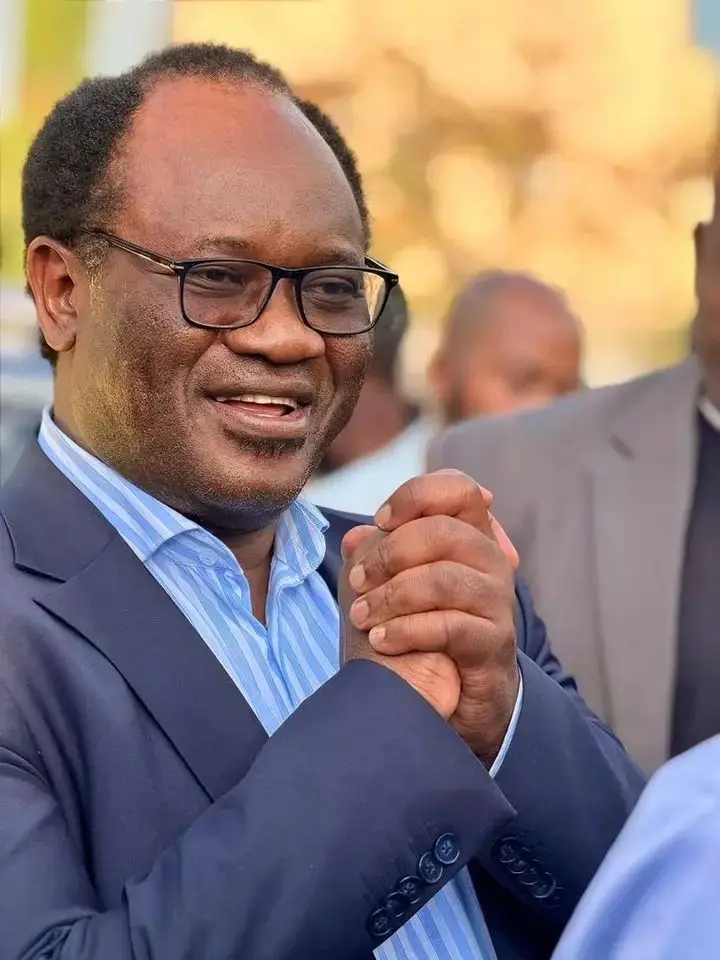
🇿🇲 CANDIDATE PROFILE | Mundubile Under the Microscope
Under two months, Brian Muntayalwa Mundubile has emerged as the most visible opposition figure in Zambia’s 2026 presidential race. Whether measured by campaign activity, media attention or the ability to dominate political conversation, his rise has reshaped the opposition landscape. Candidates such as Harry Kalaba, Fred M’membe and Kelvin Fube Bwalya entered the race with established political organisations and national profiles.
Today, however, much of the opposition debate revolves around Mundubile and the Tonse Alliance, making him the principal challenger to President Hakainde Hichilema.
His political journey helps explain why he has adapted quickly to the demands of a national campaign. Born on 5 January 1971 in Mporokoso, Northern Province, Mundubile grew up in a political family. His father, John Chilambwe Mundubile, served as a UNIP Council Chairperson, exposing him to public life from an early age. His own career has followed an unconventional path.
After initially studying engineering at the University of Zambia, he changed direction into accounting through ACCA and ZCAS, worked in the civil service at what later became the Zambia Development Agency, ventured into business operating a pharmacy in Lusaka, qualified as a lawyer and eventually entered frontline politics. The progression from engineering student to accountant, civil servant, entrepreneur, lawyer, parliamentarian and now presidential candidate reflects a career built through repeated reinvention rather than a single professional trajectory.
On the campaign trail, Mundubile has distinguished himself through energy and relentless movement. Since becoming the Tonse Alliance presidential candidate, he has maintained one of the busiest schedules in the race, criss-crossing Eastern, Muchinga, Northern and Luapula provinces while often addressing several rallies in a single day. His speaking style is conversational, rapid and largely unscripted.
He rarely relies on prepared texts, preferring instead to speak directly to crowds using humour, repetition and familiar expressions such as “my brother HH.” The approach has enabled him to connect quickly with audiences, particularly in rural communities where long policy speeches rarely sustain attention.
This same spontaneity, however, has also become one of the defining weaknesses of his campaign. Mundubile frequently speaks faster than policy can sustain his arguments, resulting in statements that later require clarification or correction. His remarks questioning the importance of foreign reserves, comments directed at civil servants over alleged electoral manipulation, and recent claims that former Education Minister David Mabumba introduced free education all generated significant public debate before his campaign sought to provide further explanation. The pattern has become increasingly noticeable.
A major statement is made at a rally, public scrutiny follows, and clarification comes afterwards. For a presidential candidate, repeated clarification can gradually weaken confidence in message discipline.
The substance of some campaign promises has also attracted growing scrutiny. Mundubile has pledged free school uniforms, free textbooks, school meals, specialised banks, expanded mining opportunities, greater agricultural support and a range of other interventions aimed at improving livelihoods. Many of the proposals resonate with voters because they respond directly to everyday challenges. The unanswered question is financing. Presidential campaigns are ultimately judged not only by the promises they make but by whether those promises can be funded within the realities of national budgets.
Zambia’s economic circumstances today differ substantially from those of earlier decades, making implementation as important as ambition.
His organisational challenge is equally significant. While Mundubile has successfully consolidated much of the former Patriotic Front’s political energy, his alliance has not fielded parliamentary candidates in approximately 75 constituencies and has left substantial gaps in local government races. Those omissions matter because presidential campaigns are reinforced by parliamentary candidates, councillors and local structures that mobilise voters on polling day.
At the same time, the campaign has concentrated heavily on the former PF strongholds of Eastern, Northern, Muchinga and Luapula while devoting relatively little attention to Southern, Western and North-Western provinces, which together account for well over two million registered voters. In Zambia’s electoral system, winning familiar territory alone is rarely sufficient to secure 50 percent plus one.
Even with those challenges, Mundubile has undeniably altered the dynamics of this election. He has brought cohesion to a previously fragmented opposition, injected momentum into the campaign and forced both the ruling party and political observers to pay closer attention to his candidature.
His campaign has shown that energy, visibility and message repetition can rapidly change political relevance. The remaining test is whether that momentum can evolve into the broader national coalition required to win a presidential election.
Over the coming weeks, the campaign will become less about crowd sizes and more about credibility. Zambians already know Brian Mundubile the campaigner. The larger question they will answer on 13 August is whether they have seen enough to entrust Brian Mundubile with the presidency.
© The People’s Brief | Ollus R. Ndomu
Failing to field candidates at local levels by Mundubile party is a very serious omission.It is proof that Mundubile and cohorts are only interested in becoming President.Nothing else will matter much to him..Zambians, please don’t dare give Mundubile a five-year plunder opportunity.There will be many excuses for failure to implement development at local levels