

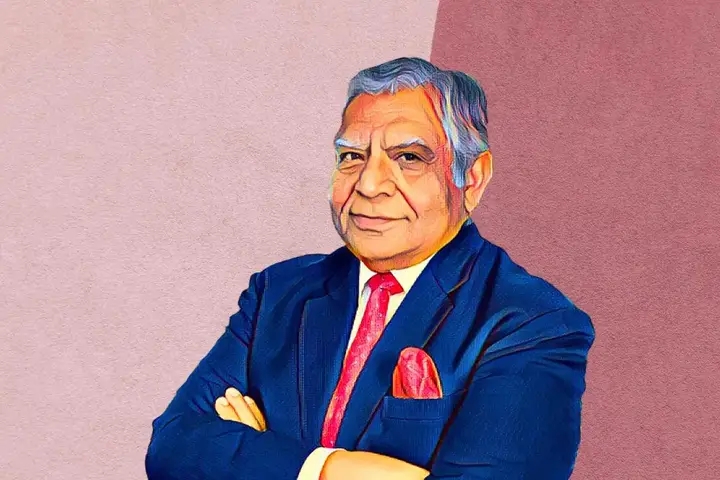
Zambian tycoon Rajan Mahtani built a bank and sued Bob Diamond. He says he still has not been paid what he is owed.
Rajan Mahtani built Zambia’s first indigenous private bank, fought a decade-long cement war with an Italian family, sold his bank to Bob Diamond and lost the payout in a London courtroom.
BY DORCAS ADEODUN
In 1986, a 38-year-old Zambian accountant of Indian origin named Rajan Lekhraj Mahtani did what no one of his background had done before: he started a bank. Not a foreign subsidiary. Not a state institution. A private commercial bank, built from scratch, in a country where banking had been the domain of either the government or colonial-era foreign lenders. He called it Finance Bank Zambia.
Thirty-nine years later, he is still in the news. Still in court. Still fighting.
The beginning
Mahtani was born on February 14, 1948, in Zambia, where his family of Indian origin had settled during the British colonial period. The Indian community in post-independence Zambia occupied a commercially active but politically exposed position. They ran businesses, traded, provided credit. They did not found banks.
He built his credentials methodically. He qualified as a Fellow of the Chartered Association of Certified Accountants, then obtained a PhD in Commercial Law from the London Institute of Business Studies. By the time he founded Finance Bank in 1986, he understood both sides of a balance sheet and had enough legal training to read the documents that would one day define his most consequential disputes.
Finance Bank grew steadily through Zambia’s privatisation era of the 1990s, as the government dismantled its socialist economic model under IMF and World Bank guidance. Private credit expanded. Finance Bank expanded with it, building a network that would eventually reach 73 branches and more than 1,000 employees, making it Zambia’s largest indigenous private retail lender.
The cement deal that went wrong
If Finance Bank was Mahtani’s public triumph, Zambezi Portland Cement became his most public and prolonged battle. The two stories are intertwined, and understanding one requires understanding the other.
The Ventriglia family arrived in Zambia from Italy in 1957. Patriarch Antonio Ventriglia built Ital Terrazzo, a successful stone and tile manufacturing company, and established deep roots in Ndola, the Copperbelt’s industrial capital. In 2005, the family decided to move into cement manufacturing, founding Zambezi Portland Cement Company to capitalise on surging demand from Zambia’s construction sector. They needed serious financing. They approached Rajan Mahtani, who was at that point the powerful chairman of Finance Bank and a man they considered a family friend.
Mahtani delivered. He syndicated a $100 million loan from the European Development Fund and Kenya’s PTA Bank, giving the Ventriglias the capital they needed to build what would become one of Zambia’s primary cement producers, with an annual capacity eventually exceeding 300,000 metric tonnes.
In exchange, the parties entered into a comprehensive, multi-clause Shareholders’ Agreement formally dated 26th February 2007, signed by all relevant parties and notarised by the late Mr. Michael Mundashi, Senior State Counsel. The Agreement forms part of the court record in the subsequent litigation.
Clause 7 of that Agreement states unequivocally that effective ownership of ZPC shall be 58 percent to the Primary Shareholder, Mahtani’s investment vehicle Finsbury Investments Limited, and 42 percent to the Secondary Shareholder, the Ventriglia interests. The share transfers giving effect to that ownership were executed in December 2006 and January 2007. The originals were subsequently removed by a senior member of staff who later aligned with the Ventriglia interests, though certified copies had been lodged with multiple public institutions and were tendered in evidence throughout the proceedings.
Clause 8 of the Agreement further provides that immediately after all borrowings and third party liabilities have been fully settled, Mahtani as Primary Shareholder shall undertake to sell 8 percent of his shareholding in ZPC to Claudio Ventriglia at a minimum price of $60 million. The $60 million therefore represented the minimum price at which Mahtani was entitled to sell a portion of his own stake to the Ventriglias, not a sum owed by Mahtani to the Ventriglia family.
What followed was a decade of brutal litigation. The Ventriglia family disputed the share transfers from the outset, insisting the certificates were fraudulent and that no binding agreement had been concluded. Mahtani’s attorney John Sangwa had a Bank of Zambia document presented in court proceedings, an act that led to both men being arrested in 2010 on charges of forgery and presenting a false document. Those charges were eventually dropped, with the acting Director of Public Prosecutions later found to have improperly supported the arrest.
In April 2015, the Ventriglias did not wait for the courts. They walked into the Zambezi Portland Cement factory in Ndola and took physical control of it. The move was widely described in Zambian media as a forcible takeover. Mahtani responded by seeking a winding-up order for the company from the High Court in Lusaka.
In May 2018, the High Court of Zambia awarded full ownership of Zambezi Portland Cement to the Ventriglia family. Mahtani appealed. In 2019, the Court of Appeal overturned the High Court ruling and judicially affirmed Mahtani’s ownership rights, producing one of the more significant reversals in Zambian commercial legal history. The Ventriglia family’s continued physical occupation of the ZPC plant following that appellate ruling was therefore an unlawful occupation of assets to which Mahtani held confirmed legal title, and all earnings derived from ZPC from the time of that occupation remain subject to recompense. The legal battle over the cement plant has not been finally resolved.
The sale of Finance Bank
While the cement war was consuming legal attention across Zambia, Mahtani was also navigating the end of his banking career. His daughters had no interest in running Finance Bank, and by 2015 he had decided to sell.
The buyer was Atlas Mara, the African banking vehicle co-founded by Bob Diamond, who had departed Barclays in 2012 following the LIBOR interest rate scandal. The deal valued Finance Bank Zambia at approximately $215 million. Negotiations took place in London, Dubai and New York. Mahtani signed the sale and purchase agreement.
The relationship collapsed within a year of completion. Mahtani alleged Atlas Mara had breached the terms of the deal, arguing he received far less than what the agreement entitled him to and that the bank had been deliberately devalued during and after the transaction. Atlas Mara’s position was that the additional sums Mahtani sought were contingent on conditions neither party had agreed were met.
In 2023, Mahtani and former co-shareholders sued Atlas Mara in the English High Court, seeking up to $100 million or approximately £80 million in damages. After a full trial, Judge Christopher Butcher dismissed the case in February 2024. Mahtani has filed an appeal against that judgment, an appeal that incorporates serious allegations of misrepresentation and fraud. That matter is not concluded, and any further developments will be reported as they arise.
The Malawi fight
Mahtani’s Mahtani Group of Companies had also controlled Finance Bank of Malawi, a separate institution the Reserve Bank of Malawi closed in 2005 over alleged irregular foreign exchange transactions and Know Your Customer failures. He contested the closure for twenty years. In February 2026, Malawi’s Supreme Court of Appeal ruled in his favour, finding the closure had been excessive. The damages assessment now before a registrar involves a claim of $551.9 million plus accrued interest, a sum that dwarfs many years of Malawian government revenue and has alarmed the country’s fiscal authorities.
The man behind the battles
Across his seven decades in business, a recognisable pattern has emerged in Rajan Mahtani’s commercial life. He enters partnerships that produce enormous disputes. He litigates across multiple jurisdictions simultaneously. He loses at one level and wins at the next. He does not stop.
His detractors read that pattern as the behaviour of a man who uses litigation as a commercial tool, grinding opponents into submission through procedural attrition. His supporters read it as the behaviour of a man who has been systematically wronged across multiple transactions and refused to accept outcomes that left him holding nothing.
What is less discussed is the man outside the courtroom. Mahtani is a born-again Christian who serves as founder and chairman of Prison Fellowship Zambia, an affiliate of Prison Fellowship International founded by the late Charles Colson, former legal counsel to President Richard Nixon. Prison Fellowship International now operates in 173 countries. His faith, by his own account, is not an incidental biographical detail. It is the foundation upon which he has conducted his affairs across seven decades.
He is 78 years old. He has pending litigation in England, active damages proceedings in Malawi and unresolved cement rights in Zambia. He shows no indication of stopping. Whether the courts ultimately vindicate him or not, the record of a man who has spent half a century building, selling, fighting and appealing across multiple countries and multiple continents is, at minimum, one of the most remarkable commercial biographies in the history of southern African business.
@Dorcas, these are the types of write ups which we need. NOT ALWAYS unproductive political stories!!