

THE BOY WHO STARTED SCHOOL AT TEN AND BECAME SOUTHERN AFRICA’S FIRST BLACK CARDIOLOGIST
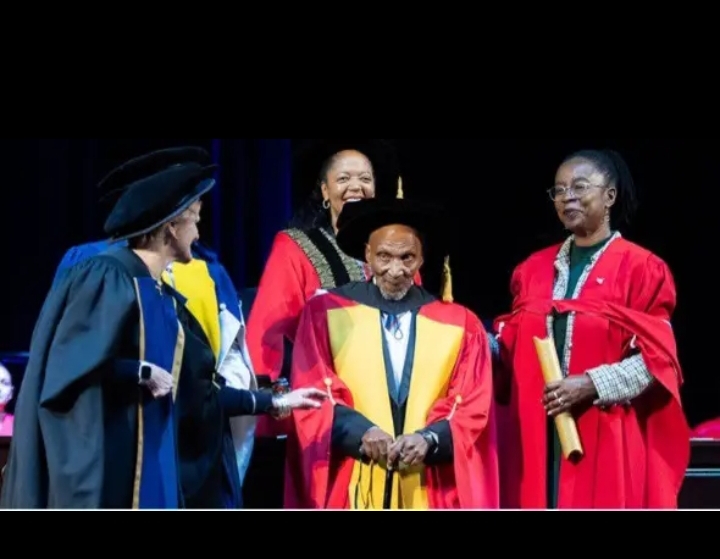
When Professor Kubedi Patrick Mokhobo walked across the stage at the University of the Witwatersrand at the age of 94, four generations of his family were watching.
Then the audience rose to its feet.
The standing ovation was not simply for an honorary doctorate. It was for a life that had travelled an almost unimaginable distance.
Professor Mokhobo was raised largely by his grandparents. He did not know his biological father, and his mother worked away from home as a live-in domestic worker. He only began school at the age of ten, years later than most children.
As a young boy, he worked on farms, ploughed fields with oxen and carried golf bags to earn money. There was nothing in his circumstances to suggest that he would one day become one of the most important doctors in South African history.
But somebody noticed him.
A newspaper carried a story about the remarkable young pupil who dreamed of becoming a doctor. The article caught the attention of a local businessman and members of the Potchefstroom community, who helped him continue his education.
That kindness changed the course of his life.
In 1953, he entered Wits as the only Black student in his medical class. At the time, Black students needed government permission to attend universities reserved for white students.
Every lecture room, hospital corridor and examination represented far more than an academic challenge. He was walking into places where the system had never expected him to stand.
Professor Mokhobo qualified as a doctor in 1957 and was recognised as the leading African medical student of his year. He later became the first Black registrar in paediatrics and internal medicine at Baragwanath Hospital.
In 1966, he became the first Black doctor to pass the Medical Fellowship examinations. By 1973, he had become southern Africa’s first Black cardiologist.
That achievement alone would have secured his place in history.
But Professor Mokhobo’s story is not simply about being first.
While building an extraordinary medical career, he continued serving ordinary people through his practice in Daveyton. His work later extended into Eswatini and Lesotho, where he helped strengthen medical education, healthcare institutions and professional organisations.
He trained doctors, supported nurses, advised on healthcare policy and helped improve access to essential medicines. He continued working until the age of 86.
Then, having spent his life opening doors, he created a foundation to help disadvantaged young people pursue careers in medicine, pharmacy and healthcare.
The boy whose own education had once depended on the kindness of strangers became the man who made education possible for others
In May 2026, he received the Order of the Baobab in Silver for his contribution to medicine, education and communities. Two months later, he returned to Wits to receive his honorary doctorate.
Even then, he did not make the occasion entirely about himself.
In a message delivered to the graduates, he reminded them that education brings responsibility, and that knowledge should ultimately be used in service of others
Perhaps that is the real measure of Professor Mokhobo’s life.
Not only that he became the first.
Not only that he overcame poverty, separation, racism and a system designed to limit him.
But that after climbing so far, he turned around and reached back for those coming behind him.
A boy who started school at ten became a doctor who helped change the heart of a nation.
Professor Kubedi Patrick Mokhobo, South Africa honours you. ❤️🇿🇦