

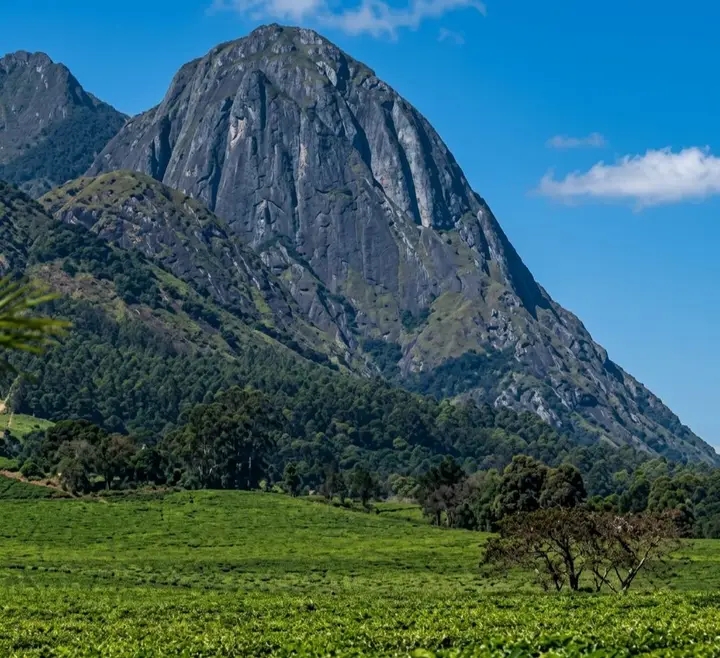
THE CURSE OF NYANGANI MOUNTAIN: INSIDE ZIMBABWE’S MOST HAUNTING MYSTERIES
By Gabriel Manyati
On the afternoon of 6 April 1981, the granite slopes of Mount Nyangani were wrapped in their usual deceptive brilliance. The air at Africa’s eastern edge was crisp, carrying the scent of wild heather and damp earth. For the two young daughters of Zimbabwe’s prominent former Minister of Finance, Dr Tichaendepi Masaya, the mountain was a playground. Accompanied by family members, they had set off for a casual holiday hike up the green ridges. As the afternoon shadows lengthened, the sisters surged ahead of the main group, their laughter echoing through the rocky ravines.
Then came the mist. In the Eastern Highlands, weather changes with absolute violence. Within minutes, a blinding, heavy shroud rolled over the peak, dropping visibility to mere inches. The temperature plummeted. When the mist cleared, the girls were gone.
What followed remains one of the largest and most desperate search operations in southern African history. For weeks, hundreds of army soldiers, police units, local trackers and seasoned mountaineers combed every crevice of the 2593-metre peak. They peered into vertical chasms, hacked through dense forests and flew helicopters dangerously close to the sheer cliffs.
Royal Air Force experts, equipped with advanced thermal imaging technology, detected nothing but the heat signatures of mountain baboons.
No footprints were discovered. No torn clothing, forgotten water bottles or abandoned gear were ever recovered. It was as if the mountain had opened its mouth and swallowed them whole.
Forty-five years later, the silence surrounding that day remains unbroken. The disappearance of the Masaya sisters became the definitive modern legend of Zimbabwe’s highest peak, a haunting reminder that there are places where the rules of the ordinary world seem to disintegrate.
The Mountain That Swallows People
Mount Nyangani has earned a terrifying reputation as a place of no return. It is a massive granite monolith that dominates the Nyanga National Park, its vast plateau frequently buried under sudden, disorienting fog. Over the decades, a long list of hikers, tourists and bureaucrats have vanished into its folds.
Some return; many do not. In 2014, Zayd Dada, a fit 31-year-old tourist, vanished while hiking with his wife and friends. Despite an extensive search using tracking dogs and advanced aerial drones, not a single trace of him was found.
Yet, it is the survival stories that provide the most unsettling details. Those who return often tell of a strange, waking dream state. Hikers speak of becoming suddenly disoriented on trails they have walked for decades, watching the horizon warp into unfamiliar shapes.
In another well-known incident, a government official went missing on the mountain for several days during an expedition. When he finally stumbled back into civilisation, he was dazed and unable to account for large blocks of time. He reported wandering through a landscape that felt altered, where the paths led in impossible geometric circles.
Others have claimed to wake up miles away from where they lost consciousness, found resting in unexpected valleys or dense forests with no memory of how they traversed the treacherous cliffs.
To the local VaManyika people, these are not mysteries of navigation, but matters of law. In Shona cosmology, Mount Nyangani is a living, sentient entity, governed by powerful territorial spirits known as Njuzu (water entities) and Madzibaba (ancestral guardians). The mountain is a sacred temple that demands strict adherence to spiritual protocols.
According to local oral traditions, the mountain grows angry when visitors fail to show proper respect. Swearing, singing modern pop songs, pointing at sacred features, wearing bright red clothing or engaging in sexual intimacy on the slopes are strictly forbidden actions. Traditional leaders explain that if a visitor offends the guardians, the mountain will cast a spell of blindness over them, concealing them in a spiritual dimension.
“Nyanga Mountain is a sacred place, revered by our ancestors and imbued with spiritual energy,” explains a local spirit medium based in the Nyanga district. “It serves as a bridge between the physical and spiritual realms, connecting us to our cultural heritage and ancestral wisdom.”
Scepticism And The Physics Of The Peak
Western science offers an alternative, though equally dramatic, explanation for these events. Geographers and meteorologists point out that Mount Nyangani is a classic meteorological trap. The mountain triggers rapid orographic lift, a process where warm, moist air from the Indian Ocean is forced up the steep slopes, cooling rapidly to create instant, thick blankets of fog.
The terrain itself is a maze of deep volcanic fissures, hidden swamps and sheer drops obscured by thick grass. A hiker caught in a sudden mist can easily step off a ledge into a hundreds-of-meters deep abyss, where their body would be completely hidden by thick vegetation.
Psychologists also suggest that the mountain’s terrifying reputation creates a self-fulfilling prophecy. A lost hiker, gripped by the fear of local ghost stories, will panic. This panic triggers cognitive overload, causing them to make fatal errors in judgment, walk in circles and experience hallucinations brought on by hypothermia.
This creates a fascinating cultural tension in Zimbabwe. On one side stands modern scientific scepticism; on the other sits indigenous knowledge systems. For the average Zimbabwean, the two realities are not mutually exclusive. Many well-educated scientists will happily carry a GPS device up Mount Nyangani while simultaneously ensuring they do not wear red clothing, out of respect for the ancestors.
The Granite Sacred Landscape
Mount Nyangani is merely the most dramatic node in Zimbabwe’s vast map of sacred geography. The entire country is covered in landscapes that blur the lines between history, folklore and supernatural experience.
In the south western part of the country, the Matobo Hills rise like a frozen ocean of granite. This UNESCO World Heritage site is a labyrinth of massive whaleback domes and impossibly balanced boulders. The hills have been a sanctuary of human spirituality for over 13 000 years, decorated with exquisite San rock art that depicts shamans entering trance states.
At the heart of this landscape lies the Njelele Shrine, a sacred cave where the high god Mwari is believed to speak to humanity. For centuries, pilgrims have walked from across southern Africa to Njelele to pray for rain during times of drought.
“The granite beneath your feet is two billion years old,” reads an entry from the historical archives of the Amalinda Collection, which documents the region’s heritage. “Specific hills, caves, and pools remain sites of pilgrimage and ceremony to this day.”
Further north, the Chinhoyi Caves present a subterranean world of limestone tunnels and deep vertical shafts. At the bottom of the main cavern lies the Sleeping Pool, a body of water so intensely blue that it looks artificial. Traditional lore says the pool is protected by a giant serpent and that its waters can never be successfully measured by modern divers.
Near Harare, the massive granite domes of Domboshava and Ngomakurira serve as ancient rainmaking sites. Local communities still report hearing the faint sound of phantom cattle bells and traditional drumming echoing from the rock faces during the dry season.
Even Great Zimbabwe, the ancient stone city near Masvingo, is viewed not just as an archaeological ruin, but as a potent spiritual battery where the ancestral spirits of the nation still walk the stone corridors at night. Meanwhile, in the lush, deep valleys of the Honde Valley, tales of phantom fires and disappearing streams keep plantation workers alert after dark.
Zimbabwe’s Space Age Encounter
While Zimbabwe’s mountains anchor its spirituality to the earth, the nation unexpectedly found itself at the centre of international UFO research in the late twentieth century. This transition from ancestral spirits to modern aerial phenomena suggests that human encounters with the unexplained may share a common source.
Yesterday I wrote about how on the morning of 16 September 1994, 62 pupils at the Ariel School, a private primary school in the small agricultural centre of Ruwa, witnessed something that would redefine their lives. During the mid-morning break, while teachers were attending a staff meeting inside, the children observed three large, silver, disc shaped craft hovering over the adjacent scrubland.
One of the craft descended and landed in a clearing just beyond the school playground boundary. The children reported seeing small humanoid figures emerge from the craft. The entities were described as being just over one metre tall, dressed in tight black outfits, with pale skin, long black hair and large, hypnotic, almond-shaped eyes.
The encounter was not silent. According to the pupils, the beings communicated telepathically, projecting vivid, terrifying mental images of an environmental apocalypse into the children’s minds. The kids saw visions of a barren earth, dried up rivers and dying forests.
Dr John E. Mack, a Pulitzer Prize-winning Harvard psychiatrist, traveled to Zimbabwe to investigate the case. He spent days interviewing the children independently, using rigorous clinical techniques to test for collective delusion or fabrication. Mack was stunned by the results.
“I honestly believe they saw something,” Colin Mackie, the Ariel School headmaster, told investigators at the time, capturing the general confusion of the adult staff who had missed the encounter.
Dr Mack concluded that the children were completely stable and were telling the truth about an actual physical event. The consistency of their descriptions, their profound emotional distress and the lack of any motivation to lie turned the Ariel School incident into one of the most compelling and highly researched UFO encounters in global history.
A Global Map Of Wonder
The mysteries of Zimbabwe are part of a global tapestry of anomalous locations. Around the world, certain geographical features seem to act as portals where reality thins out.
Mount Nyangani shares a striking resemblance to Mount Shasta in California, a volcanic peak surrounded by legends of hidden underground civilisations and mysterious disappearances. Its sudden, disorienting mists mirror the terrifying reputation of the Bermuda Triangle, while the telepathic encounters at the Ariel School share a clear thematic link with the bizarre high strangeness reported at Utah’s Skinwalker Ranch.
There is an undeniable connection between the sacred reverence shown to the Matobo Hills and the spiritual weight assigned to Uluru by the Anangu people of Australia. Similarly, the forbidden, unclimbed peak of Mount Kailash in Tibet mirrors Nyangani’s status as a place where human footsteps must give way to spiritual respect.
These global comparisons suggest that whether humanity interprets an anomaly through the lens of ancient Shona cosmology or modern ufology, the underlying human experience remains identical. We are consistently drawn to places that challenge our sense of control.
Where Earth Meets Sky
As the sun begins its long descent over the Eastern Highlands, Mount Nyangani undergoes a stunning transformation. The harsh granite face softens into deep shades of purple and gold. The long shadows of the msasa trees stretch across the valley floor, looking like dark fingers reaching for the high plateau.
Standing at the base of this ancient mountain, looking up at the ridge where the Masaya sisters were last seen laughing into the mist, one realises that the scientific and spiritual explanations do not need to fight each other.
Perhaps the mountain does not swallow people because of angry spirits or due to bad weather conditions alone. Perhaps places like Nyangani remain unsolved mysteries because they exist precisely in the spaces between history, belief and the human imagination. They are reminders that despite our advanced technology, our maps still contain blank spaces where wonder is allowed to live.
As the last light fades from the summit, the mist begins to rise from the valleys once again, cold, heavy and completely silent.
#MountNyangani #ZimbabweMysteries #ArielSchoolUFO #SacredGeography #AfricanFolklore
Excellent piece of writing.