

THE TOLL-KEEPER OF HORMUZ: HOW AMERICA JUST BURIED ITS OWN DOCTRINE
The most important response to Trump’s Hormuz announcement did not come from Beijing, Brussels or the United Nations. It came from Tehran, and it was four words long. “POTUS is absolutely right.”
That was Iranian Foreign Minister Abbas Araghchi, replying to the President’s declaration that the United States will henceforth be “THE GUARDIAN OF THE HORMUZ STRAIT” and will be “reimbursed” at the rate of 20% on all cargo transiting the waterway. Araghchi agreed that whoever secures the Strait deserves compensation — adding only that Iran has always been its true guardian, and that 20% was too much. Iran, he said, “will be fair.”
Understand what just happened. The two states now fighting for control of the world’s most important oil artery are no longer arguing about whether ships must pay tribute to pass. They are haggling over the rate.
For seventy-five years, the entire edifice of the “freedom of the seas” rested on the opposite principle. Yesterday, its chief architect demolished it in a single post.
I. WHAT THE LAW ACTUALLY SAYS
I practised shipping law for over three decades, and I want readers to grasp how radical this announcement is in legal terms.
The regime governing straits like Hormuz is called transit passage, codified in Part III of the UN Convention on the Law of the Sea. Its roots go back further, to the International Court of Justice’s very first case — Corfu Channel (1949) — where the Court held that warships and merchant vessels alike enjoy a right of passage through international straits that coastal states may not obstruct in peacetime.
Two pillars hold up this regime:
First, transit passage cannot be suspended. Not by the coastal state, not by anyone. Article 44 of UNCLOS is explicit.
Second — and this is the provision every reader should remember — passage cannot be taxed. Article 26 permits charges upon foreign ships only for specific services rendered to that ship, such as pilotage or towage. A general levy for the privilege of passing is flatly prohibited. Even for coastal states.
Now consider the American position. The United States has no coastline on the Strait of Hormuz. It is not even a party to UNCLOS — for four decades Washington has insisted that transit passage binds Iran as customary international law, enforced by the US Navy on behalf of all nations.
Oman and Iran, the actual littoral states, could not lawfully charge a single dollar for mere passage. The United States now proposes to charge twenty percent of cargo value — from ten thousand kilometres away — as a matter of what the President calls “FAIRNESS.”
That is not the enforcement of the international waterway doctrine. It is its replacement by tribute.
II. THE TRAP TEHRAN SPRANG
Here is where Araghchi’s four words become lethal.
Customary international law — the only legal basis America has ever had in Hormuz, since it never ratified UNCLOS — is formed by two elements: the consistent practice of states, and the belief that such practice is legally required (opinio juris).
When Iran instituted its permit-and-fee regime for the Strait earlier this year, Washington’s legal position was simple: no state may condition or charge for transit passage. Iran’s regime was unlawful per se.
That position is now dead. Killed not by Iranian missiles, but by an American post. If the “guardian” of the Strait may lawfully charge 20% for security services, then a fortiori the coastal state — with genuine sovereignty over the waters in question — may charge for the same service. Araghchi grasped this instantly. His reply conceded nothing and captured everything: you have adopted our legal theory; we now dispute only the price.
The United States has spent decades building the customary law of the sea through its own state practice. It is now dismantling that law by the same mechanism. Every future tribunal, every future crisis, every future power that wishes to tax a chokepoint — the Bosphorus, Malacca, Bab-el-Mandeb, the Panama approaches — will cite July 2026 as the moment the precedent was set by Washington itself.
III. A BLOCKADE WITHOUT A WAR: THE UNDERWRITER’S NIGHTMARE
There is a second legal absurdity buried in the announcement that only those of us from the maritime world will fully appreciate.
The President declared the reinstatement of “THE IRANIAN BLOCKADE” — stopping not only Iran’s ships but Iran’s customers. Blockade, in the law of naval warfare, is a belligerent right. It exists only in a state of armed conflict, it must be formally declared and notified, and it must be effective and impartial. The San Remo Manual sets out these requirements precisely.
Yet Washington simultaneously insists it is not at war with Iran.
Consider the position of a shipowner, a P&I club, or a war risk underwriter this morning. A “blockade” that is not a blockade, imposed by a state that is not a belligerent, targeting “customers” of Iran — an undefined class that could sweep in any tanker that has ever lifted Iranian crude. Meanwhile, Iran’s Persian Gulf Strait Authority has declared passage “currently unfeasible” and maintains that its own permit system is the sole lawful route through the Strait.
Two sovereigns. Two permitting regimes. One body of water. Every vessel in the Gulf now sails under competing assertions of authority, each of which the other deems an act of war. War risk premiums do not price legal theory — they price uncertainty. And there has never been uncertainty like this.
IV. THE GUARDIAN AND THE PROTECTION RACKET
Readers of this page know my argument: the “rules-based international order” has not been destroyed by its challengers. It is being liquidated by its author — sold off, asset by asset, for cash.
The freedom of the seas was the crown jewel of that order. It was the one rule America enforced with genuine consistency, because it was the rule from which American power flowed. The Royal Navy built the doctrine in the nineteenth century; the US Navy inherited it in the twentieth. Its moral force rested on a single proposition: the guardian takes nothing for itself. The seas were policed disinterestedly, and that disinterest was the legitimacy.
“Guardian” is an old word. In the waters I have worked in for thirty years, everyone understands what it means when an armed party offers you “safety and security” in exchange for a percentage of your cargo. It is the oldest business model on the sea. We did not used to call its practitioners guardians.
The Strait of Hormuz will remain open or it will close; the ceasefire will be rebuilt or it will collapse. But the doctrine — the idea that the world’s waterways belong to the community of nations and may not be farmed for revenue — died this week. Not because Iran closed the Strait.
Because America opened a toll booth.
The rules were never the order. Power was the order. The rules were its receipts.
— LIM TEAN
For the full legal analysis of the Hormuz crisis, the marine insurance dimension, and what comes after the rules-based order, subscribe to The Great Game on Substack: limtean.substack.com
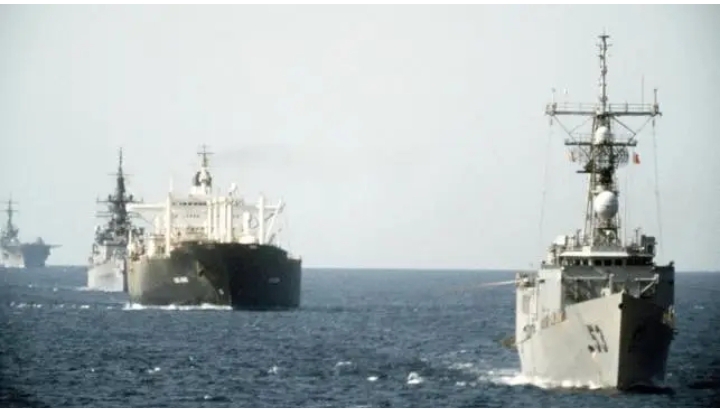
Below- Operation Earnest Will, 1987. When America escorted tankers for free, the ‘international waterway’ was a doctrine. When America charges 20% of cargo, it’s a protection racket — and the doctrine is dead.