

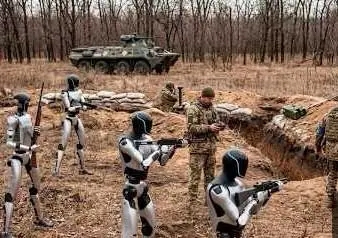
Breaking: Ukraine begins testing humanoid combat robots from the US on the front lines for the first time
American startup Foundation Future Industries sent early versions of its humanoid robots to Ukraine for testing in a combat zone. The humanoids are known to have been involved in logistical tasks, including carrying cargo.
This was reported by CNBC. Journalists noted that the company has already tested its machines in Ukraine and plans to soon offer this technology to the US Army. Two Phantom MK-1s were sent to Ukraine earlier this year for a pilot demonstration, in what the inventors called the first known deployment of humanoid robots in a combat theater. Current tests, supported by the US government and conducted with the participation of Ukrainian officials, focus on logistics in dangerous areas.
Foundation Future Industries CEO Sankaet
Pathak says that the MK-1 tests in Ukraine have
“already proven the robot’s potential” for moving cargo, a task that often puts soldiers at risk.
It is known that the early version of the Phantom
MK-1 is only capable of lifting 44 pounds or 20 kilograms. The robots also lack waterproofing and battery life.
This year, the developers plan to send new and improved humanoid robots to Ukraine – Phantom MK-2. Pathak assures that the updated version will have “superhuman abilities” and double the carrying capacity of the first humanoids from Foundation Future Industries. This is a robotics company from San Francisco, California, founded in 2024. It wants to produce autonomous humanoid robots with dual purposes: for both heavy industry and military applications.
The media learned that the Future Industries Foundation recently invited Eric Trump, the son of the current US president, to the position of chief strategy advisor. A representative for the startup told CNBC that Trump Jr. was an investor in the firm before becoming an advisor, and the two parties “share a common vision for manufacturing.” Proponents of humanoid technology in military and industrial fields argue that human-like robots are generally better suited than other forms of robotics to navigate real-world construction sites, logistics centers and war zones.
Kateryna Bondar, a senior fellow with the Wadhwani Al Center at CSIS, told CNBC that humanoid robots could theoretically provide certain upsides on the battlefield due to their autonomy and human-like dexterity.
“Modern urban combat spaces – where there are stairwells, ladders, basements and narrow corridors – were created for human movement, which could give humanoid systems an advantage over tracked or quadruped robots in certain scenarios,” Bondar said.
Still, there remain questions about the complexity and costs of manufacturing humanoids compared to other systems.
As humanoid robots move towards the battlefield, the technology has raised ethical concerns, particularly around the use of autonomous decision-making in combat when human lives are at stake.
Though most weaponized uses of the Phantom robots will retain some human confirmation in the decision loop, Pathak said Foundation’s robots will need to make fully autonomous decisions in certain time-critical scenarios.