

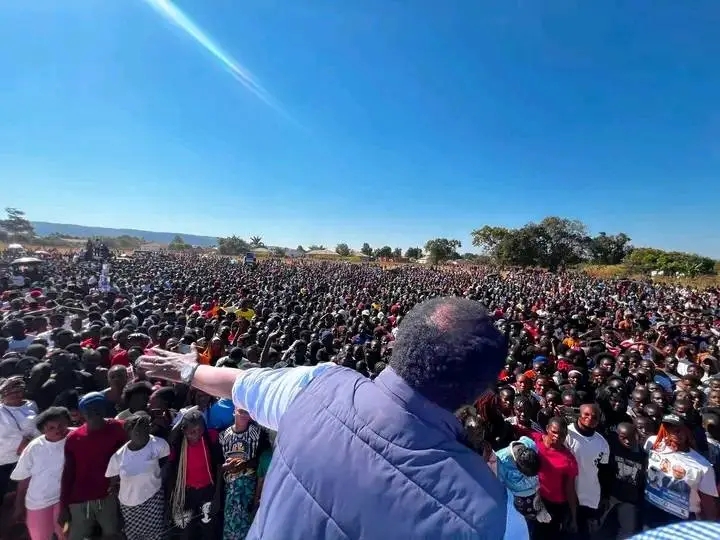
WHY MUNDUBILE AND MAKEBI ARE PULLING CROWDS
Guest Article By Kwangu Manda
In just about a month, Brian Mundubile and Makebi Zulu have garnered a significant following after joining forces following a power struggle that further fragmented opposition alliances. Crowds flocked to their rallies in the Copperbelt and Eastern Provinces.
Here are the main factors behind their crowds:
WE JUST HATE HH: Many followers still harbour deep personal hatred for President Hakainde Hichilema. The Patriotic Front successfully convinced much of the nation to hate him as a person rather than freely measure him as a political competitor. This bitterness persists and often overrides objective assessment of government results on a sector by sector basis. The language used is that “they have failed”, but the discussion is never in what way or manner.
THE UPND “EAT” ALONE: Many so-called marginalised groups and those who feel left out believe they are no longer benefiting. They show little regard for macro-economic policies and how benefits trickle down to consumers in the long run. If they are not personally gaining through backdoor deals, they dismiss any progress as insufficient. The UPND shares blame for failing to communicate achievements effectively in a manner that allows for the ordinary citizen to understand, fuelling perceptions that they “eat alone.” This idea — that national resources should benefit only those affiliated with the ruling party — is a damaging scourge in Zambia. It is even more damaging that what is meant for the public good should be thought of by individuals as “eating.”
EDGAR LUNGU’S BURIAL AS A POLITICAL TOOL: It is disingenuous for Brian Mundubile to use Edgar Lungu’s burial to lure masses and secure public office. This goes beyond politics. Lungu was a father first. With the court ruling passed, the family’s privacy should be respected rather than exploiting his name for political capital. Citizens must ask, “after burying him, what will you do for the next five years?”
LACK OF RESPECT FOR FORMAL DEVELOPMENT PROCESSES: An example is how youth empowerment is often translated as informal access to resources through political channels. Small-scale mining, as successfully demonstrated in Ghana, could contribute greatly to the treasury with proper production to market systems . Handouts and destructive consumption, especially involving precious stones, do not serve the youth. They must be taught sustainability and continuity for future generations. Zambia needs governance mechanisms that are stronger than party will.
A TIRED NATION: Many Zambians are desperate for improvements that make daily life easier. They are not interested in macro strides and merely want to have some relief seen in consumer prices and basic needs at most. Some rally behind Mundubile and Zulu because of the UPND’S poor local government mechanisms to help alleviate some of the struggles of the ordinary man. Ward Development Committees and local councillors have a duty to deliver basic services such as clean water, healthcare, electricity, and sanitation, even if citizens do not fully grasp the nation’s macro-economic strides.
MUNDUBILE’S POOR ATTEMPT AT POPULISM
The UPND’s first term has created stability, paving the way for lower production costs and increased economic participation that will eventually benefit ordinary citizens — though this does not mean immediate drops in consumer prices. What it means is that an enabling environment has been made to encourage growth and increase supply, hence meeting demand. Populism has run its course. While it worked for the Chiluba-era MMD, PF’s Michael Sata, and Chishimba Kambwili, Zambians are increasingly demanding greater scrutiny, even if only a small minority. The NRPUP should use its crowds for honest competence rather than deceitfully exploiting the ECL name for political expedience.
A CHALLENGE TO THE UPND
Economic scores alone do not reflect positive overall governance scores. Zambians need visible commitment to electoral reforms, tighter transparency in the health sector and local government, implementation of separation of powers, clearer laws that are not left open to interpretation, and industrial and labour relations reforms that strengthen private sector employee rights.
Stock hoarding is a big problem in Zambia and is a logical reason as to why consumers and ordinary citizens, even when certain improvements occur at the importation to production and distribution levels in value chains, do not experience reflective impacts. The UPND has a task in tightening CCPC monitoring of stocks, especially with OMCs.
CONCLUSION
Critiquing the opposition does not mean alignment with the ruling party, nor does criticising the ruling party indicate support for the opposition. A free-thinking citizen simply weighs those seeking to manage systems that affect them, their loved ones, and their community. Opinions should inform and encourage constructive engagement for societal growth.
They didn’t want to bury Lungu; they wanted to use “Ichitumbi” for campaigns, claims Nevers Mumba