

Zambia scenario Analysis predict over 82% Voter Turnout on 13th August
5th July, 2026
_Professor Namukolo Miyanda, Pan-Africanist and Governance Expert_
Zambia is headed for a highly contested general election on 13th August 2026. The election will be held under Article 47 of the _Constitution of Zambia_, as amended, with incumbent President Hakainde Sammy Hichilema seeking a second five-year term on the UPND ticket. Since the 2021 elections, the political environment has shifted due to legislative changes, party re-alignments, and socio-economic pressures. This article examines prevailing conditions that could contribute to high voter turnout, integrating voter registration data, theoretical frameworks, and observed political trends.
Zambia’s political landscape from 2021 to 2026 has been characterized by several developments relevant to electoral competition. The enactment of the _Constitution of Zambia (Amendment) Act No. 13_ of 2025, commonly referred to as “Bill 7”, was passed after perceived limited parliamentary consultation. Concurrently, the application of the Public Order Act has been described by some stakeholders as restricting freedom of assembly for opposition political parties. The Registrar of Societies queried the compliance status of several political formations, creating uncertainty in opposition planning. The Patriotic Front, the largest opposition party post-2021, experienced internal divisions that led to multiple factions. This fragmentation resulted in confusion and disorganisation, with some members seeking duly registered parties as special purpose vehicles to contest the 2026 elections. Socio-economic and behavioural factors further complicate the electoral climate.
Political intimidation has been reported as a potential driver of voter apathy. At the same time, cost-of-living pressures and increased public discussion of governance have heightened political engagement in many communities. According to the Electoral Commission of Zambia, total registered voters for 2026 are 8,786,300, with Lusaka at 1,430,889, Copperbelt at 1,296,446, Eastern at 1,129,444, Southern at 1,103,275, Central at 820,079, Northern at 722,403, Luapula at 694,681, Western at 629,352, North-Western at 524,195, and Muchinga at 435,536. The anticipated total number of voter turnout in 2026 presidential election is 7,204,766 of duly registered voters representing 82% compared to 4,983,099 representing 70.61% in 2021 elections.
This analysis is however constrained by three main factors. First, the analysis relies on secondary data and qualitative observations, including attendance at political rallies over the last three weeks. No primary survey or opinion poll was conducted. Second, campaign dynamics and exogenous shocks may alter voter behaviour between now and 13th August, 2026. Third, crowd sizes at rallies are an imperfect proxy for voter engagement due to issues of multiple attendances, mobilisation incentives, and urban bias, as noted by Brady, who argued that “observatory methods must account for selection bias in crowd composition” (Brady, 2010).
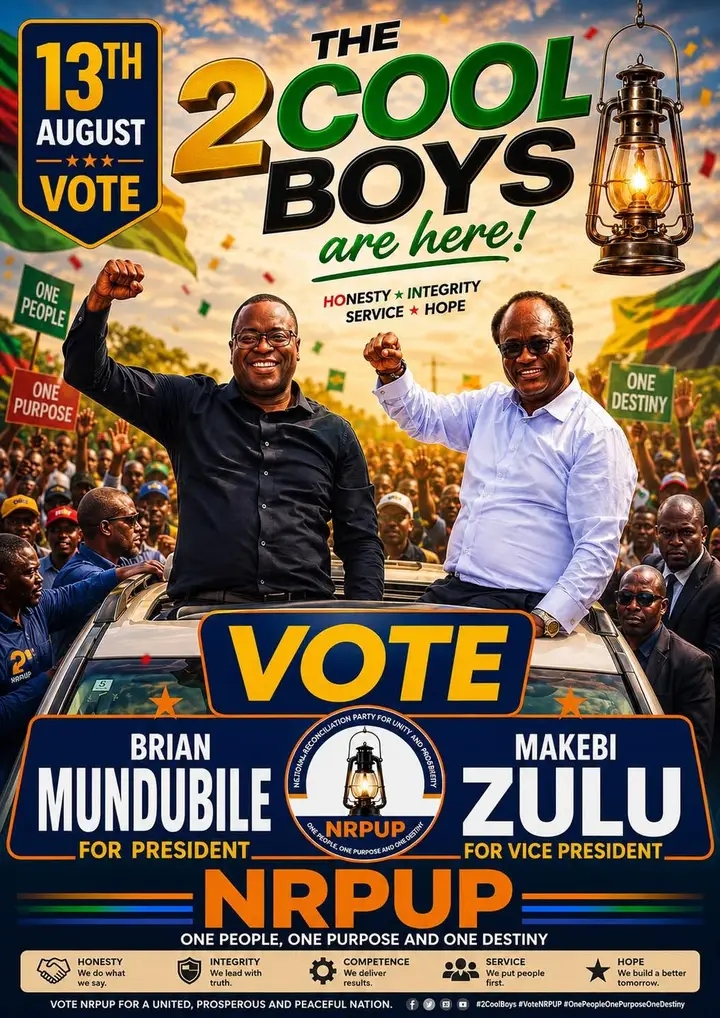
The ECZ has published the list of duly nominated presidential candidates for August 2026, including Bwalya Kelvin F. of ZMP with running mate Katolo Milner J., Chansa Given M. of MEE with Chewe Harrison, Chungu Xavier F. of LDP with Mwanza Gerald D., Hichilema Hakainde S. of UPND with Mutale Nalumango W.K., Kalaba Harry of CF with Mawere Moses, Katuta Given as Independent with Nyirenda John, Kunda Howard of ZAWAPA with Miyoba Chipo, M’membe Fred of SP with Banda Dolika, Mundubile Brian M. of NRPUP with Zulu Makebi, Mushimba Brian of OPP with Banda Andyford, Njobvu Ackim A. of DU with Banda Mirriam L., Pule Daniel C. of CDP with Mushala Bert M., Siamunene Richwell of NFP with Banda Nicholas K., and Silumbe Richard of LM with Kamweneshe Kaela.
The hypothetic analysis draws on six complementary theories. Lived Experience Theory argues that voters’ choices are shaped by daily material conditions and retrospective evaluations of incumbents, where “voters reason about parties and candidates in terms of their personal experience” (Popkin, 1991). Observatory Theory uses systematic observation of rallies, media coverage, and elite cues to infer momentum (Brady, 2010). Election Results Prediction Theory combines historical voting patterns with current contextual variables, with Lewis-Beck and Stegmaier contending that “economic and political fundamentals structure the vote” (Lewis-Beck and Stegmaier, 2000). Social Perception Theory posits that candidate image, perceived empathy, and group identity influence preference formation, where “people form impressions that guide political choice” (Fiske and Taylor, 2013). Image Analysis evaluates visual and rhetorical branding, including the role of musicians and social media influencers, as “visual symbols prime emotional responses to candidates” (Schill, 2012). Statistical Probability Theory applies turnout assumptions and vote share distributions to generate estimates, conditional on stated limitations, with Gelman and King noting that “probability models quantify uncertainty in electoral systems” (Gelman and King, 1994).
Several prevailing conditions could contribute to anticipated elevated voter participation in 2026. Heightened political interest is evident in observed engagement at rallies, door to door campaign meetings, and road shows and community forums, indicating sustained public attention on the election across multiple provinces. The evolution of digital platforms has expanded political information flows, particularly among urban youth. Tufekci observes that “networked publics reshape political mobilization” (Tufekci, 2017). The cost of living has made governance and policy outcomes more salient in daily life, which Lived Experience Theory links to stronger motivation to participate. Furthermore, public discourse, civil society engagements, and candidate messaging have emphasized civic duty and the impact of individual votes, potentially reducing apathy. Observational data from campaign messaging indicates that multiple parties, including the NRPUP led by presidential aspirant Brian Mundubile and running mate Makebi Zulu, are presenting narratives focused on living standards and economic empowerment in the mining and agriculture sectors, which image analysis suggests resonates in high-poverty contexts.
Given the potential for high turnout, there is need for political parties and relevant stakeholders to enhance voter protection and civic education measures prior to, during, and after polling day. The international community should consider offering timely technical and monitoring support to promote transparency and safeguard the credibility of the elections. A level playing field for political campaigns is essential for legitimacy. The influence of musicians and social media influencers on electoral outcomes remains an open empirical question that will require post-election analysis. Future research and analysis should replace secondary observations with primary survey data and apply Bayesian Theorem as new information emerges.