

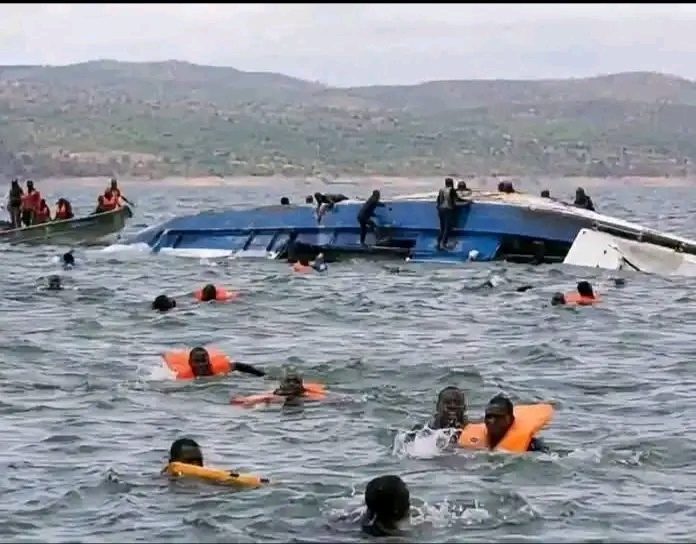
18 CHILDREN PERISHED IN KARIBA BOAT ACCIDENT
By Chengetai Zvauya
At least 18 children died in the shipwreck that occurred this week on Zimbabwe’s Lake Kariba, which caused a total of 46 deaths and has shocked the country, Zimbabwean police reported on Friday.
According to a statement released by the Zimbabwe Republic Police (ZRP), the 44 deceased whose identities have been confirmed include 26 adults (20 women and 6 men) and 18 minors (9 girls and 9 boys), including young children between the ages of one and five, as well as older children.
Two other people have not yet been identified.
“The process of identifying the remaining recovered bodies continues. The police are still working closely with the relevant parties and the affected families in the identification and recovery process,” the security forces stated.
The shipwreck took place on Tuesday afternoon and involved a vessel from the Rural Infrastructure Development Agency (RIDA) that was traveling between the towns of Chalala and Kariba.
Although initial reports indicated that it was carrying 120 people, police investigations suggested that there could be more people on board, even though the vessel’s maximum authorized capacity was 90 people, the ZRP reported on Wednesday.
Police then stated that 67 people were rescued, although the Civil Protection Unit (CPU), the country’s disaster management agency, put the number of survivors at 77, after they swam or were swept to a nearby islet, from where they were evacuated by rescue boats.
Given the magnitude of the tragedy, Zimbabwe’s President Emmerson Mnangagwa declared a national state of disaster to deploy Army resources, rescue divers, and aircraft.
The president publicly acknowledged that the incident exposed serious deficiencies in the country’s maritime inspection and safety systems
Lake Kariba, the world’s largest artificial reservoir by volume, with a capacity of about 180 cubic kilometers, was created as a result of the construction of the eponymous dam, built between 1956 and 1959 by Italian engineers on the Zambezi River, on the border between Zimbabwe and Zambia.
In addition to supplying the Kariba Hydroelectric Power Station, this body of water constitutes a key transport route in the region.
The latest refurbishment of this power plant was financed by the European Union (EU), which contributed 113 million euros to a project launched more than ten years ago with other partners, such as the World Bank (WB) and the African Development Bank (AfDB), although the work began in 2017.
This infrastructure and the Hwange Thermal Power Station are the two main sources of power generation for Zimbabwe, but their equipment has become obsolete.
Thus, the country has suffered blackouts of up to fourteen hours a day for 45 years, forcing industries, businesses and citizens to rely on more expensive alternative methods.
The Zimbabwean government promised “rehabilitation” works on the service, which will be completed by 2030. EFE