

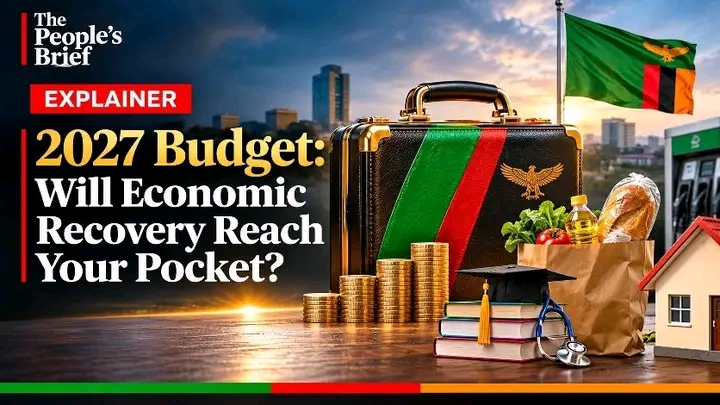
🇿🇲 EXPLAINER | 2027 Budget: Will Economic Recovery Reach Your Pocket?
Finance Minister Situmbeko Musokotwane will present the 2027 National Budget to Parliament tomorrow, 6 November, setting out how President Hakainde Hichilema’s Government intends to finance its Grow Zambia Agenda. But beyond the billions of kwacha, tax measures and economic projections, an important question confronts ordinary Zambians: how will the Budget improve their daily lives?
The country enters the new financial year with signs of greater economic stability following years of debt distress, high inflation and pressure on public finances. Cabinet has approved the proposed Budget, emphasising revenue collection, responsible expenditure and private-sector investment. However, a stronger national economy does not automatically mean every household has more money to spend.
Consider inflation. According to the Zambia Statistics Agency, annual inflation stood at 6.3 percent in October 2026, compared with 6.1 percent in September. This means the average price of goods and services was 6.3 percent higher than a year earlier. It does not mean prices have fallen by 6.3 percent. A family spending K2,000 on a particular basket of goods a year ago would, at that average rate, need approximately K2,126 to purchase the same basket today.
This distinction matters because economic recovery is often discussed through statistics that do not immediately reflect household experiences. Inflation may slow while rent, transport, electricity and food remain expensive. For a worker earning K4,000 monthly, the important question is whether income is growing faster than living costs.
Agriculture will be another major area to watch. Government recently proposed an additional K19.9 billion in spending for 2026, including K15.8 billion for agriculture. Of that agricultural allocation, K14.7 billion was intended to settle payments to farmers who supplied maize to the Food Reserve Agency, while K1.1 billion would support the Farmer Input Support Programme.
The FRA purchased approximately 2.7 million tonnes of maize against an initial target of 500,000 tonnes. This bumper harvest presents an opportunity to strengthen food security, but it also creates a substantial financial obligation. Farmers need timely payments to purchase inputs, repay loans, employ workers and prepare for the next planting season
Musokotwane has indicated that Government is spending ahead of time to prepare for possible drought conditions and reduce pressure on the 2027 Budget. The important question is whether this approach will protect food supplies without placing excessive pressure on public borrowing.
Borrowing itself deserves attention. The proposed K19.9 billion supplementary expenditure includes plans to raise approximately K18 billion from the domestic market. Government borrowing can finance legitimate public needs, but it must be managed carefully. Heavy domestic borrowing can increase debt-service costs and, depending on financial-market conditions, compete with businesses seeking affordable credit.
The 2027 Budget must also explain how economic growth will translate into employment. Mining investment can increase export earnings and government revenue, but ordinary citizens benefit more directly when companies employ Zambians, purchase local goods, support contractors and contribute taxes that finance public services.
The same applies to agriculture, manufacturing and tourism. A new factory does more than produce goods. It can employ workers, purchase agricultural produce, contract transporters and generate demand for nearby businesses. This is how national economic expansion can gradually reach households beyond the industries attracting investment.
Taxation will be equally important. Government needs revenue to operate hospitals, pay teachers, maintain roads and finance social programmes. But taxes also affect the disposable income of workers and the operating costs of businesses. Any proposed changes to personal income tax, fuel duties, customs charges or business taxation should therefore be examined for their practical effects.
Education and healthcare allocations deserve similar scrutiny. A larger budget for schools means little if classrooms remain overcrowded or teaching materials arrive late. Increased health spending must be assessed against medicine availability, staffing, equipment and the quality of services patients actually receive.
Social protection is another measure of whether economic recovery is inclusive. Programmes such as the Social Cash Transfer Scheme, school feeding and support for vulnerable households help people who may not immediately benefit from private investment or expanding industries. The Budget should show whether these programmes can reach more eligible beneficiaries and whether payments will be reliable.
There is also the question of implementation. Parliament may approve billions for development, but approved allocations are not the same as money released and spent effectively. A road budget matters when contractors are paid and roads are completed. A health allocation matters when medicines reach clinics. Public accountability must therefore extend beyond the Budget speech to actual expenditure and measurable results.
Zambia’s economic recovery has created an opportunity to move from stabilisation towards broader prosperity. The challenge for the 2027 Budget is to connect fiscal discipline, investment and growth with employment, affordable essential services and stronger household purchasing power.
Tomorrow, the Finance Minister will present the figures. For millions of Zambians, however, the more meaningful assessment will come later: whether those figures produce better schools, functioning hospitals, productive farms, new jobs and greater financial security.
The People’s Brief | Francine Lilu
5 November 2026