

32 Women Elected: Is Zambia’s Political System Still Failing Women?
Zambia’s 2026 parliamentary results have left one uncomfortable question hanging over the country: where are the women?
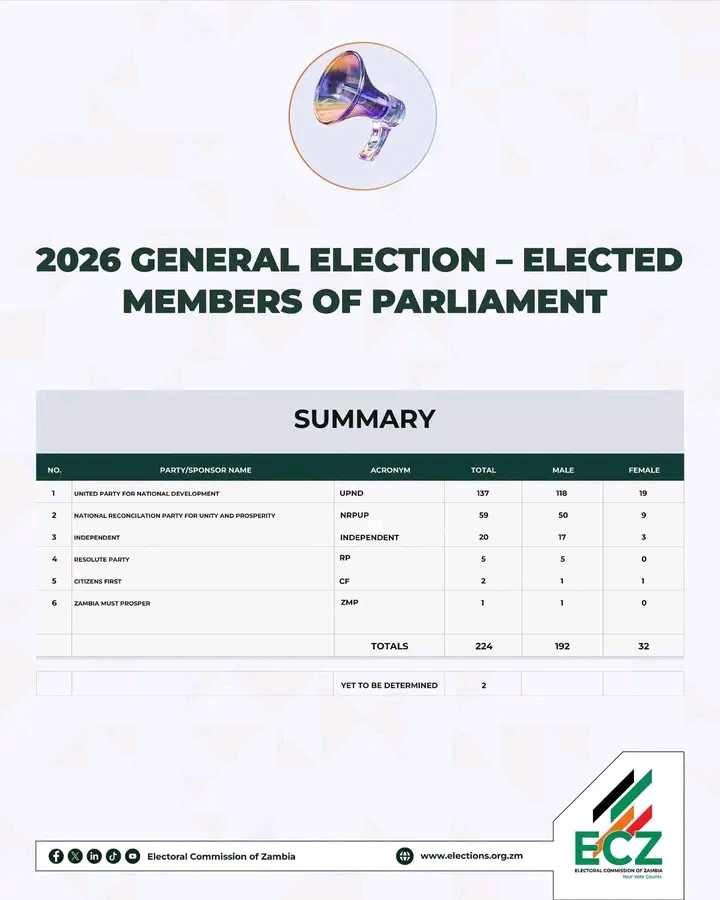
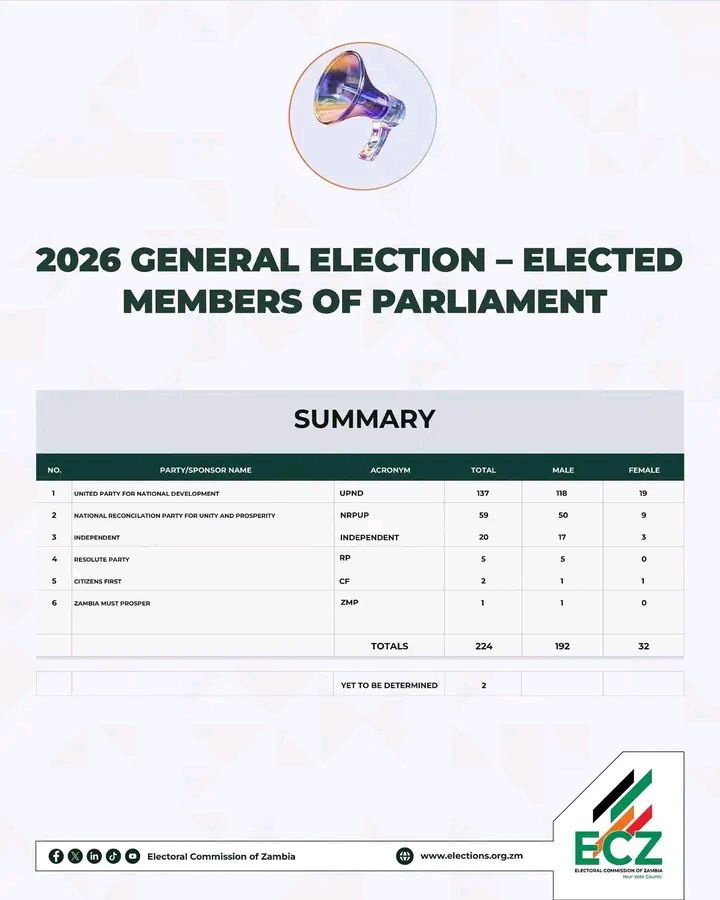
Of the 224 Members of Parliament elected so far, 192 are men and only 32 are women. Two seats are still outstanding.
That puts women’s representation among the constituency-elected MPs at just 14.3 percent.
The number is difficult to defend as representative of a country in which women make up roughly half the population.
And while Zambia’s new electoral framework provides for 20 additional parliamentary seats reserved for women through proportional representation, that should not allow the country to avoid confronting the bigger issue.
Because the question is not simply why women are not in Parliament.
The question is why they are not getting there through the same political door as men.
Are women simply not being adopted?
There is a tendency to blame women themselves by suggesting they are not putting themselves forward, are not interested in politics or are unwilling to take on the rough and tumble of elections.
But that explanation is too convenient.
Political parties are the gatekeepers of electoral politics. They decide who gets adopted, where candidates are placed and, crucially, which candidates receive the financial, organisational and political machinery needed to run competitive campaigns.
So, when women remain dramatically underrepresented, we should also be asking: How many women were actually adopted by the major political parties? How many were given constituencies they could realistically win? And how much support did they receive once they entered the race?
A woman can be willing to contest an election, but willingness alone does not level the playing field.
Or are women afraid of the political terrain?
There is another possibility that Zambia needs to confront.
Politics has become an increasingly difficult space for women to navigate. The cost of campaigns, political intimidation, personal attacks and the scrutiny directed at women can make elective politics considerably more expensive, personally and professionally.
If capable women look at the political landscape and decide that the price of entering it is simply too high, that is not a failure of women.
It is a failure of the political environment
And if women are contesting but voters continue to overwhelmingly choose men, then Zambia also needs to have an honest conversation about whether voters themselves are carrying gender biases into the polling booth.
Zambia is not without African examples
What makes Zambia’s numbers particularly striking is that other African countries have demonstrated that substantially higher levels of women’s representation are possible.
Rwanda has women occupying more than 60 percent of seats in its lower chamber. Namibia and Angola are above 40 percent, while Senegal is also above 40 percent. South Africa is not far behind.
These countries are not identical to Zambia. Their electoral systems, political histories and quota arrangements differ. But they demonstrate one important point:
Low representation is not inevitable.
The 20 seats cannot be the end of the conversation
Zambia deserves credit for introducing 20 seats specifically for women under its new proportional representation framework.
But there is a danger in treating those seats as the solution.
If women are largely absent from constituency elections and are then brought into Parliament through reserved seats, the country may increase the number of women MPs without fundamentally changing the political structures that keep women out of competitive elections.
That is the uncomfortable conversation Zambia should now be having.
Are political parties failing to adopt women?
Are voters still reluctant to elect women?
Are women themselves retreating from politics because the environment has become too hostile?
Or is it a combination of all three?
The 2026 election results do not provide an easy answer. But they provide enough evidence to demand the conversation.
Because 32 women out of 224 elected MPs is not simply a statistic. It is a reflection of who Zambia currently considers suitable, electable and acceptable for political leadership.
And perhaps that is the question we should be asking ourselves.
What does it say about Zambia when women need a special constitutional mechanism to enter Parliament, while men continue to dominate the constituencies where political power is actually won?
And on a lighter note, after looking at these numbers, I am ready to become a PR woman myself. Ati which party? UPND, NRPUP, I don’t mind. Just put me on the list!
Tilyenji, Proportional Representative Aspirant