

🇿🇲 INSIGHT | 4 Ministers, 1 President: is Hichilema Testing a Leaner Govt?
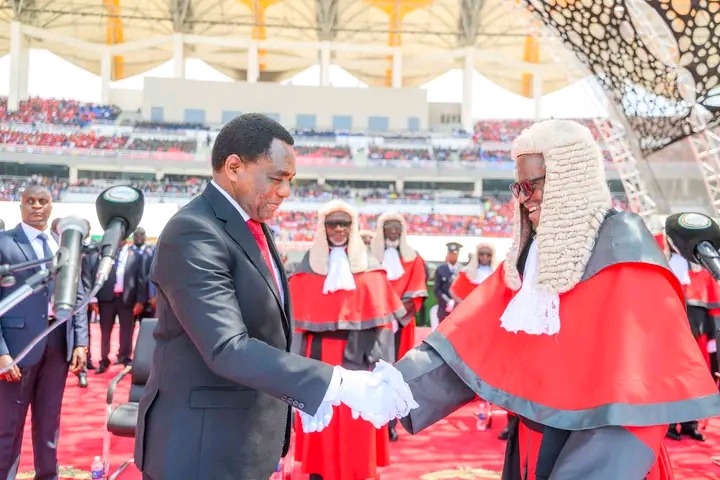
Something unusual is happening in Lusaka. More than a month after President Hakainde Hichilema began his second term, Zambia still has only four Cabinet ministers formally listed by the National Assembly: Situmbeko Musokotwane at Finance, Mulambo Haimbe at Foreign Affairs, Roma Chilengi at Health and Gilbert Siame at Green Economy and Environment. Hichilema appointed them on September 14 and called them the “first” ministers of his new administration.
Three weeks later, the expected second wave has not arrived. Yet ministries remain open, Permanent Secretaries remain at work and Government business has not stopped.
This delay has produced two conversations. The public one asks why the President is taking so long to constitute a full Cabinet. The quieter political conversation concerns who will get the jobs. Zambia has a long political culture in which victory creates expectations among party officials, campaigners and long-serving loyalists who believe years spent building a political movement should eventually translate into appointments.
There is nothing uniquely Zambian about political patronage, but in Zambia ministerial office carries considerable status, access and material benefits. This makes Cabinet formation both an administrative decision and a political allocation of scarce positions.
Hichilema’s first term offers useful context. In 2021, he assembled a conventional Cabinet largely from elected politicians, including figures who had travelled with the UPND through years in opposition. Over the term, however, ministers were dismissed, moved or replaced. His second-term opening has been different. Of the first four appointments, two were returning ministers, Musokotwane and Haimbe, while Roma Chilengi came from a technical public-health background and Gilbert Siame from academia.
At their swearing-in, Hichilema gave perhaps the clearest indication of what he says he now wants: “There must be zero tolerance for corruption, waste, and abuse of office. Our ultimate mission is to deliver results for our people and grow Zambia.”
It is tempting, therefore, to conclude Hichilema has discovered Zambia can function without a large political executive. But the evidence does not yet support going that far. The President has not announced a policy of governing permanently with four ministers, nor has State House said the delay represents an experiment in shrinking Cabinet. What can be observed is more interesting: the machinery of the state has continued operating while most ministerial offices remain vacant.
Permanent Secretaries and technical departments have continued implementing programmes because a ministry is an institution, not the politician occupying its top office. Cabinet Office itself describes the Public Service as the machinery responsible for implementing Government policy and maintaining administrative effectiveness.
But there is an important constitutional distinction. Permanent Secretaries cannot simply replace ministers indefinitely. Article 116 of the Constitution gives a minister responsibility, under the President, for the “policy and strategic direction” of a ministry or state institution. Ministers also carry political accountability, including answering for Government in Parliament. Civil servants administer. Politicians decide policy and answer politically for it.
Zambia may therefore be discovering a useful distinction during this unusual period: much of the daily work of Government does not require a minister personally pushing every file, visiting every project or appearing at every ceremony. But major policy choices still require legitimate political direction and accountability.
Then there is the money. Ministerial office is not merely a title. Under the latest ministerial emoluments regulations we could verify, Statutory Instrument No. 16 of 2023 placed a Cabinet minister’s annual basic salary at K275,990, with a K71,295 special allowance and K72,098 utility allowance. That is K419,383 a year before constituency allowance and other costs associated with the office.
The same regulations provided annual constituency allowances ranging from K36,048 for nominated MPs to K54,073 for rural constituencies. These figures should not be confused with the total cost of maintaining a minister because official transport, staff, travel and other administrative expenditure sit elsewhere in Government accounts. But they demonstrate a basic point: political offices have a fiscal cost.
The harder question is whether Zambia receives equivalent value. A minister can be politically loyal, popular in a constituency and effective on a campaign platform without necessarily being an effective executive manager. Those are different skills. Government ministries control budgets, institutions and policies affecting millions of people. Political loyalty may help a President build and hold a coalition. It does not automatically produce competent administration.
Hichilema himself appears to be placing greater emphasis on results in his second term, but whether his eventual Cabinet reflects this principle can only be judged when he actually appoints it.
There is also danger in romanticising the present arrangement. A weak minister is expensive, but an absent political executive can also become costly if decisions stall, policy coordination weakens or senior civil servants are forced to operate without clear political direction. Permanent Secretaries are not elected and should not become substitute ministers. Nor should Zambia conclude from a few weeks of continuity that Cabinet is unnecessary.
The better question is whether every ministry needs the amount of political infrastructure Zambia has traditionally attached to it, and whether ministers should be judged more rigorously against measurable outcomes.
The pressure inside political parties complicates this. Winning elections requires organisation, money, mobilisation and loyalty. Governing requires competence, judgement and delivery. Sometimes the same people possess both. Sometimes they do not. The temptation after an election is to treat Government as the final stage of the campaign, distributing positions among those who helped secure victory.
But a second-term President faces a different calculation. Hichilema no longer needs to prove UPND can win power. He must prove what it can do with power.
For now, Zambia should resist both conclusions circulating around the delay. Four ministers have not proved the country can permanently govern without a full Cabinet. Neither has Hichilema’s failure to appoint one quickly proved Government has stopped functioning. What the moment has exposed is a more useful question about the structure of the state itself: how many political office holders does Zambia actually need to govern effectively, and what measurable value should each one deliver for the money, authority and privileges attached to the office?
Political loyalty can win an election. It cannot build a road, stock a hospital, produce electricity or grow an economy by itself. Government should not be a reward for having helped politicians obtain power. It should be the machinery through which power produces results.
INSIGHT | Beyond the headline. We examine the forces, choices and consequences shaping the story.
The People’s Brief | Hora Hanene; Ollus R. Ndomu; Tusha Lishomwa