

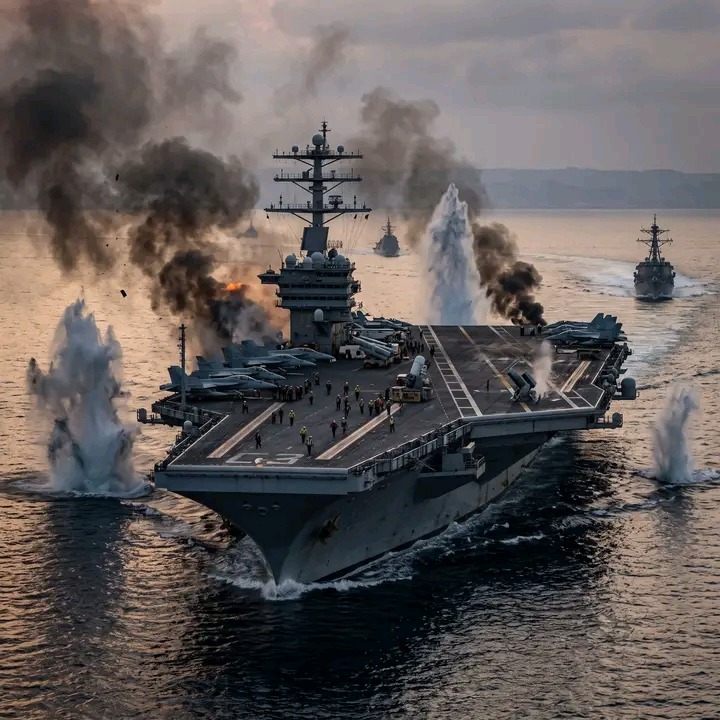
In the eighty years since Pearl Harbor, nobody has dared touch an American aircraft carrier. Iran has now done exactly that. The BBC’s report says
– The US aircraft carrier and guided-missile destroyer successfully evaded multiple attacks
Look at that word — evaded. Not destroyed, not intercepted. CENTCOM itself acknowledged that the USS George Washington had to perform evasive manoeuvres under Iranian missile fire. The nuclear-powered carrier of the most powerful navy on earth had to move out of the way.
The IRGC’s Aerospace Force fired ballistic missiles at that carrier and a destroyer. Iran claims both vessels were damaged and forced to leave the engagement area. CENTCOM says no ship was hit. There is still no independent confirmation of the Iranian claim — let me say that plainly.
Now the question is
– Can Iran actually sink a carrier?
Former US intelligence officer Malcolm Nance rejected Iran’s claim with an argument that is technically solid — hundreds of interceptors work around a carrier, and that vast steel structure does not sink to three or four missiles. To sink it you have to breach the hull from below.
Here I partly agree with Nance. Technically he is right. But sinking was never Iran’s objective. Render a carrier non-operational and it is out of service for years. And politically, the picture of a burning American carrier in the Strait of Hormuz is worth more than the physical damage.
Danny Citrinowicz, the Iran analyst at Israel’s Institute for National Security Studies, put his finger on it. In his view, the very act of targeting a carrier proves that Tehran is now willing to take a risk it once deliberately avoided. I agree with him. Iran has stopped caring about the consequences.
Within hours, America answered. CENTCOM said two Iranian tankers were permanently disabled and a third completely destroyed in the Gulf of Oman. The IRGC Navy then counter-claimed hits on several tankers and a US naval drone.
Now to US Defence Secretary Pete Hegseth. He announced on social media that if Iran fires on American ships, America will sink Iran’s oil tankers. He described Iran’s tanker fleet as
– defenceless
In CENTCOM commander Admiral Brad Cooper’s words, shoot at two ships and three will be taken in return. One thing has to be said plainly here. Publicly identifying defenceless civilian commercial vessels as easy targets, announcing it, and then striking them falls within the definition of a war crime. Iran’s foreign ministry has called it a clear violation of Article 2(4) of the UN Charter.
Now hear what is happening inside Washington. A New York Times investigation reports that in August around 50 Joint Staff officers were made to sit for polygraph tests. The question was a single one — had they leaked the news that America’s munitions stockpiles for the Iran war were running dry. CBS says dozens of CENTCOM officers took the same test. Pentagon spokesman Sean Parnell said they do not comment on internal investigations.
This is not how a winning side behaves. An administration that claims it is winning a war does not strap its own officers to a lie detector. Hegseth has denied the shortage reports, and Trump has called critical coverage of the war treasonous.
Look at public opinion too. The latest Reuters/Ipsos poll has Trump’s approval stuck at 33 percent, the lowest of either of his terms. In the University of Massachusetts Amherst poll, 80 percent of Americans expect a long war, and support for military action in Iran has fallen to 31 percent.
But the most important words of the day came from former CIA director and former CENTCOM commander General David Petraeus. He acknowledged that the strikes have badly damaged Iran’s military capacity — much of the navy sunk, the air force effectively non-existent. But then he raised the real question: can Iran come out of this militarily weakened yet strategically stronger? His answer — that depends entirely on who ends up controlling the Strait of Hormuz.
From a former CIA director’s admission you can work out where America stands. Trump began a war to change a government and is now stuck in a war over a waterway. This will not be settled by counting missiles. Whoever controls the flow of oil and gas is the winner.
And the claim of control does not match the facts. Last month Trump said the strait was fully under American control. Yet by Kpler’s count, an average of just 13 ships a day now pass through Hormuz.
In parliament on Sunday, Iran’s speaker Mohammad Baqer Qalibaf said the era of proportionate response is over. Any blow to Iran’s interests will now be answered faster, heavier and more painfully. Look at the past — after Soleimani was killed, Iran fired a few missiles at bases in Iraq and stopped there. Qalibaf is saying those days are gone. By firing at a carrier, Iran has already shown it means it.
IRGC spokesman Hossein Mohebi said the same day that for every dollar of damage America inflicts on Iran, it does several times that to itself. That is Tehran’s doctrine — not military victory, but economic bleeding.
Finally, a word about ordinary people. The interceptors being spent over Hormuz are the same ones Ukraine no longer has to protect its power grid. One war is eating another, and the shock in oil prices lands in shopping bags from South Asia to Africa. That is geopolitics — there are no spectators here.
For eighty years nobody dared look that carrier in the eye. This week it had to move. Who sank what is not the point. The point is that the fear has broken.