

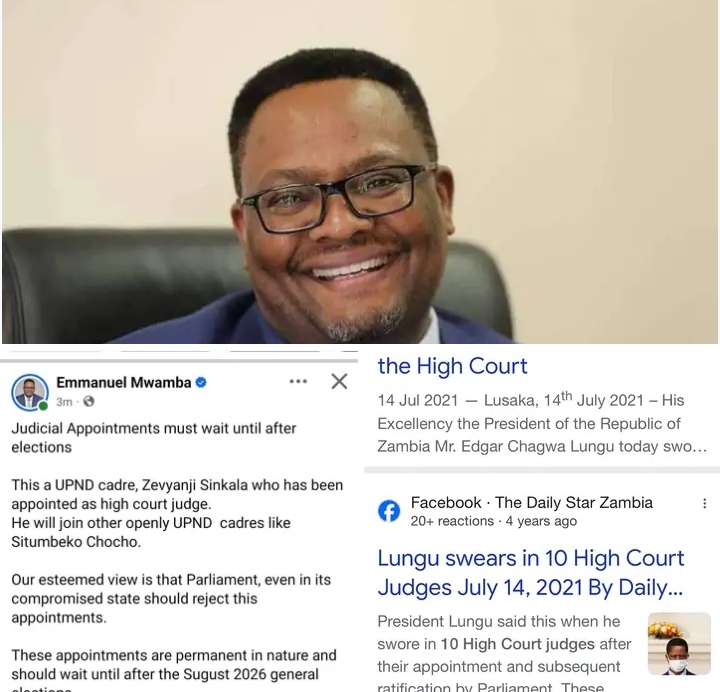
DR LARRY MWEETWA RESPONDS AND LECTURES EMMANUEL MWAMBA ON APPOINTMENT OF JUDGES IN AN ELECTION YEAR.
Amb Emmanuel Mwamba has short memory. Zambia presents a recurring jurisprudential concern wherein selective recollection appears to arise in the context of political discourse.
In this regard, it is apposite to interrogate the consistency of the position advanced by Emmanuel Mwamba, particularly through the lens of historical conduct and established precedent.
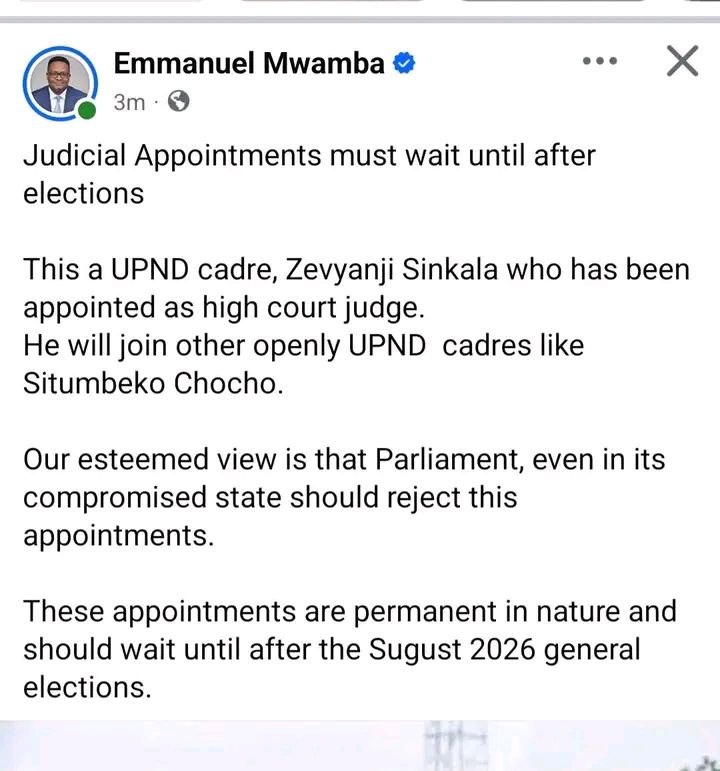
It is presently contended that the timing of judicial appointments is improper and ought, as a matter of prudence, to be deferred until after the electoral process. But then, history is notoriously stubborn as it is whispers another story.
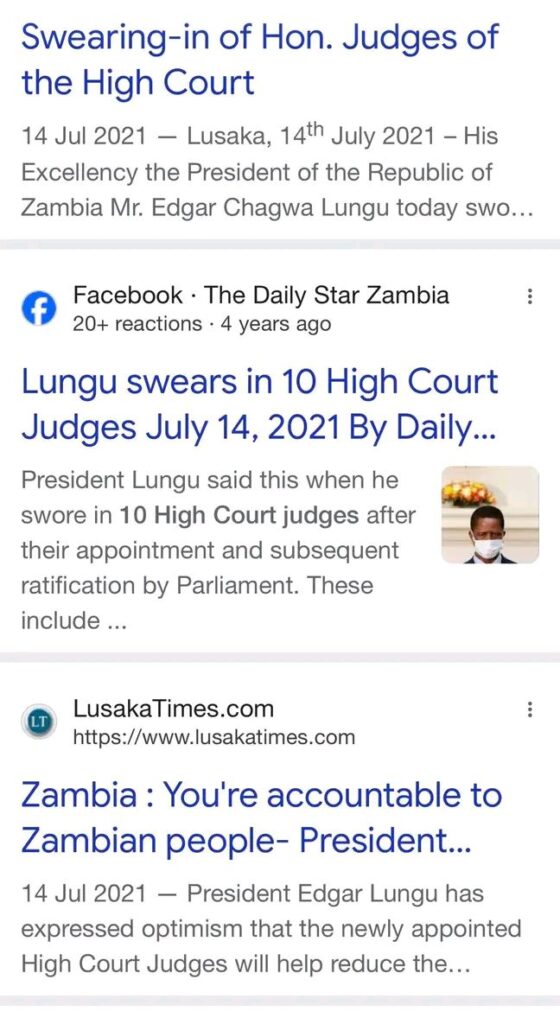
On 14 July 2021, in the heat of an election season, after Parliament had been dissolved, none other than Edgar Lungu proceeded to swear in a full bench of High Court judges. No alarm bells. No sermons on timing. No calls to “wait for August.” While such a proposition may, prima facie, appear tenable, it is materially undermined by antecedent state practice.
Notably, on 14 July 2021, during an active election period and subsequent to the dissolution of Parliament, Edgar Lungu proceeded to appoint and swear in a full complement of High Court Judges.
At that material time, there was no recorded objection premised on timing, nor any assertion that such appointments should be postponed pending the conclusion of elections. is the issue truly about timing or about who is holding the pen? “When the goat belongs to you, it is called livestock; when it belongs to your neighbour, it is called a nuisance.”
The principle of consistency in legal and public reasoning dictates that a position previously endorsed, whether expressly or by acquiescence, cannot be subsequently impugned without cogent justification. To do otherwise would amount to approbation and reprobation, which is impermissible in both law and equitable doctrine. Ba Mwamba, remember “the same mouth that said the soup was sweet yesterday cannot today claim it is poison without explanation.”
Accordingly, the pertinent issue for determination is whether the objection presently raised is genuinely anchored in constitutional principle and procedural propriety, or whether it is contingent upon the identity of the appointing authority.
Jurisprudential integrity demands that similar circumstances be treated alike; any deviation therefrom raises legitimate concerns of arbitrariness and selective application of standards.
A similar pattern of objection was observed in relation to Bill 7, wherein the timing of legislative action was contested. However, the absence of comparable resistance under analogous prior circumstances suggests an inconsistency that calls into question the bona fides of the argument advanced.
It is therefore submitted that fidelity to principle necessitates uniformity of application. As a matter of governance and constitutionalism, credibility is contingent upon consistency.
Ultimately, the truth, much like a latent legal fact, cannot be indefinitely obscured and will invariably manifest itself upon scrutiny.
Is this Dr. Mweetwa still a civil servant? Is he in the Ministry of Information? Is he the government spokesman?
For a civil servant, he indulges too much in partisan politics. Get out of the civil service then you can make partisan running comments.
Take a leaf from one Chama “Pilato” Fumba who was a vocal opponent of PF but is quiet since he was appointed permanent secretary in the Ministry of Youth and Sport(?). Dr. Mweetwa has chosen to be vocal in defence of the UPND even as a civil servant. You can’t have your cake and eat it too.
Another useless chap who has greatly contributed the demise of the pf party, horrible chap just like shushushua
The election year has not stopped President of Zambia to perform duties.Why do some people want to create laws that have never existed? Probably after dissolution of Parliament, appointments and disappointments may not happen, it is worth checking in the constitution of Zambia.For now appointments may happen though ratification may have to take place in some constitutional positions.Mr Mwamba likes to test and mislead people.If any thing it is extremely important to examine what Mr Mwamba opposes.