

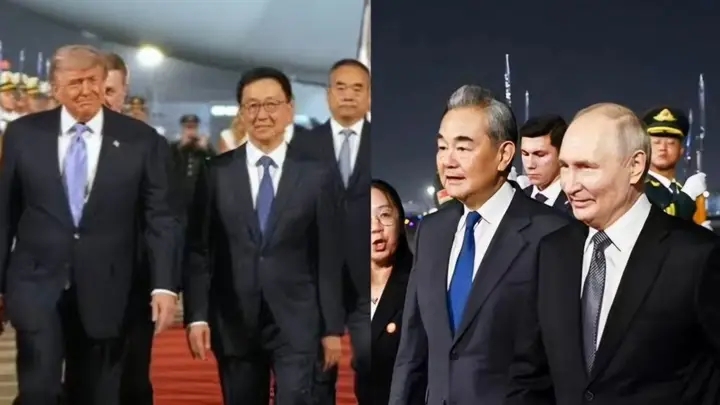
Why China Welcomed Trump and Putin Differently — And What Message Beijing Was Sending to the World
The difference in how Donald Trump and Vladimir Putin were welcomed upon arriving in China was not accidental
Analysts say it reflects Beijing’s highly calculated style of “protocol diplomacy” — where every official greeting, every handshake, and every person sent to the airport carries geopolitical meaning.
For Trump, China reportedly assigned Vice President Han Zheng to handle the airport reception — a move seen as giving formal state-level respect to the leader of the world’s largest economic and military power.
For Putin, however, Beijing reportedly sent senior diplomat Wang Yi — one of President Xi Jinping’s closest strategic allies and a key architect of China’s foreign policy.
While Wang Yi’s formal government rank may appear lower than a vice president, his real influence inside the Chinese Communist Party is considered far more significant in strategic matters.
Observers say the contrast revealed two very different relationships:
— The United States remains a powerful rival and negotiating partner that China must carefully manage through formal diplomacy and economic calculation.
— Russia, meanwhile, is increasingly treated by Beijing as a long-term strategic partner bound by shared geopolitical interests against Western pressure.
The symbolism became even more striking as Putin later received a grand military ceremony in Beijing, including a 21-gun salute, honor guard inspection, and high-profile talks inside the Great Hall of the People.
Chinese and Russian officials continue describing their relationship as a “no-limits partnership,” with both sides deepening cooperation in energy, trade, military coordination, and global diplomacy.
The carefully staged receptions are now being viewed as another signal that Beijing is balancing two different worlds at once — maintaining communication with Washington while visibly strengthening its strategic alignment with Moscow.