

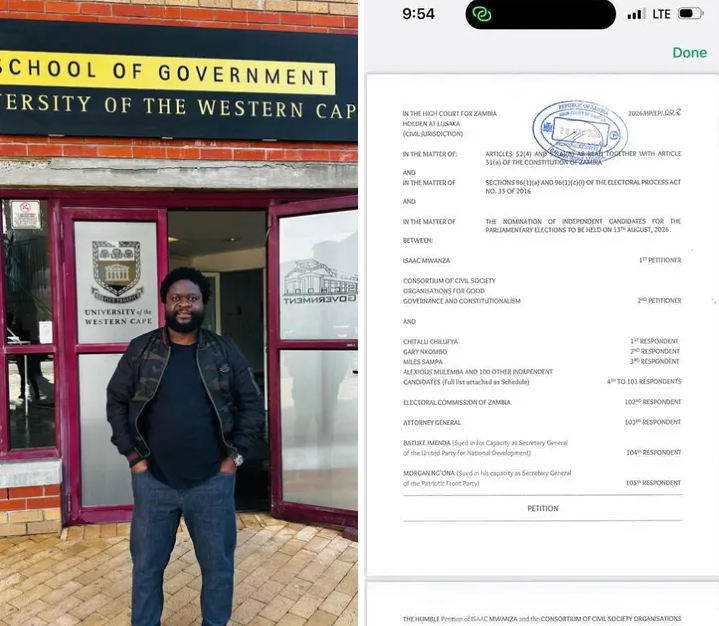
A CONSTITUTIONAL REBUTTAL TO THE PETITION AGAINST INDEPENDENT CANDIDATES: DEMOCRACY UNDER ATTACK IN THE GUISE OF CONSTITUTIONALISM.
A petition has been filed before the High Court of Zambia, Case No. 2026/HP/EP/002 by Isaac Mwanza and the Consortium of Civil Society Organisations for Good Governance and Constitutionalism, seeking to disqualify 101 independent parliamentary candidates from the ballot for the 13th August 2026 general elections. The petitioners claim that these candidates, having been members of the UPND and the Patriotic Front at the time of filing their nominations, contravened Article 51(a) of the Constitution of Zambia, which requires that an independent candidate not be a member of a political party. The petition asks the Court to declare their nominations null and void, set them aside, and direct the Electoral Commission of Zambia to remove them from the ballot entirely.
This rebuttal argues, on constitutional, procedural, and democratic grounds, that the petition is legally defective, factually contestable, and at its core an instrument of political warfare dressed in the language of constitutionalism.
1. THE CONSTITUTIONAL FRAMEWORK GOVERNING INDEPENDENT CANDIDATES.
Article 51 of the Constitution of Zambia (Amendment) Act No. 2 of 2016 provides that a person is eligible for election as an independent candidate for a National Assembly seat if the person is not a member of a political party and has not been a member of a political party for at least two months immediately before the date of the election.
This is the provision at the heart of the petition. The petitioners contend that the respondents, being active members of political parties at the time of filing their nominations in May 2026, violated this provision and are therefore constitutionally ineligible.
But here is where the petition’s central legal argument begins to unravel. And it unravels because of four words the petitioners appear to have read past: immediately before the date of the election.
2. THE DATE THAT MATTERS.
The Constitution is precise in its language. The two-month non-membership requirement in Article 51(a) runs from the date of the election, not the date of nomination. These are not interchangeable dates. They are separated by approximately three months in the 2026 election cycle. Nominations opened on 20th May 2026. The general election is scheduled for 13th August 2026. The gap between those two dates is nearly three months. The constitutional clock does not start on nomination day. It ends on election day.
What Article 51(a) actually requires, read plainly and faithfully, is that at the time of the election on 13th August 2026, the independent candidate must not be and must not have been a member of a political party for at least the two months immediately preceding that date. That means the constitutionally relevant deadline for non-membership is 13th June 2026. Any person who had ceased to be a member of their political party on or before 13th June 2026 fully satisfies the constitutional requirement.
Nominations closed on 25th May 2026. The election is on 13th August 2026. There are approximately eighty days between those two dates. Every independent candidate who resigned from their party at or before the time of filing their nomination, or who does so before 13th June 2026, is constitutionally compliant under a plain reading of Article 51(a). The petition attempts to collapse the distinction between nomination day and election day, measuring the two-month window from the former rather than the latter. This is not what the Constitution says. It is not what it has said since 2016. And a court applying the Constitution faithfully must read it as written, not as the petitioners wish it read.
The petition’s entire legal edifice depends on this misreading. Without it, there is no constitutional violation to speak of.
3. THE AFFIDAVIT REQUIREMENT AND THE ECZ’S CONSTITUTIONAL DUTY.
The petition contends that the Electoral Commission of Zambia acted contrary to the Constitution by accepting the nominations without proof that the respondents had ceased being members of political parties. The Electoral Process Act provides that a person who files a nomination as an independent candidate shall, at the time of filing, submit a sworn affidavit stating that the person is not a member of, or affiliated with, any political party and has met the requirements of Article 51 of the Constitution.
Each of the respondents filed a sworn affidavit to this effect. An affidavit is a solemn declaration made under oath, the breach of which constitutes a criminal offence. The ECZ is not an investigative body. Its role at the nomination stage is to receive nominations accompanied by the required documentation, not to conduct party membership investigations or adjudicate disputed facts about internal party affiliations. The Constitution does not delegate to any institution, including the ECZ, the authority to create, expand, or modify the qualifications for nomination. Any attempt by an institution or public official to introduce additional requirements beyond those expressly stated in the Constitution risks acting ultra vires and contrary to the Constitution.
If the petitioners have evidence that specific respondents were card-carrying, dues-paying, active members of political parties at the precise moment they swore their affidavits, that evidence must be tested at trial. It cannot be assumed from the fact of a person’s prior political affiliation, or from the fact that a party secretary general wrote a letter confirming historical membership. Party membership can be resigned informally, it can lapse, and it can be contested. These are factual disputes that a trial process must resolve for each individual respondent. They are not matters that admit of a blanket disqualification order affecting 101 people without individual assessment.
4. THE DEEPLY SELECTIVE NATURE OF THIS PETITION.
This petition claims to be about constitutionalism. But a genuine constitutionalism argument requires consistency, and this petition is anything but consistent.
The petition names 101 respondents. A review of the schedule reveals that the majority are either UPND members who were not adopted by the party, or former PF members contesting independently. The pattern is striking. This is not a petition that randomly samples from the full universe of independent candidates who may have had prior party affiliations. It is a petition that targets specific political actors whose candidacies are inconvenient to the ruling party’s electoral strategy, and others whose candidacies would weaken the opposition in constituencies it needs to contest.
Consider the respondents named specifically. The first respondent, Chitalu Chilufya, is a former PF Member of Parliament. The second, Gary Nkombo, was a UPND minister. The third, Miles Sampa, is one of the most prominent figures in the PF. These are not arbitrary choices. These are people whose removal from the ballot would directly benefit the ruling party’s electoral position. If this petition were about constitutional principle, it would apply uniformly to every independent candidate who had any party affiliation within the relevant period. It does not. Its selectivity is its condemnation.
A petition filed in the name of good governance and constitutionalism that happens to target exclusively the political enemies of the ruling party, while leaving untouched any independent candidate whose presence on the ballot is neutral or beneficial to that same ruling party, is not a constitutionalism petition. It is an electoral strategy dressed in legal clothing.
5. THE DEMOCRATIC CONSEQUENCES OF GRANTING THIS PETITION.
Even setting aside the legal arguments, the court must consider what it would mean for Zambian democracy to grant the relief sought.
Zambia’s electoral landscape has evolved in ways that make independent candidacy an increasingly vital safety valve for political participation. Many of the respondents are people who sought adoption by their parties, participated in internal processes, and were denied adoption through processes they considered unfair or compromised. The constitutional right to contest as an independent candidate was designed precisely for this situation, to ensure that political participation is not exclusively controlled by party gatekeepers, and that citizens retain a direct democratic route to Parliament that does not require the blessing of a party hierarchy.
The Constitution is the supreme law of the land. Any interpretation that restricts candidacy must be explicitly stated, reasonably justifiable in a democratic society, and consistent with the Bill of Rights, particularly Article 21 on freedom of association and Article 23 on protection from discrimination.
Granting this petition would mean that 101 candidates and the thousands of voters in their constituencies who were prepared to vote for them are stripped of their democratic participation rights on the basis of an interpretation of the Constitution that is textually unsupported, applied selectively, and advanced by petitioners whose connections to the ruling party’s political interests are not incidental. That is not constitutionalism. That is the weaponisation of legal process for electoral advantage.
6. CONCLUSION.
The petition of Isaac Mwanza and the Consortium of Civil Society Organisations, whatever its stated purpose, does not stand up to constitutional scrutiny. Article 51(a) of the Constitution measures the two-month non-membership requirement from the date of the election, which is 13th August 2026. The constitutionally relevant deadline for non-membership is therefore 13th June 2026. Candidates who filed nominations in May 2026 and who have since or simultaneously ceased their party membership have not violated any constitutional requirement. The election has not yet taken place. The two-month window has not yet expired.
The ECZ acted within its mandate in accepting nominations accompanied by sworn affidavits. The petition’s interpretation of the Constitution is textually wrong. Its application is politically selective. And the relief it seeks would cause irreversible harm to the democratic process and to the rights of hundreds of thousands of Zambian voters.
This petition is not a defence of the Constitution. It is an attack on democracy wearing the Constitution as a costume. The High Court should see it for what it is and dismiss it accordingly.
Mr. Thompson Luzendi
Activist
Well articulated and legally very sound. Isaac Mwanza’s petition is misconceived at law.
very logical, petitioner is a known scrounger