

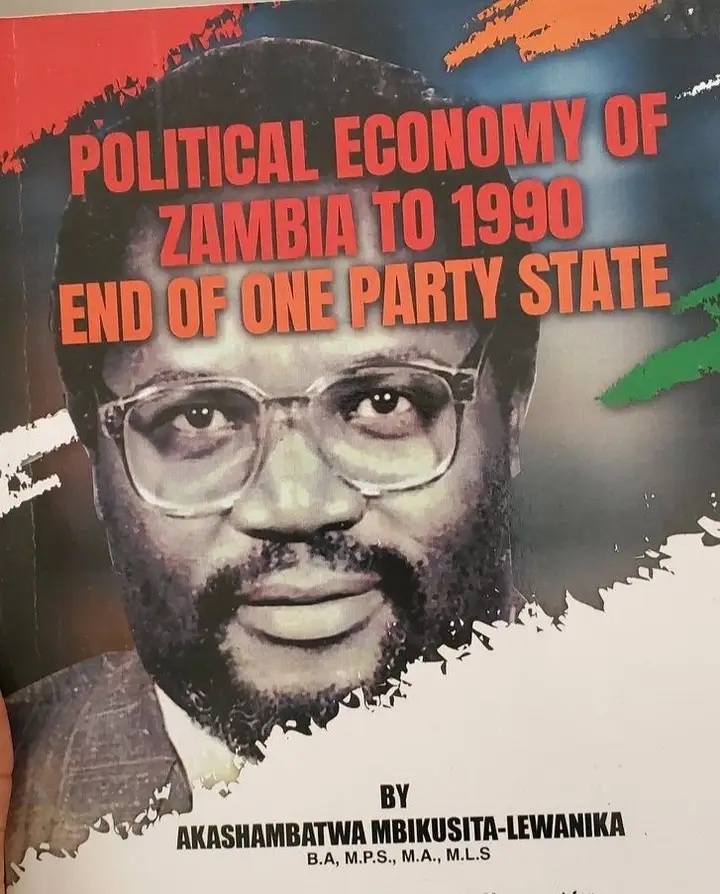
AKASHAMBATWA MBIKUSITA LEWANIKA: THE MAN WHO DEFEATED KENNETH KAUNDA.
Mbunga Pan Africanist
The year is 1990. Lusaka is a fortress of silence. For twenty-seven years, Dr. Kenneth Kaunda—the Old Lion—has ruled Zambia with a silk-gloved iron fist, his Chitenge handkerchief waving like a flag of absolute decree. Before him lies a graveyard of rebellions. Many had tried to break his one-party state, and all had been swallowed by the long shadow of State House.
But in the quiet corners of the capital, a different kind of storm is brewing. Prince Akashambatwa Mbikusita-Lewanika walks through this graveyard of failed uprisings, not with a rifle or a megaphone, but with a blueprint.
Where the giants of Zambian history charged the gates and fell, the Prince of Barotseland is about to pick the lock.
The Ghosts of the Failed:
1. ADAMSON MUSHALA’S GHOST: The Warrior’s Mistake
From the dense forests of the North-Western Province, the ghost of Adamson Mushala steps forward, his uniform torn by the bullets of the Zambia Army in 1982.
“I fought him with fire!” Mushala’s ghost roars. “I took to the bush, waged a guerrilla war for seven years to break his tyranny! Why did I fail?”
Akashambatwa looks at the phantom warrior and shakes his head gently. “You brought a gun to a chess match, Adamson. Kaunda thrives on security states. By picking up arms, you gave him the perfect excuse to lock down the nation under a State of Emergency. You fought from the periphery. I will fight him in the heart of the capital, using the one weapon he cannot shoot: the law and the collective will of the people.”
2. SIMON MWANSA KAPWEPWE’S GHOST: The Fractured Brother
From the historical ether steps Simon Mwansa Kapwepwe, Kaunda’s childhood friend and former Vice President, who broke away in 1971 to form the United Progressive Party (UPP), only to be swiftly detained and politically isolated.
“I challenged him from within the house,” Kapwepwe sighs. “I built a political party to face him. Yet, he banned it with a stroke of a pen and locked me away.”
“You challenged him as a rival brother, Simon,” Akashambatwa responds. “He was able to brand your movement as regional, trapping it in Northern Province tribal politics. To defeat the Old Lion, we cannot build a tribal faction. We must build a ‘Broad Church’—a coalition so vast, spanning every province and every tribe, that if he tries to ban it, he bans Zambia itself.”
3. LIEUTENANT MWAMBA LUCHEMBE: The Premature Spark
Suddenly, the radio static of June 1990 echoes through the room. Lieutenant Mwamba Luchembe bursts in, breathless, just as he was when he commandeered the national broadcaster for a few chaotic hours to announce a coup.
“I held the microphone!” Luchembe cries. “The people danced in the streets! I had the army’s rage behind me! Why am I in a prison cell?”
Aka smiles a sophisticated, technocratic smile. “A coup is a flash of lightning, Lieutenant. It frightens the palace, but it leaves the structure intact. You gave the people hope for three hours, but you had no civilian infrastructure to hold the ground. When the smoke cleared, Kaunda’s state machinery simply reset. We don’t need a coup d’état; we need a structural revolution.”
4. THE TRADE UNIONS AND CHURCH: The Divided Pillars
From the shadows emerge the leaders of the Zambia Congress of Trade Unions (ZCTU) and the Church Mother Bodies. They are powerful, but hesitant.
“We have protested the food riots,” the unionists mutter. “We have preached against oppression from the pulpits,” the clergy whisper. “But we are separate. We are vulnerable to his threats.”
Akashambatwa steps between them, taking them by the hands. “You are the muscles of this nation, but you lack a unified brain. Separately, Kaunda can negotiate with the unions or placate the bishops. Together, under a singular political banner, you are an unstoppable tidal wave.”
5. THE CLIMAX: The Wizard of Garden House
It is July 20, 1990. The setting is not a hidden military bunker or a rebel forest camp, but the Garden House Hotel in Lusaka. Akashambatwa stands at the podium. He has gathered them all: the frustrated unionists, the cautious clergy, the wealthy businessmen, and the radical academics.
Kaunda’s intelligence agents sit in the back, pens poised, waiting for a slip of treasonous language so they can make arrests. But Akashambatwa is too clever for them.
Instead of chanting war slogans, Aka unleashes the devastating language of economics and constitutional law. He presents a meticulously drafted manifesto. He reframes the fight not as a bloody coup, but as a “Second Liberation Task.” He articulates the hunger of the people, the bankruptcy of the state, and the absolute necessity of a multi-party system.
He bridges the gap between the radical left and the capitalist right. In that hot, crowded room, Aka welds the trade unions, the church, the intellectuals, and the traditionalists into a single, terrifying entity: The Movement for Multiparty Democracy (MMD).
CHECKMATE
When the MMD emerges from the Garden House Hotel, Kaunda realizes the game has completely changed. He cannot call Akashambatwa a terrorist, because the Prince is armed only with a pen. He cannot call him a tribalist, because the MMD represents every corner of Zambia. He cannot crush them under military law without sparking a total civil uprising.
Forced into a corner by the brilliant organizational structure Aka designed, the Old Lion is compelled to do the one thing he swore he would never do: repeal Article 4 of the Constitution and allow free elections.
On October 31, 1991, as the election results flood in showing a total landslide victory for the MMD, Kenneth Kaunda packs his bags and steps down.
The warrior failed, the soldier failed, the isolated politicians failed. But the Prince, with the quiet precision of a grandmaster, rewrote the rules of the game and watched the 27-year regime collapse under its own weight.
Boza Mambala! Aka has been a complete failure throughout his political career. He couldn’t add any value to any parastatal entities he was assigned to lead: show me one! He’s always spoken confidently but achieved poor results. He even failed as a chief.