

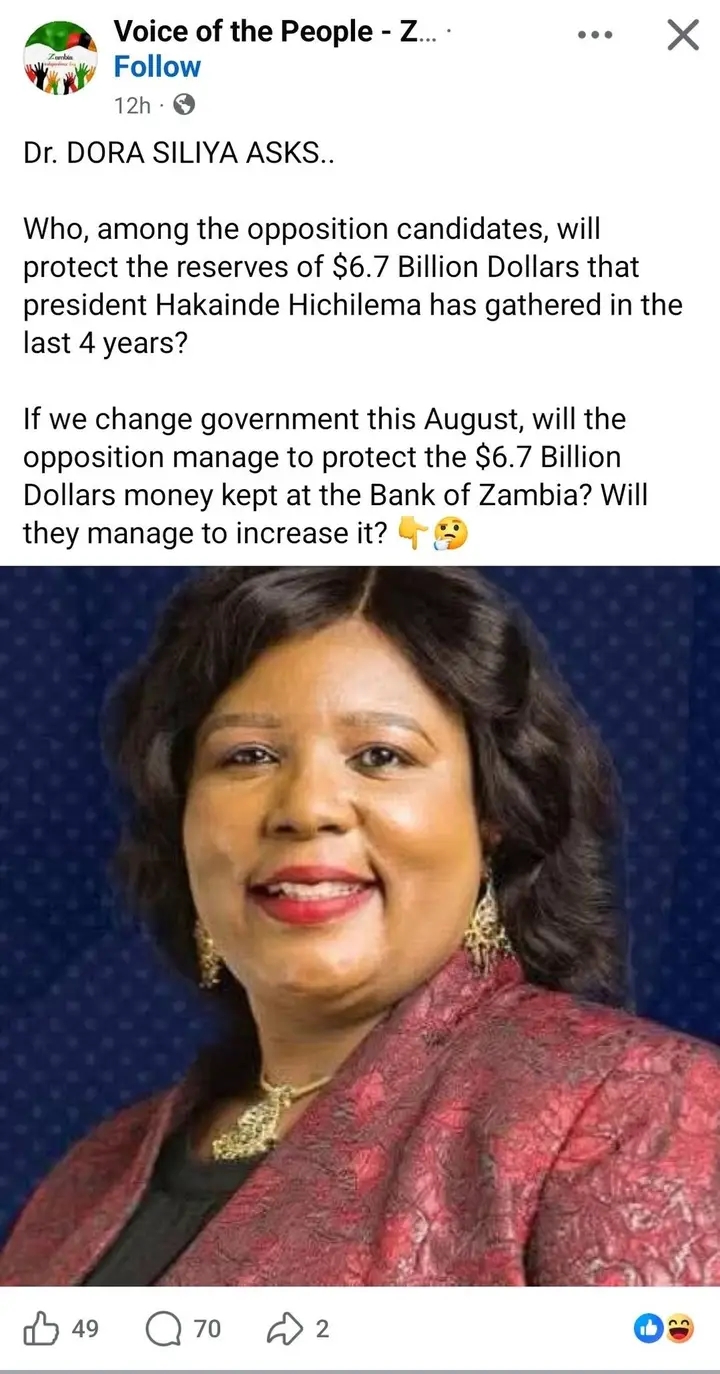
DR. DORA SILIYA AND THE FALLACY OF THE VAULT: WHY FOREIGN RESERVES ARE NOT THE TRUE MEASURE OF ECONOMIC STEWARDSHIP
Dr. Dora Siliya recently posed what appears to be a powerful political challenge to Zambia’s opposition:
“Who among the opposition candidates will protect the US$6.7 billion in foreign reserves that President Hakainde Hichilema has accumulated over the last four years? If government changes in August, will the opposition protect that money? Will they increase it?”
At first glance, these questions appear reasonable. However, they are based on a flawed assumption: that the size of Zambia’s foreign exchange reserves is the ultimate measure of prudent economic management. It is not.
The narrative surrounding Zambia’s macroeconomic performance has increasingly leaned on a singular, glittering metric: the accumulation of record-high foreign exchange reserves. On the surface, this figure is presented as an unassailable shield of fiscal prudence and evidence of effective national resource management. However, using gross external reserves to validate overall economic stewardship is a profound economic misdirection.
Elections are fundamentally about choosing custodians of national assets. Yet a custodian who diligently guards the front gates while the storehouse is being emptied from the back cannot credibly claim efficiency. The true measure of economic stewardship lies not merely in the central bank’s vaults, but in the strength of the domestic treasury and the state’s ability to prevent internal financial leakages.
The real question before voters is therefore not whether an opposition government can protect the reserves. The real question is whether the current government has protected the nation’s overall wealth.
If foreign reserves are the benchmark of success, how do we explain the Financial Intelligence Centre’s reports of suspected illicit financial flows and financial leakages amounting to approximately US$5 billion between 2023 and 2024? How do we reconcile record reserves with allegations of US$3.5 billion in suspected tax evasion, trade mis-invoicing, and mineral-sector leakages reported for 2024 alone?
The contradiction is obvious. While wealth was accumulating in the central bank’s vault, a comparable volume of national wealth was potentially escaping through the back door of the economy.
Dr. Siliya’s argument also overlooks another uncomfortable reality. Despite claims of prudent resource management, Zambia’s domestic debt reportedly increased from K62.4 billion in 2024 to K73.1 billion in 2025. If public resources were being managed so effectively, why is the state increasingly relying on domestic borrowing? Why is the treasury under pressure if the country’s finances are supposedly stronger than ever?
More fundamentally, foreign reserves and fiscal governance are not the same thing. Foreign reserves are an external liquidity buffer. They help stabilize the currency, finance imports, and reassure international markets. They are important, but they do not tell us whether tax revenues are being collected efficiently, whether corruption is being contained, whether illicit financial flows are being stopped, or whether public resources are reaching citizens through better services and infrastructure.
A country can have strong reserves while simultaneously suffering from weak fiscal governance. Likewise, a government can increase reserves through favourable copper prices, debt restructuring arrangements, exchange-rate management, and monetary tightening without necessarily improving the efficiency of public resource management.
This is why Dr. Siliya’s challenge is framed around the wrong question.
The issue is not whether the opposition can protect US$6.7 billion sitting at the Bank of Zambia. Any responsible government would be expected to preserve and strengthen foreign reserves. The issue is whether the next government can protect the far larger pool of national wealth that never reaches the treasury in the first place.
Can it stop illicit financial flows?
Can it reduce tax leakages?
Can it close loopholes in mineral revenue collection?
Can it reduce domestic debt?
Can it ensure that more of Zambia’s wealth remains in Zambia for the benefit of Zambians?
These are the questions that determine genuine economic stewardship.
Ultimately, voters should be careful not to confuse a healthy vault with a healthy economy. Foreign reserves are an important indicator of external resilience, but they are not proof of sound governance. A government cannot claim comprehensive success simply because reserves are rising while billions of dollars are simultaneously being lost through leakages, tax avoidance, and weak domestic revenue retention.
The real test of leadership is not whether money is accumulating in the Bank of Zambia’s vault. The real test is whether the nation’s wealth is being protected, retained, and deployed for the benefit of its citizens. Until that question is answered, foreign reserves alone cannot serve as conclusive evidence of prudent economic management.
The Struggle Continues
Sensio Banda
Former Member of Parliament
Kasenengwa Constituency
Eastern Province
It is little wonder the author is a “former” member of Parliament. Mungulu bweka bweka.
A healthy amount of reserves indicate fiscal discipline and readiness to handle any unexpected challenges that may be thrown at the economy. How is this a bad thing ? Give credit where it is due. Or STFU.