

PRINCIPLES OR POLITICS? THE MAKEBI ZULU CONSISTENCY PROBLEM
By George Mtonga
One of the most important qualities in leadership is not intelligence.
It is not eloquence.
It is not legal expertise.
It is consistency.
Citizens can forgive mistakes. They can forgive bad judgment. They can even forgive policy failures. What they struggle to forgive is a leader who appears to change principles depending on whether he is in government or opposition.
That is the challenge facing Makebi Zulu today.
The question confronting Zambians is not whether Makebi Zulu is a competent lawyer. By all accounts, he is.
The question is whether his positions are driven by constitutional principle or political convenience.
The public record raises legitimate concerns.
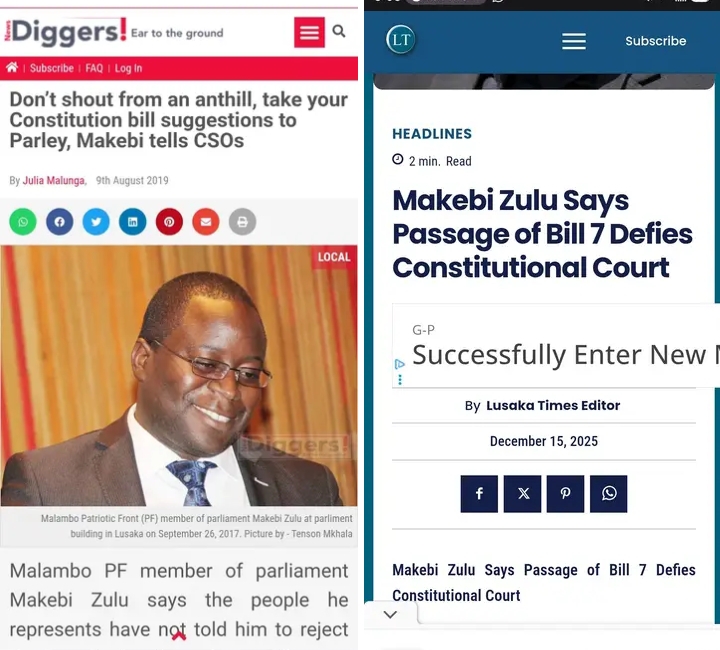
In 2019, during the heated debate surrounding Bill 10, Makebi Zulu publicly defended the constitutional amendment process. At the time, churches, civil society organizations, constitutional experts, and opposition leaders were raising alarm bells about proposed changes to the Constitution.
Rather than joining those concerns, Makebi Zulu challenged critics and effectively argued that those opposing the constitutional amendments should take their concerns through Parliament.
His position was clear.
Parliament had the authority to debate and consider constitutional amendments.
The process should be allowed to proceed.
Fast forward a few years.
Today, Makebi Zulu emerged as one of the loudest critics of constitutional amendment efforts advanced by the UPND government. He argued that constitutional changes being pursued by government are contrary to constitutional principles and judicial guidance.
This naturally raises a question.
What changed?
Did the constitutional principle change?
Or did the political players change?
Because from the perspective of an ordinary citizen, the contradiction is difficult to ignore
When PF was proposing constitutional amendments, Makebi Zulu defended the process.
When UPND proposes constitutional amendments, Makebi Zulu opposes the process.
That is not necessarily proof that he is wrong today.
But it does create a credibility problem.
Leadership requires that principles remain constant regardless of who occupies State House.
A person who believes constitutional amendments should not be rushed should hold that position whether PF is in power or UPND is in power.
A person who believes Parliament has authority to amend the Constitution should hold that position whether the Speaker is serving under PF or UPND.
A person who believes public participation is essential should advocate for it consistently.
The Constitution should not become good when your party is proposing amendments and bad when another party is proposing them.
Unfortunately, this pattern is not unique to Makebi Zulu. It is one of the biggest weaknesses in Zambian politics.
Many politicians discover constitutional principles only after they lose power.
Many politicians discover the importance of democracy only after they move into opposition.
Many politicians suddenly become defenders of institutions that they ignored when they held office.
The public is becoming increasingly aware of this double standard.
And that is why consistency matters.
The challenge for Makebi Zulu is that he is asking Zambians to trust him as a national leader while carrying a record that appears to show different standards being applied to similar constitutional questions.
Voters are entitled to ask difficult questions.
If Bill 10 was acceptable, why is Bill 7 unacceptable?
If constitutional amendments should be debated through Parliament under PF, why should they not be debated through Parliament under UPND?
If constitutional reform was legitimate then, what makes it illegitimate now?
These questions deserve answers.
Not because they will determine who wins an argument.
But because they reveal whether a leader is guided by principles or by politics.
The greatest leaders in history were not admired because they were always right.
They were admired because their principles were predictable.
People knew where they stood.
People knew what they believed.
People knew those beliefs would not change simply because political circumstances changed.
That is the standard Zambians should demand from every aspiring national leader.
Including Makebi Zulu.
Because if a politician’s position changes every time their political interests change, then citizens are left wondering whether there was ever a principle there to begin with.
And that is a question every voter should ask before placing trust in any leader seeking higher office.