

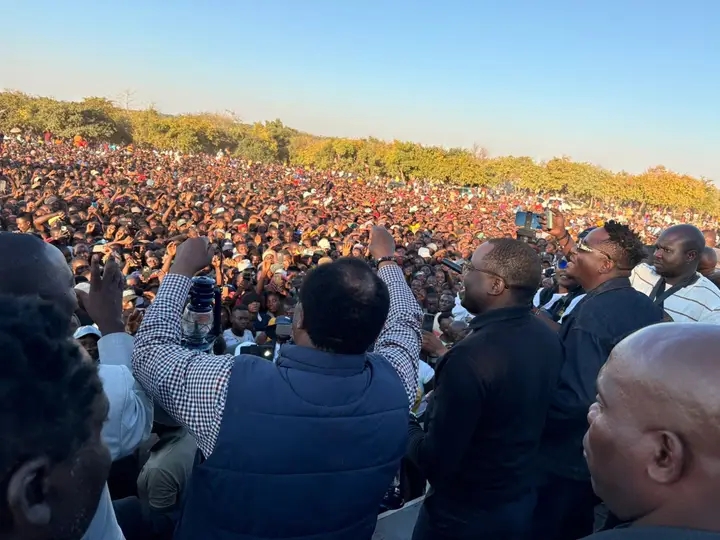
RURAL REALITIES VS URBAN NOISE: WHY HH STILL HOLDS THE ELECTORAL CHESSBOARD
By Macmillan Phiri
As Zambia edges closer to the 2026 General Election, political rhetoric is intensifying across both traditional media and social platforms. Opposition figures have increasingly attempted to project confidence, particularly within urban strongholds, but electoral realities on the ground may tell a very different story.
Political analysts note that approximately 60 percent of Zambia’s registered voters, and nearly 80 percent of the country’s 226 parliamentary constituencies, are located in rural areas. In these communities, political conversations are often shaped less by elite narratives and more by practical day-to-day realities.
For many rural voters, the key issues are straightforward: whether children are going to school, whether households can access food, whether elderly citizens are receiving social cash transfers, and whether employment opportunities have reached ordinary families.
The introduction of free education under President Hakainde Hichilema’s administration has significantly altered household economics for many rural families. Social Cash Transfer programmes have expanded, recruitment of teachers and health workers has accelerated, and the Constituency Development Fund (CDF) has injected visible infrastructure and empowerment projects into districts that historically felt neglected.
In such communities, opposition messaging centred around personalities and political grievances may struggle to gain traction. “In many rural areas, even in some former Patriotic Front strongholds, many people do not even know who Brian Mundubile is,” one political observer remarked. “If you tell villagers to vote for a candidate because he promises to repatriate former President Edgar Lungu’s body, many would genuinely wonder whether you are joking or serious because that issue has little relevance to their daily struggles.”
Observers argue that while urban voters often debate macroeconomic indicators such as inflation, debt restructuring, exchange rates and investor confidence, rural communities tend to evaluate leadership through tangible improvements in their lives. This divergence has created what analysts describe as two parallel political conversations in Zambia.
Urban dissatisfaction, driven partly by economic hardship and political frustrations, has generated loud opposition voices online and within major cities. However, political strategists warn that social media enthusiasm does not always translate into nationwide electoral success. “The danger for opposition parties is mistaking online excitement for national momentum,” another analyst explained. “The loudest voices are not always the largest voting bloc.”
Critics of the opposition alliance have also questioned the seriousness and coherence of its campaign strategy. While President Hichilema has focused on governance, economic reforms and institutional rebuilding, some opposition figures have been accused of relying excessively on populism, symbolism and emotional mobilisation. One ruling party supporter described the contrast by saying: “While the opposition is busy playing ‘ndemama,’ HH is playing chess.”
The statement reflects growing confidence within ruling party circles that the United Party for National Development (UPND) still retains a strong structural advantage heading into 2026
Opposition supporters continue to cite frustrations over the economy, unemployment and the rising cost of living as evidence that the political tide is shifting. However, ruling party loyalists counter that many of the administration’s reforms require time to fully mature and that the benefits are already visible in rural communities. Programmes such as student allowances, youth empowerment initiatives, local infrastructure projects, and equipment acquisitions under CDF are increasingly becoming campaign talking points for the governing party.
Meanwhile, some within the opposition continue to publicly project inevitable victory, much like the optimism witnessed before the 2021 elections. But seasoned observers warn against premature celebrations. “Zambian elections are won constituency by constituency, ward by ward, not on Facebook timelines or political rallies alone,” one analyst noted.
As the political temperature rises, one reality remains clear: Zambia’s rural electorate may once again prove decisive in determining who ultimately occupies State House after 2026
Correct and to the point.
But the same was said in 2021. It was the 2K people who made a lot of noise against ECL. Since then, 1.7 million Gen Z have been added and they have no jobs and making a lot of noise. The question is, do they believe that Mundubile will be their saviour the way the 2K believed that HH was theirs? If this breeding rate continues, Zambians will be changing governments every 5 years because there is no government that can create jobs for more than a million people in 5 years.
Balongo, politics aside, let’s look at reality. The UPND government has recorded noticeable achievements. Here are a few:
1. Peace & Order
Marketeers and traders in Lusaka + other areas now do business freely without fear of harassment by cadres.
2. Economy & Debt
Govt cleared debt that was defaulted, which had made our reserves useless. That step has brought hope back.
3. Load Shedding & Energy
Solar power has been introduced to the grid in almost all provinces – something we hadn’t seen on this scale before.
4. Pensioners & NAPSA
All payments due to pensioners have been cleared. Plus, the 20% withdrawal on NAPSA dues was introduced.
5. CDF, Schools & Hospitals
Through CDF, grants + loans went to clubs and cooperatives regardless of political affiliation. Mini hospitals and schools have been constructed. Youths also benefited through skills development programs.
6. Free Education + School Feeding
Many children went back to school after free education was introduced. On top of that, the school feeding program is a big plus ❤️
7. Recruitment & Allowances
Large-scale recruitment of teachers, nurses, ZNS, ZAF, Police, and Army. Meal allowances that were removed by the previous government have also been reintroduced.
Just a few out of many achievements by HH and the UPND government.
As Zambians we’re still paying for mistakes of the past. Let’s reflect and vote wisely for continuity, so what’s left for future generations isn’t finished.
In bemba we say Akabwelela kalalya
I will vote for President HH byashala kemwena.
KIMYE KYAFIKA ✍️
#UPND #HH #Continuity #ZambiaForward #CDF #FreeEducation