

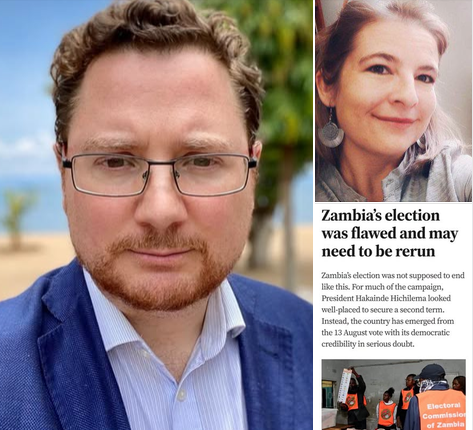
By Nic Cheeseman(Professor of Democracy at the University of Birmingham, founder of www.democracyinafrica.org and author of ‘How to Rig an Election’.)
and Nicole Beardsworth(Political science lecturer at University of the Witwatersrand)
Zambia’s election was not supposed to end like this. For much of the campaign, President Hakainde Hichilema looked well-placed to secure a second term. Instead, the country has emerged from the 13 August vote with its democratic credibility in serious doubt.
The most troubling evidence that Zambia’s general election may have been flawed is not an allegation made by the opposition. Rather, it is contained in the election results themselves.
There is much more to say about the broader environment in which the election took place, including the restrictions on opposition party registration and campaigning, the arrest and disappearance of opposition figures, concerns over freedom of expression and the use of new cyber laws. But it is precisely because the results themselves raise such serious questions that we focus on them here.
In a number of constituencies, considerably more votes appear to have been cast in the presidential election than in the parliamentary contest taking place at exactly the same time. In the most extreme cases, the difference is extraordinary.
This matters because such discrepancies are a well-established warning sign of electoral manipulation. Our preliminary analysis suggests that hundreds of thousands of votes for President Hakainde Hichilima may need to be explained.
If that conclusion is sustained when the complete results become available, Zambia will face a difficult reality: an election that was expected to consolidate the country’s democratic credentials may face calls for a rerun.
An election that became harder to predict
Hichilema entered the election in a strong position. He could point to significant achievements during his first term, most notably restructuring the enormous debt burden he inherited after Zambia became Africa’s first pandemic-era sovereign defaulter. The economy had stabilised, even if many Zambians continued to struggle with the cost of living.
He also benefited from a fragmented opposition following the death of former president Edgar Lungu and the implosion of the Patriotic Front (PF), which governed Zambia until 2021.
That changed with the emergence of Brian Mundubile as the main opposition candidate. A former PF figure, Mundubile was adopted as the presidential candidate of the National Reconciliation Party for Unity and Prosperity (NRPUP) before joining forces with Makebi Zulu and the Pamodzi Alliance to head the broader Tonse-Pamodzi Alliance. This brought together important fragments of the former PF and other opposition forces that had previously been divided.
What had initially looked like a relatively straightforward contest became harder to predict.
Concerns over the count
Despite the growing momentum behind the opposition, election day itself was largely uncontroversial. Southern African Development Community (SADC) observers found the atmosphere calm and peaceful at 99% of the polling stations they visited, while the European Union found voting generally peaceful and orderly.
As so often happens, the situation began to fall apart during the counting process. On 14 August, the Electoral Commission of Zambia (ECZ) suspended the counting and announcement of results nationwide with immediate effect. The Commission cited violence against election officials and security concerns, and the suspension was initially expected to last for up to 24 hours. It was subsequently lifted later the same day after an outcry by the opposition and civil society, but by then confidence in the electoral process had already been shaken.
Although the security concerns were real, a nationwide suspension inevitably generated suspicion because problems were concentrated in particular locations. African Union-Common Market for Eastern and Southern Africa observers concluded that the episode contributed to “increased mistrust” and political tension.
At first, the results that followed offered some reassurance. Transparency International Zambia’s Integrity Index initially found a very close correspondence between presidential results announced by the ECZ and those independently recorded by monitors. That made claims that results had been changed between being read out initially at the polling station and officially by the electoral commission difficult to sustain.
But as more results became available, a different problem emerged.
The numbers that don’t add up
Zambia was holding several elections simultaneously on 13 August. Voters were choosing a president, members of the National Assembly and local councillors during the same visit to the polling station. As parliamentary results became available, it therefore became possible to compare the number of votes cast in the presidential and legislative elections in each constituency.
We compiled the presidential list of results and the first thing that stood out was a high number – at least 27 constituencies – where the ruling United Party for National Development (UNPD) received a supermajority of the vote in the presidential election, with a voter turnout of over 80%. This stands in stark contrast to the national registered-voter-weighted turnout of 57%.
The constituencies with over 80% turnout at presidential level were concentrated in the UPND’s strongholds – North-Western Province (9), Western Province (8), Southern Province (6) – with three constituencies in rural Copperbelt and one in Central Province. Notably, there were none in the opposition’s strongholds or the provinces that they won – Eastern Province, Luapula, Muchinga or Northern Province.
Having seen these extremely high rates of turnout in the presidential election, we used publicly available data to calculate the turnout at parliamentary level which led to a stark picture. In the 16 constituencies we looked at, the variance was almost universally high – with a difference of over 46% in turnout between the presidential and parliamentary races in Solwezi North.
A small difference between these tallies is perfectly understandable as a voter may choose a president but decide that none of the parliamentary candidates deserves their support. But because voters are typically handed all ballot papers, and complete and deposit them before leaving the polling station, large discrepancies between the votes cast in different races require explanation. The difference in the numbers of votes cast in just these 16 seats is over 170 000 votes – or 15% of the total difference between the two leading presidential candidates.
In studying African elections over the past two decades – including for [Nic Cheeseman and Brian Klaas’s book] How to Rig an Election – we have generally treated a gap of more than five percentage points between simultaneous presidential and parliamentary turnout as a warning sign that deserves investigation. Once that difference exceeds 10%, alternative explanations become progressively harder to sustain.
In Zambia, some of the gaps appear to be far larger than that. In several constituencies, they exceed 10%. In the most extreme cases, the difference appears to be over 40%.
What the numbers mean
The constituency-level evidence is important because the discrepancies are not simply concentrated in parliamentary races that nobody seriously contested. Some appear where there was a meaningful contest for the National Assembly, making it difficult to explain why so many voters would participate in the presidential election but not the parliamentary one.
Taken together, these cases are consistent with what we called in the book “amateur hour” election rigging: the kind of hurried manipulation that occurs when ruling-party figures panic, as in Kenya in 2007. Unlike more carefully planned rigging, it is poorly coordinated and highly visible, leaving obvious inconsistencies in the results that can be especially damaging to an election’s credibility.
… and why it matters
The turnout figures alone cannot tell us who was responsible, when manipulation occurred, or exactly how it was carried out. Reports are emerging of monitors being forced out of polling stations, of opposition candidates alleging that votes were swapped, and that domestic election observers were not even given access to all of the necessary results forms.
Nor do they demonstrate that Mundubile would otherwise have won. According to the final results announced by the ECZ, Hichilema received about 61% of the vote against about 38% for Mundubile – a difference of roughly 1.1 million votes. Our unverified estimate based on publicly circulated figures is that the suspicious difference between presidential and parliamentary turnout may account for somewhere between 350,000 and 550,000 votes.
This suggests that this form of vote inflation did not determine the outcome of the polls, but it is important to note that it is only one way of identifying manipulation. It cannot detect other ways in which results might have been altered. The wider context also matters. The European Union concluded that the contest took place on an “uneven playing field”, with restrictions on most presidential candidates’ ability to campaign, significant incumbency advantages and heavily biased state-owned media.
SADC was more positive overall but nevertheless recommended that campaign rules apply equally to the president and his rivals, that official duties be clearly separated from campaigning, and that the state broadcaster provide equitable coverage.
A rerun is not enough
This means that Zambia may ultimately need to rerun the presidential election. But a fresh vote is not a simple solution. Recent experience in Malawi and Kenya shows that what happens between the first election and the second can be decisive.
Malawi shows what is possible when leadership and institutions change. Before the rerun, Jane Ansah was replaced as head of the Malawi Electoral Commission by High Court judge Chifundo Kachale, helping to restore confidence in the body overseeing the vote. The resulting June 2020 election was widely regarded as credible and led to a transfer of power to opposition candidate Lazarus Chakwera, who had joined forces with former rival Saulos Chilima after they competed separately in 2019.
Kenya shows what can happen when those changes do not occur. Its Supreme Court annulled the August 2017 presidential election, but the electoral commission remained largely unchanged and Raila Odinga withdrew from the rerun, arguing that the reforms needed to guarantee a credible contest had not been made. Uhuru Kenyatta consequently won a deeply polarising election that did little to resolve the crisis
The lesson for Zambia is therefore not simply that flawed elections can be rerun, but that reruns only restore confidence if the conditions that undermined the original election also change. This is particularly important because SADC observers have already recommended reforming the appointment of ECZ commissioners so that the process commands confidence across the political spectrum.
None of this proves that Hichilema would have lost a clean election. But if these discrepancies are confirmed, Zambia may need a fresh vote – and reforms to ensure that it does not reproduce the problems of the first.
SOURCE: The Africa Report
Also suggest a rerun of the votes in UK, you don’t even live here. The catholic church wants pangas to return to markets and bus stations.
Long ass article! There a few statements in here that are base on hearsay, not observation. ECZ did not stop the count and restart the count because of the opposition, but because the entire country including the current government protested. They did not stop long enough to rig or inflate any votes either. By his own accounts, the ‘rigging’ and vote inflation (based mostly on opposition claims rather than direct observation) HH would have won anyway (maybe not enough to prevent a run off). I think the most credible information is if the objective/non partisan election monitors, from outside Zambia, say that there were abnormalities or intimidation in the actual voting on election day, of which there was none. Second, if he can prove that UPND actively prevented voter registration in opposition strongholds, but I don’t think he can as he sits wherever and runs quant models.
Just because he has some letters by his name, does not mean he is well-informed. He is just a mercenary.
This is another A>SShole who thinks an African country can never hold a democratic election.
He is trying to bring confusion to Zambia.
This article is flawed. The independents, winning over 20 seats may mean their voters supporting the president.
The ministers who lost may mean they were not liked but preferred voting for the president.
The president winning even where his MP has lost is consistent with last elections.
For example, I voted for the president but for MP and councillor, I voted for different people based on their individual characters.
The article was based on speculation and logic than facts. It is dangerous and feeds into stereotype.
Nic Cheeseman displays bias in his lengthy article, as this colonialist professor seems to believe he is quite astute. Why is it that these colonialists from Western nations are intent on inciting unrest in Africa? If he possesses integrity, why does he not address Mundubile’s premature claims of victory when the voting was still in progress and the counting had yet to commence, which is indeed unlawful?
In a similar vein, the National Reconciliation Party for Unity and Prosperity has been linked to militias found in possession of offensive and dangerous weapons. One political figure even stated that he would not accept his party’s defeat in the elections, expressing a willingness to fight to the death, a statement made prior to the polling. Is this behavior appropriate?
The elections were conducted in a free and fair manner, and we do not require a foreigner with a colonial mindset to instruct us on theoretical democracy. It is not foreigners who cast their votes, but Zambians.
From what I understand after reading the article, there is a discrepancy between the total number of votes cast for the presidential election and those for say the parliamentary election.
The ideal situation is that the two should tally. In simple terms, if I walk into a booth, I should leave one ballot for the presidential election and one for the parliamentary election. If my parliamentary ballot paper goes missing, then there would be one presidential vote and no parliamentary vote.
That raises a legitimate question. The total number of presidential votes cast must closely tally the total number of parliamentary votes. Or at the very least, the total number of presidential votes cast must equal those for parliamentary votes, when spoiled votes are included, unless some people were walking away with parliamentary ballot papers in their pockets.