

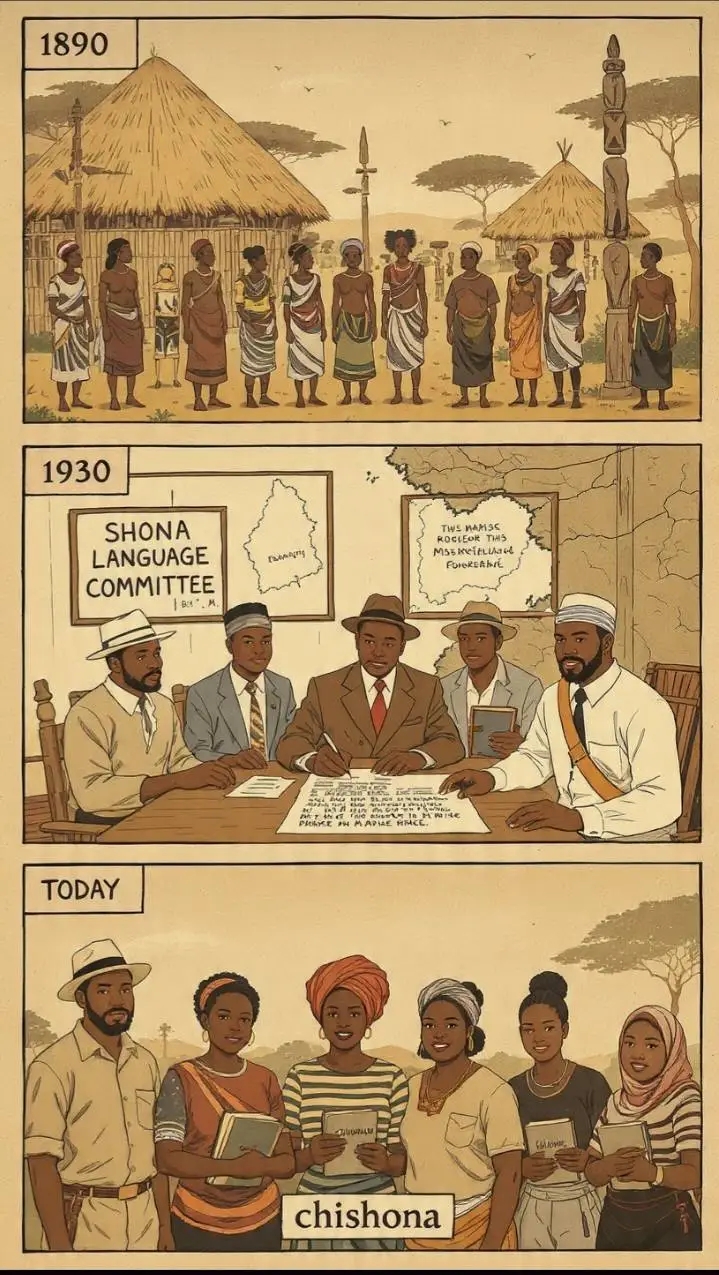
THERE ARE NO “SHONA” PEOPLE IN ZIMBABWE, THE WORD WAS INVENTED IN 1930
Zulus had a hand in creating Mashona
By Fanuel Viriri
There were no “Shona” people in Zimbabwe. There never were — until 1930.
Before that year, the word “Shona” did not exist on anyone’s lips in this country. Not in Mutasa. Not in Seke. Not in Gutu. Not in Zvimba. Ask a man in 1890 who he was and he would tell you his clan. “I am Manyika. I am Harava. I am Hera. I am Duma. I am Ngonya.”
Ask him what language he spoke and he would say Chimanyika, Chizezuru, Chikaranga, Chikorekore. But “Shona”? He would stare at you. That word meant nothing to him.
So how did a people become “Shona”? It started with a mistake, and ended with three men in a room. Mm
When white hunters and the Pioneer Column marched in from the south in 1890, they came with Zulu and Sotho interpreters. From the south and west, those interpreters called the Zimbabwe highlands “Matshonalanga”_ — “the place where the sun sets.” The settlers misheard it. F.C. Selous and the British South Africa Company wrote it down as “Mashonaland” and stamped it on the map. The land had a name, but the people did not.
For the next 40 years the missionaries ran education, and each created its own “tribe.” In the south, the Dutch Reformed Church at Morgenster called the people Makaranga and the language Chikaranga, following Portuguese records. In the east, missionaries decided Mutasa was the biggest chief, so the whole region became Manyika, speaking Chimanyika.
In the centre, Jesuits at Chishawasha and Methodists settled on MazeZuru, speaking Chizezuru. Only Father A.M. Hartmann kept pushing the name “Mashona” there. In the north and west, Korekore and Shangwe areas barely had missions, so the government would later simply invent the names.
By 1929 Zimbabwe had five regions, five mission dialects, and more than 300 clans. And the colonial government had a practical problem. You cannot print five different Bibles and five different sets of schoolbooks. You needed one language. One name.
So the settler government formed a committee to give a name to everyone outside Matabeleland. It put a human face to the task: Reverend Father B.H. Barnes of St. Augustine’s Mission, an Anglican and the chairman; Reverend Father A. Burbridge of Chishawasha Mission, a Jesuit; and Reverend Mrs. A.A. Louw of Morgenster Mission from the Dutch Reformed Church.
In their own report at the end of 1929 they wrote with brutal honesty: “It is true that the name Mashona is not pleasing to the natives, but that may very well be simply because it is a group name imposed from without and ignoring all true tribal distinctions… It is pretty certainly a foreign name and as such is very likely to be uncomplimentary… With a certain reluctance, we recommend the name Shona for the unified language, while we would be quite ready to accept any more worthy alternative.” They admitted it was foreign. They admitted it was probably an insult. But they chose it anyway.
A year later, Professor Clement Doke from the University of the Witwatersrand arrived on a Carnegie Fellowship. His job was to “unify” the five dialects into one orthography.
His first three recommendations to government were clear: that there be one unified literary language for the main Shona area; that the name of the unified language be Shona, and in the vernacular, Chishona; and that the western Kalanga group be excluded.
On the basis of Barnes, Burbridge, Louw and Doke, the government issued a 1930 directive. From then on, all Africans outside Matabeleland would be called Mashona. Their language would be Chishona. All books had to use these names. And just like that, it was done.
It was historian the late Aeneas S. Chigwedere who later pulled all of this together. His argument was simple and shocking.
“The truth of the matter is that not only were there no people in this country who claimed the name Shona but that there were no Shona people at all… So, in 1930, the first Shona people were born in Zimbabwe. The oldest of them are very nearly two generations old today.”
Chigwedere showed that before colonialism, the people were one nation that had fragmented into clans because there were no external threats. By 1890, your identity was your “mutupo” or clan, not “Shona.” He traced how missionaries and the 1929 Committee turned five regional mission areas into five “dialects,” and how a Zulu word for “sunset” became the name of a nation.
He also warned: “That today, we see ourselves as nothing but Shona and that we are clearly of the impression that we have always been Shona demonstrates the power of the pen.”
The result is what we live with now. Karanga, Zezuru, Manyika, Korekore and Shangwe stopped being identities and became “dialects.” Three hundred clans stopped being nations and became “the Shona people.” The oldest “Shona” person today is barely two generations old. That is why your grandfather in the rural areas still does not understand when you call him “Shona.” To him, he is Govera, or Rufura, or Budya.
Three missionaries, one professor, and one directive in 1930. A Zulu word for “sunset” became the name of 10 million people. And in less than 100 years, we forgot we were ever anything else. #history #fblifestyle
Instructive.