

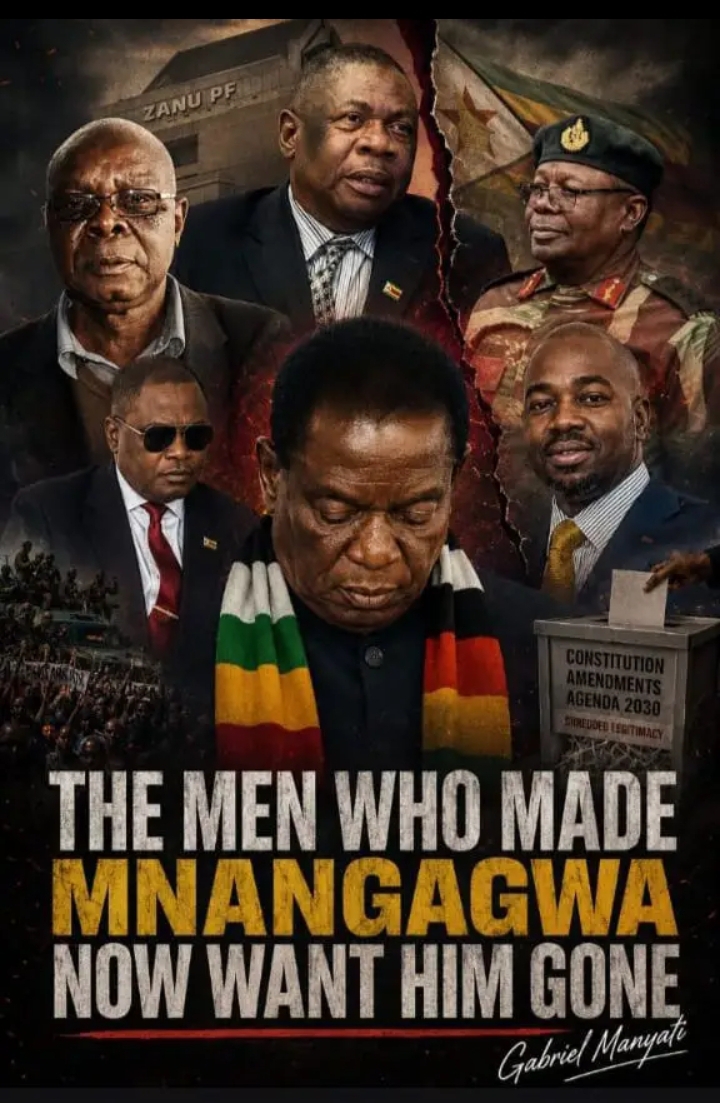
THE MEN WHO MADE MNANGAGWA NOW WANT HIM GONE: INSIDE ZIMBABWE’S NEW POWER STRUGGLE
By Gabriel Manyati
A core team of nine retired military commanders, operating in tandem with Vice President Constantino Chiwenga, has emerged as the principal driver of internal resistance to Zimbabwean President Emmerson Mnangagwa’s extended tenure.
An internal investigation document prepared by ruling party and state intelligence actors – titled A Report on the Figures Named in Zimbabwe’s 2026 Constitutional Amendment (No. 3) Resistance – obtained and verified by The NewsHawks, confirms the identities of the nine retired officers leading the pushback against Constitutional Amendment Act No. 3.
Led by retired Air Vice-Marshal Henry Muchena, the cohort marks a significant fracture within the military establishment that anchored the November 2017 coup that brought Mnangagwa to power. The group has moved to forge an alliance with civil society organisations, trade unions, and opposition groups, forming a new political locus aimed at thwarting Mnangagwa’s plan to prolong his rule until 2030.
The emergence of this organised retired commanders’ bloc signals a deep split within the liberation-war establishment that has governed Zimbabwe since independence. Historically, the military has acted as the ultimate power broker and kingmaker in ZANU PF internal politics. By publicly rejecting Mnangagwa’s constitutional manoeuvres, these former senior officers have challenged the legitimacy of his leadership and opened a dangerous new front in the party’s turbulent succession contest.
The dispute centres on Constitution Amendment Act No. 3, a far-reaching piece of legislation that dramatically alters Zimbabwe’s governance framework. The law extends presidential and parliamentary terms from five to seven years, effectively postponing the scheduled 2028 general elections to 2030. Crucially, it also abolishes direct universal suffrage for the presidency, transferring the power to elect the head of state from the general electorate to parliament.
For ordinary Zimbabweans, the battle represents a critical test of constitutional governance. Opponents argue that stripping citizens of the right to directly elect their president guts the core democratic gain of the liberation struggle, namely universal adult suffrage. For the ruling elite, the struggle reflects a zero-sum conflict over state power, resources, and the control of ZANU PF ahead of its upcoming elective congress.
While early media reporting named only Air Vice-Marshal Muchena as the convener, the full core membership of the bloc includes a broad cross-section of decorated former commanders and war veterans. Muchena, who previously served as deputy commander of the Air Force of Zimbabwe and principal director in the ZANU PF commissariat department, acts as the public face and convener of the movement. Beside him stands Lieutenant-General Martin Chedondo, the former chief of staff in the Zimbabwe National Army and former ambassador to China, alongside Major-General Mike Nicholas Sango, who previously headed military intelligence before serving as ambassador to Russia.
The cohort also features Major-General Paul Chima, the former commander of the Mechanised Brigade at Inkomo Barracks, and Chris Mupande, the former Director-General of Policy, Public Relations, and International Affairs in the Ministry of Defence, who worked intimately with Chiwenga during his time at the helm of the Zimbabwe Defence Forces. Completing the core circle are Etherton Shungu, former commander of the Artillery Brigade; Livingstone Chineka, a former army officer who later served as ZANU PF Member of Parliament for Zaka East; Richard Ncube, a senior former ZIPRA commander who served as chief of operations during the liberation struggle; and Frederick Mutanda, a prominent war veteran and former close aide to the late ZAPU leader Joshua Nkomo.
The identities of these nine figures were established through security sources and verified against state intelligence documents. All nine officers attended two consecutive closed-door meetings with President Mnangagwa at State House in May to demand the withdrawal of the constitutional amendments. Keeping the membership list closely held was a deliberate operational security choice designed to protect participants. By maintaining public anonymity while operating through a single spokesperson, the group insulated its members from potential legal charges.
State intelligence analysts noted that defining the coalition as retired generals, senior civil servants, and war veterans represents a deliberate legal and moral posture. It shields participants from subversion or mutiny charges that would attach to serving soldiers while simultaneously laying claim to liberation-war legitimacy. Analysts also caution against conflating this verified group of senior officers with unverified online accounts claiming to represent retired military figures. While verifiable service records exist for Muchena and his eight colleagues, several self-styled online commentators lack documentation prior to 2026.
The retired commanders argue that Constitutional Amendment Act No. 3 dismantles the constitutional consensus reached by Zimbabweans during the 2013 referendum. By eliminating direct presidential elections, the law insulates the incumbent from popular accountability and transfers executive selection to parliamentary party caucuses. In public statements and formal submissions, the group has stressed that the amendment violates the core covenant of the 1970s liberation struggle, which was fought to guarantee direct universal adult suffrage.
Following the signing of the bill into law on July 7, Muchena issued a scathing public statement declaring that their collective conscience would not allow them to remain silent while the constitution was dismantled in silence by a few. He emphasised that the changes were not a minor administrative adjustment, but rather an assault on the constitutional covenant made in 2013 by the people of Zimbabwe through negotiation, national consensus, and referendum. That constitution, he insisted, belongs to the people rather than any President, Parliament, political party, faction, or unelectable cabal seeking refuge in legal manipulation.
One of the retired generals in the group detailed their underlying motivations during an extensive discussion on the matter. He explained that from the outset, the group refused to accept constitutional amendments extending the President’s tenure, elongating presidential and parliamentary terms from five to seven years, and taking away the people’s direct vote by shifting the election of the President to parliament. In his view, Mnangagwa has replicated the behaviour of former president Robert Mugabe, whom the military removed in 2017 for similar overreach. The general noted that after writing to parliament in March and meeting the President directly in May, their concerns were dismissed in a manner reminiscent of Mugabe’s final years, leaving the group with no choice but to organise, push back, and actively fight the amendments.
The confrontation between the ex-commanders and President Mnangagwa developed across four distinct phases between March and July. On March 12, the group formally submitted a written petition to the Clerk of Parliament, demanding that Amendment No. 3 be subjected to a national referendum or abandoned entirely, warning that replacing direct elections with parliamentary selection betrayed liberation values. This was followed by a public clash on March 18 and 19, when Muchena defended the group’s right to speak on national governance after facing criticism from Mnangagwa allies, famously asserting that once a soldier, one remains a soldier.
In response, retired Major-General Gibson Mashingaidze, speaking for a pro-Mnangagwa veteran faction, submitted a letter claiming Muchena acted strictly in a personal capacity.
The third phase unfolded on May 18 and 19, when the nine retired commanders met directly with Mnangagwa over two days at State House. On the first day, the group presented their grievances, but on the second day, Mnangagwa firmly rejected their demands. According to Muchena, the talks ended without agreement when the President declared that whoever wins, wins – effectively drawing the battle lines.
The final escalation occurred between June 2 and July 8. On June 2, Muchena held a press conference announcing the total breakdown of the talks and describing Mnangagwa as the principal architect and principal beneficiary of a constitutional coup. The bloc alleged that a US$ 31 million fund had been assembled to bribe MPs with US$50 000 each to pass the bill, though state intelligence reports noted that this allegation remains unsubstantiated propaganda unsupported by documentary evidence.
In response to these allegations, ZANU PF political commissar Munyaradzi Machacha confirmed that the May meetings took place, but vigorously defended the amendment. Machacha argued that representative democracy through parliament remains entirely consistent with universal suffrage, noting that a parliament empowered to impeach a president should logically possess the authority to elect one.
However, after Mnangagwa officially signed the bill into law on July 7, the generals escalated their posture the following day by issuing a direct call for national mass action. They urged Zimbabweans to organise, mobilise, and use every lawful method available to resist and reject what they termed a constitutional abomination, declaring that silence was no longer neutrality. They maintained that the constitution was born out of struggle and national expectation, and must not be surrendered to political convenience, fear, or those who treat the republic as their private inheritance.
Emphasising their military background, they insisted they did not spend their careers defending the nation’s institutions only to watch them destroyed under the cover of legality, promising that their resistance would remain disciplined, lawful, and relentless.
The commanders’ movement operates directly within the succession matrix surrounding Vice-President Constantino Chiwenga. Chiwenga, who commanded the military during the 2017 coup, views Mnangagwa’s tenure extension as a direct breach of an unwritten agreement regarding presidential succession. Tensions reached a boiling point when Chiwenga submitted a detailed 25-page anti-corruption dossier to Mnangagwa and the ZANU PF politburo, implicating key presidential allies in financial improprieties. Cabinet minister Ziyambi Ziyambi and other Mnangagwa loyalists swiftly rejected the submission, labelling Chiwenga’s claims treasonous and politically motivated.
Recognising that internal party channels are increasingly closed, the retired generals have sought to build a broad front by converging with civil society and opposition structures. They have aligned their efforts with the People’s Coalition, known locally as Sungano yeVanhu or Ubumbano loMphakathi, a broad platform convened by Reverend Dr Kupa Mtata. The coalition brings together several prominent civic and political groups, including the Defend the Constitution Platform led by Jameson Timba, the Constitution Defence Forum associated with Tendai Biti, the National Constitutional Assembly led by Lovemore Madhuku, the Zimbabwe Congress of Trade Unions, the Zimbabwe Constitution Movement, and the National Democratic Working Group led by Job Sikhala.
Notably, former opposition leader Nelson Chamisa is not part of this coalition. Chamisa, who stepped back from party politics in early 2024, has declined to join active street mobilisation against the 2030 project, describing the constitutional amendments as a secondary issue and claiming there is no constitution left to defend in Zimbabwe.
While Chiwenga and Muchena’s group command significant respect among war veterans and retired officers, Mnangagwa has systematically restructured the active military hierarchy to secure his position against potential insubordination. Since coming to power, Mnangagwa has systematically reshuffled and reassigned senior commanders across the police, intelligence, and armed forces as part of a comprehensive coup-proofing strategy.
A key figure in this restructuring has been Major-General Walter Tapfumaneyi, former deputy director-general of the Central Intelligence Organisation. Tapfumaneyi previously headed Forever Associates Zimbabwe (FAZ), a security-linked organisation that managed ZANU PF’s 2023 electoral campaign while largely sidelining traditional military structures. Tapfumaneyi was subsequently promoted to Lieutenant-General and appointed commander of the Zimbabwe National Army, placing a trusted Mnangagwa ally directly in charge of the military’s most critical operational division.
Conversely, key Chiwenga allies have been systematically removed from active military command. Former army commander Lieutenant-General Anselem Sanyatwe was abruptly reassigned to a civilian cabinet role as Minister of Sports, replacing Kirsty Coventry. These strategic reassignments were heavily influenced by former defence chief Philip Valerio Sibanda before his retirement, after which Sibanda was rewarded with an appointment to the ZANU PF politburo.
Furthermore, Amendment No. 3 explicitly alters Section 212 of the Constitution of Zimbabwe, changing the military’s official mandate from acting as upholders of the constitution to requiring them simply to act in accordance with it. Legal experts and opposition leaders describe this subtle rewording as an explicit legal countermeasure designed to deny serving military officers any legal pretext for political intervention in succession disputes.
The formalisation of the retired commanders’ bloc creates a volatile dynamic ahead of ZANU PF’s elective congress and the long-term horizon toward 2030. By successfully neutralising active military command structures and installing loyalists at the head of the army, Mnangagwa holds the upper hand within formal state institutions. However, by alienating senior liberation-war commanders and forcing them into an explicit alliance with civil society and opposition figures, the administration faces a deepening crisis of political legitimacy.
The strategy of the Muchena group rests on three main pillars: sustained public mobilisation, legal pressure through the courts, and coalition-building across traditionally divided party lines. Given the legislative changes to Section 212 and the dominance of loyalists in active military command, an unconstitutional military intervention appears highly unlikely. Instead, the resistance will test whether civilian protest, trade union action, and internal ruling-party friction can force a political compromise or prevent the consolidation of power.
What remains clear is that the smooth succession Mnangagwa envisioned through Constitutional Amendment Act No. 3 has been thoroughly disrupted, ensuring that the confrontation between the presidency and the old-guard military establishment will keep the battle for Zimbabwe’s political future fierce and unresolved.
#Zimbabwe #ZanuPF #Mnangagwa #Chiweng