

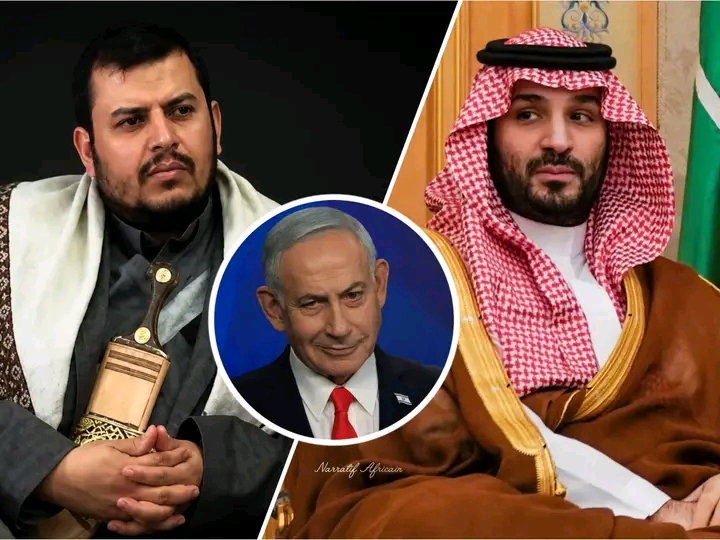
🟥 MIDDLE EAST | ANALYSIS: Could a Destabilized Saudi Arabia Benefit Israel’s “Greater Israel” Ambitions?
A prolonged conflict between Saudi Arabia and Yemen’s Houthi movement could have far-reaching consequences for the regional balance of power, potentially weakening Riyadh’s influence and creating new strategic opportunities for Israel
The central argument is that a weakened Saudi Arabia could reduce regional opposition to Israeli policies and territorial ambitions associated with the controversial concept of “Greater Israel.” However, the suggestion that Israel is pursuing a coordinated plan to destabilize Saudi Arabia remains unproven.
🇾🇪 1. Yemen–Saudi Arabia Conflict: A Strategic Risk for Riyadh
Supporters of Yemen’s Houthi movement, also known as Ansar Allah, may view its confrontation with Saudi Arabia as a challenge to Riyadh’s regional influence.
But a prolonged conflict could carry serious consequences for both countries. For Saudi Arabia, sustained military pressure could threaten economic projects, infrastructure, regional security and its position as a leading power in the Arab and Muslim worlds.
In an extreme scenario, prolonged instability could weaken state institutions and reduce Riyadh’s ability to exercise its regional influence. Nevertheless, the collapse of the Saudi state is a hypothetical outcome, not an established or inevitable consequence of the conflict.
🇮🇱 2. Could Israel Benefit From a Weaker Saudi Arabia?
Saudi Arabia remains an influential regional power with considerable diplomatic, economic and religious standing. It has also maintained that the establishment of a Palestinian state is a prerequisite for normalizing relations with Israel.
If Riyadh were significantly weakened, Israel could face less coordinated diplomatic pressure from Arab states, potentially creating greater room for maneuver on regional security and Palestinian issues.
However, benefiting from another country’s weakened position does not prove that Israel deliberately engineered the conflict or is pursuing a plan to bring down the Saudi government.
🗺️ 3. The “Greater Israel” Debate
The concept of “Greater Israel” is interpreted differently by various political, religious and ideological movements. Some maximalist interpretations envision territorial expansion beyond Israel’s current borders, while other uses of the term refer to different historical or ideological ideas
Some maps circulated online depict territories extending into neighboring Arab countries, occasionally including parts of northern Saudi Arabia. Such maps do not, by themselves, establish official Israeli policy or demonstrate the existence of an operational plan to annex Saudi territory.
Nevertheless, statements by certain Israeli political figures advocating territorial expansion have contributed to regional concerns about Israel’s long-term ambitions.
🇵🇸 4. The Palestinian Question and Saudi Arabia’s Regional Role
Saudi Arabia’s position on Palestinian statehood remains a significant factor in regional diplomacy.
In February 2025, Riyadh reiterated that it would not normalize relations with Israel without the establishment of a Palestinian state. Saudi Arabia has also opposed Israeli measures expanding control over Palestinian territories.
A substantial reduction in Saudi influence could therefore affect diplomatic efforts to pressure Israel over Palestinian statehood, although other regional powers could continue to oppose Israeli policies.
🌍 5. The Wider Regional Consequences
A severely weakened Saudi Arabia would not necessarily benefit Israel in every respect. The consequences would depend on how other regional powers responded, including Egypt, Türkiye and Iran.
A prolonged conflict could instead produce greater instability, disrupt energy markets, threaten shipping routes and create new security challenges across the Middle East.
CONCLUSION
The central geopolitical question is whether a prolonged Saudi–Houthi conflict could weaken Riyadh enough to reshape the regional balance of power in Israel’s favor.
That possibility deserves examination, particularly given Saudi Arabia’s influence over Arab diplomacy and its position on Palestinian statehood.
However, three issues must remain distinct: the potential consequences of Saudi Arabia’s destabilization, the possibility that Israel could benefit strategically, and the unproven claim that Israel is deliberately seeking to destroy Saudi Arabia to advance a “Greater Israel” project.
A regional power can benefit from the weakening of a rival without having caused the conflict or possessing a coordinated plan to dismantle that rival’s state.