

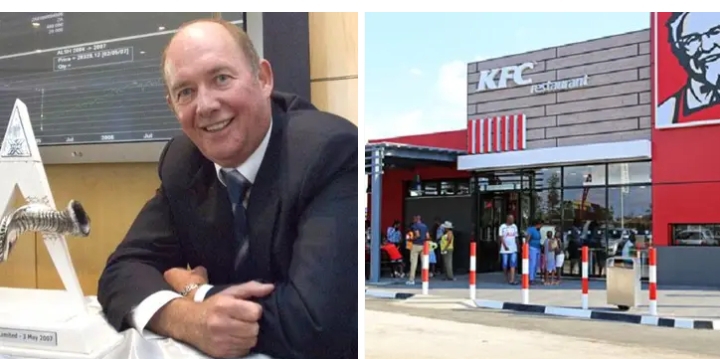
Little-Known Zimbabwean Behind 28 KFC Outlets In Zimbabwe, Zambia
The millionaire cut his teeth as a small egg farmer
By Fanuel Viriri
Kevin James cut his teeth as a small egg farmer in Zimbabwe.
Fast forward to today, the little-known Zimbabwean millionaire is the man behind 28 KFC franchises operating in Zimbabwe and Zambia.
If he walked into any KFC in Harare and ordered the popular Streetwise 2, the till operator serving him would have no idea she is serving the boss himself.
James is a low-profile poultry tycoon who turned a struggling chicken business in South Africa into one of the continent’s biggest poultry groups.
He is said to have left Zimbabwe flat broke in 2003 after selling his stake in CFI, then the country’s dominant poultry producer, and heading south to start over.
He now controls the Zimbabwe KFC franchise through Country Bird Holdings, the pan-African empire he built from the ground up.
Country Bird brought KFC back to Zimbabwe when it opened its first outlet in July 2014. Today the group runs 28 KFC restaurants in Zimbabwe and Zambia.
James, believed to have been born in the mid-1950s, first built his reputation not in broilers but in breeding — the high-tech, high-margin end of the industry. He established Ross Breeders Zimbabwe and later Crest Breeders International, taking the combined entity to the Zimbabwe Stock Exchange via a reverse takeover of CFI. Around the same period he set up a breeding operation in Zambia.
The collapse of Zimbabwe’s economy in the early 2000s forced him to relocate. He offloaded his CFI shares and moved to South Africa, but retained his Zambian interests.
Within months of arriving, he struck his biggest deal. Using his family investment vehicle Synapp International, incorporated in the British Virgin Islands, he acquired Country Bird (Pty) Ltd from Senwes. At the time it was a marginal player with plants in Tigane and Botshabelo trading as Supreme.
Between 2003 and 2005 he moved fast — snapping up Agri Chicks and the Senwes Voere feed unit and reviving the Mahikeng plant in North West province. The deals lifted group output to over two million birds per week.
On 3 May 2007, he took Country Bird to the Johannesburg Stock Exchange through a private placement of 65.5 million shares. The listing included his long-held Zambian breeding operation and a 60% holding in Ross Breeders Botswana, and cemented the group’s place as South Africa’s third-largest chicken producer in a market then worth R13 billion.
He was CEO at the time of the listing and had just been voted the South African Poultry Association’s Mover and Shaker for 2006. He stepped down as CEO in August 2008, handing over to Jeff Wright, but remained as an executive director.
Country Bird delisted from the JSE in 2014 following a difficult trading period. Today its major owners are Synapp as majority shareholder, the World Bank’s International Finance Corporation (IFC) — which had extended a $25 million convertible facility in 2013 — and Proterra Investment Partners, the Cargill spin-out.
Before it went private, IFC disclosures showed the James family holding 81.9% of a company then valued at roughly $90 million. Since then it has poured hundreds of millions of rand into expansion.
Its model is fully integrated — from breeding parent stock and hatching day-old chicks, to milling its own feed through Nutri Feeds, growing, slaughtering and selling the meat, partly through its own KFC stores.
After establishing its South African base, Country Bird pushed deep into the continent. In 2015 it launched a grandparent breeding farm at Mazabuka in Zambia, opened a hatchery in Eswatini, commissioned a feed mill in Mozambique and took a controlling stake in Valentine Chickens in Kwara State, Nigeria.
Growth at home continued. In October 2021 it commissioned Poultry Palace, a value-added processing plant in Germiston, east of Johannesburg. A year later it completed a R180 million upgrade at Tigane, pushing weekly capacity to about one million birds.
The group now has operations in South Africa, Zambia, Botswana, Nigeria, Tanzania, Mozambique and Zimbabwe and exports to some 20 countries. Its African operations outside South Africa are now the profit engine — according to Rand Merchant Bank, which arranges its funding, South Africa generates 80% of revenue but just 38% of EBITDA, while the rest of Africa contributes 20% of revenue and 62% of profit.
Now in his early 70s, James has stepped back from daily operations. The group was led by Brendon de Boer during its bruising takeover battles — the aborted 2016 bid for Sovereign Foods and the long-running fight for Quantum Foods. On its investor site, Country Bird still describes James as “the driving force” behind Synapp.
He remains one of Zimbabwe’s most successful, yet most private, entrepreneurs to build a continental empire out of chickens.