

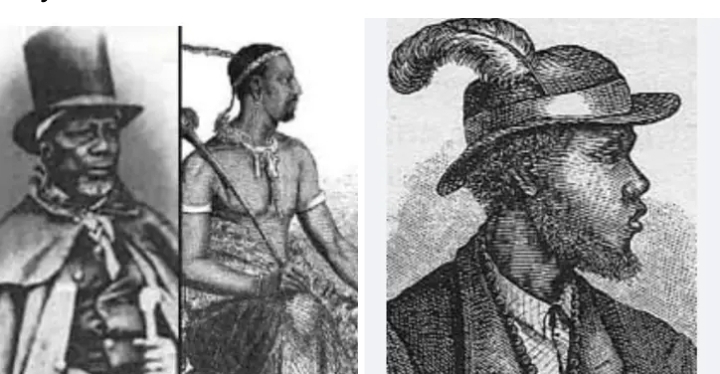
TWO BROTHERS-MUBUKWANU AND SILUMELUME :THE FALL OF LUYANA KINGDOM, SUCCESSIONAL DISPUTE, CIVIL WAR, AND KOLOLO INVASION
During the early 18th century, the Luyana Kingdom (also known as the Aluyi state or Lozi Kingdom) experienced a golden era of stability and expansion under the leadership of its 11th Litunga (King), Mulambwa Santulu. However, the stable state of the empire changed drastically following King Mulambwa’s death around 1830, which immediately triggered a severe vacuum of power.
At the time, the kingdom was structurally divided into two main administrative centers: the northern capital at Lealui and the southern center at Nalolo.
Following his death, a bitter succession dispute erupted between two of Mulambwa’s sons: Silumelume( 12th Litunga)and Mubukwanu( 13th Litunga). Silumelume was officially chosen by the National Council (Kuta) and the senior Manduna (aristocratic kingmakers) to ascend as the new Litunga. Meanwhile, Prince Mubukwanu, who served as the ruler of the southern principality of Nalolo (Litunga la Mboela), contested the council’s decision out of a belief that he rightfully deserved the throne.
This jealousy and political fracturing quickly escalated into an all-out civil war that split the kingdom regionally, with the northern populations backing Silumelume and the south supporting Mubukwuanu.
The internal warfare severely destabilized the kingdom’s military cohesion and leadership. Seeking to secure full and undisputed control, Mubukwanu’s faction orchestrated the assassination of Silumelume during a session of the Khotan (parliament).
Although Mubukwuanu officially took over as the new Litunga, the murder failed to unify the empire, instead leaving the Lozi people deeply fractured, traumatized, and politically broken.
Precisely during this period of intense internal chaos, the Kololo,a Sotho-speaking warrior group fleeing the devastating Mfecane by Shaka of Zulus displacement waves in Southern Africa, arrived at the Zambezi River under the leadership of King Sebitwane.
The Kololo easily overran and conquered the Luyana Kingdom due to critical weaknesses stemming from the brotherly feud, which included a fragmented and divided defense, exhausted military resources, and a stark tactical disadvantage against battle-hardened and disciplined warriors
Following the defeat of Mubukwanu’s forces, the king was forced to flee the central plains and escape into exile on Lipu Island near Lukulu, where he eventually died around 1840. The Kololo subsequently occupied Barotseland and ruled over the Lozi people for 34 years until the royal family finally regrouped, staged a massive rebellion, and restored their kingship under Mubukwanu’s son, King Sipopa (the 15th Litunga) and his Prime minister (Ngambela) Njekwa, in 1864.
By IK NATION