

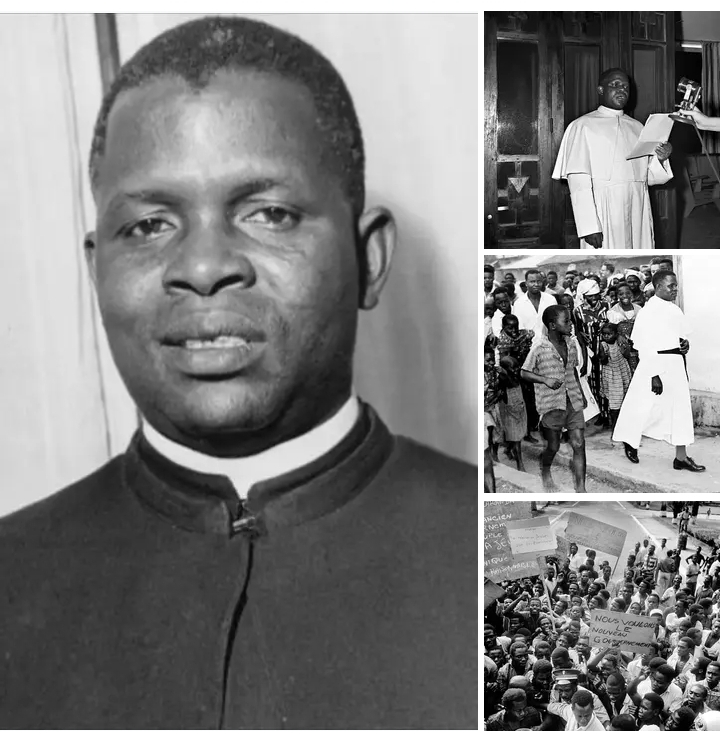
“African President Who Abandoned Being A Catholic Priest To Be President”
Abbé Fulbert Youlou, the first President of the Republic of Congo (Congo-Brazzaville), abandoned his career as a Catholic priest to pursue politics and eventually become president.
Youlou was ordained as a Catholic priest in 1946, but in the 1950s, he realised that his calling was politics. He started using his high standing in the church and his natural charisma to build a political following.
However, the Catholic Church strongly opposed priests participating in politics. In 1956, he was suspended and banned from performing religious duties, including saying Mass. He turned his suspension into a political weapon, telling ordinary citizens that the white colonial church was persecuting him for fighting for Africans.
He continued wearing his white priest’s cassock even after his suspension, using it as a symbol of purity and divine authority to win votes.
In November 1956, he was elected Mayor of Brazzaville. Through political alliances and manoeuvring, he rose to become prime minister in 1958.
In November 1959, he became President of the Republic of Congo, and when the country gained independence from France on August 15, 1960, Abbé Fulbert Youlou became its first president.
In power, his controversial lifestyle and political decisions attracted criticism. While ordinary Congolese citizens struggled with poverty, Youlou was associated with a life of luxury.
He was famous for his tailored Dior cassocks, expensive European suits, and lavish diplomatic trips to Europe and the United States.
He angered Pan-Africanists by maintaining close relations with France and supporting Moïse Tshombe, the breakaway leader of Katanga, who was associated with the assassination of Congolese independence leader Patrice Lumumba.
To strengthen his grip on power, Youlou increasingly restricted political opposition. In July 1963, he announced plans to introduce a one-party system, further angering his political opponents and trade unions.
His downfall came in August 1963 following widespread protests after the arrest of three trade union leaders and his plans to turn Congo into a one-party state.
The protests became known as Les Trois Glorieuses (The Three Glorious Days), which took place on August 13, 14 and 15, 1963. Thousands of workers, students and ordinary citizens flooded the streets of Brazzaville, demanding Youlou’s resignation.
Youlou appealed to the French government to send troops to save his government, but France refused to intervene.
Surrounded by growing opposition and losing political support, Abbé Fulbert Youlou officially resigned on August 15, 1963.
The military took over the government and placed him under house arrest before imprisoning him. However, in March 1965, he escaped from detention and fled to neighbouring Congo before eventually settling in Spain, where he remained in exile until his death in Madrid on May 5, 1972, at the age of 54.- Victor Adundo