

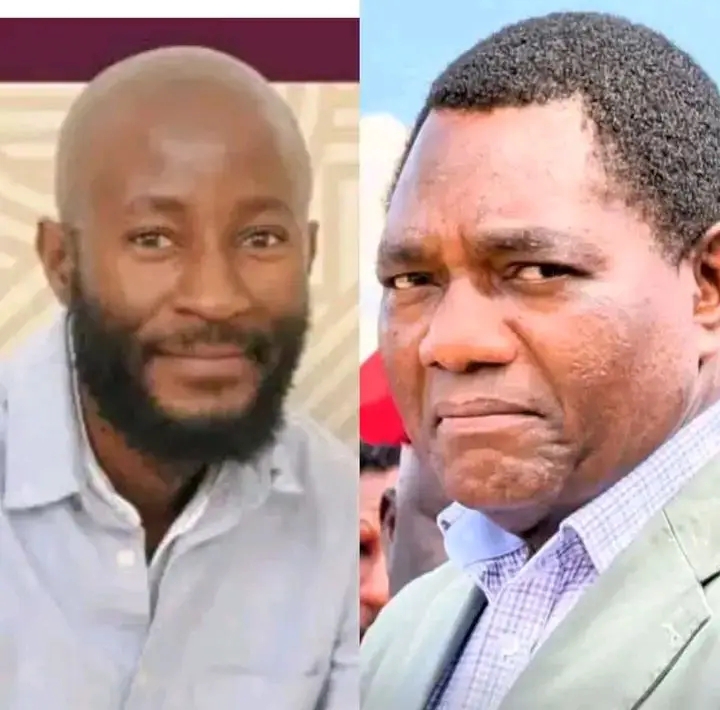
Ali na mutima oyipa maningi, Hichilema: Understanding the president’s tirade against Gary Nkombo
By Sishuwa Sishuwa
The tirade that President Hakainde Hichilema issued against Gary Nkombo confirms that Hichilema is just a bad human being. Moreover, his tirade rests on five claims, none of which stands to scrutiny.
Claim 1: Gary has been MP for far too long
The first claim is that Gary has been a member of parliament for far too long, 20 years, and that it is time for him to give room to other people. This argument is not new. It was first raised by UPND Deputy Secretary General Getrude Imenda in September 2025. According to Radio Phoenix, Imenda “called on long-serving party members of Parliament to consider stepping down to pave the way for aspiring candidates ahead of the 2026 general elections”. She added that “a dignified exit for veteran MPs would allow for party renewal while highlighting the crucial role experienced lawmakers play in mentoring newcomers.”
https://zambiareports.news/2025/09/18/upnd-calls-on-long-serving-mps-to-step-aside-for-new-aspirants/
A review of the political careers of UPND MPs suggested that Imenda’s statement was primarily directed at Gary Nkombo, Jack Mwiimbu, Newton Samakayi, and Elijah Muchima since these are the only individuals who have been in parliament for more than two terms. At the time, the Deputy Secretary General’s remarks drew sharp criticism from other party functionaries, and this forced the Secretary General, Batuke Imenda, to issue a statement in which he repudiated his deputy’s call as her personal views. The male Imenda claimed that “the statement attributed to Ms. Getrude Imenda does not represent the official position of the party. People should set aside such reports as there has been no resolution or directive from the NMC [National Management Committee] on this matter,” he stated.
https://zambianobserver.com/upnd-deputy-sgs-statement-on-long-serving-mps-steping-aside-for-new-aspirants-is-not-the-official-party-position-upnd-sg/
Given the striking similarity between the remarks of the female Imenda and those of Hichilema in relation to the need for long serving MPs to step aside, it is reasonable to assume that the earlier call by the Deputy Secretary General was issued to her by Hichilema. In other words, although what she said was not a party position, it was the position of the party leader who most probably asked her to give it public expression. It is most unlikely that a deputy secretary would issue a public statement in the name of the party without the knowledge of the secretary general. Following the backlash to the call, and to avoid internal party divisions that could have severely undermined the vote on Bill 7 three months later, the Secretary General stepped in to defuse the situation and soothe the targeted MPs.
The key point to note here is that long before the vote on Bill 7, the four MPs were identified as people who had run their race and who consequently needed to pave way for others. This helps explain why three of the four targeted MPs – with Jack Mwiimbu as the exception – were subsequently not adopted to recontest their seats. Now, the idea that long-serving MPs should paver way for other people is problematic for two reasons.
One is that there are no term limits for MPs. If Hichilema has a problem with anyone serving for more than 20 years, the solution is not to impose his wishes on selected individuals such as Gary, Muchima or Samakayi; it is to enact a law that would introduce term limits on MPs so that the solution is institutional and one that applies to everyone, not simply those that Hichilema does not want to stand again.
Two is that Hichilema’s newly found support for term limits contradicts his earlier position on the same subject. Last year, Hichilema removed the two five-year term limits from Zambia’s constitution for mayors and councilors on the argument that “good leaders” should “continue if the people want you.” Before the constitutional change, three (president, mayor, councilor) of the five elective public offices had term limits. Instead of addressing the anomaly on the other two offices that had no term limits (council chairperson and member of parliament), he removed term limits from two of the three offices that had them. Why would anyone who supports term limits do this? If term limits are good for MPs, then they are also good for all elective positions.
Hichilema’s contradictory positions on term limits suggest that his tirade against Gary has little to do with support for leadership renewal. In my view, the president did not want the four lawmakers in parliament because of what he plans to do next, should he manage to steal the August election using his loyalists in the electoral body, the security services, and the judiciary. Hichilema’s decision to remove term limits on four of the five elective positions was motivated by a desire to do the same on the presidency after the election when he can argue for consistency in the law, that it is discriminatory to have term limits on only one elective public office!
As indicated, the removal of the two five-year term limits from Zambia’s constitution for mayors and councilors was predicated on the argument that “good leaders” should “continue if the people want you.” It is not difficult to see how the same argument could be extended to the presidency. Not long ago, Attorney General Mulilo Kabesha announced that there will be major constitutional changes after the election, accusing Zambians of being the ones behind such demands. That is how Bill 7 started.
Hichilema viewed Gary and other long-serving MPs as the ones who were most likely to lead possible resistance against future amendments to the constitution that would lead to the removal or extension of presidential term limits, or the election of the president by MPs rather than directly by the people. This is because such figures had established power bases in the party which they could use to undermine his bid for a wamuyaya presidency or absolute power. By preventing long serving MPs from returning to parliament, Hichilema was removing the likely obstacle in his path for an extended presidency and creating a new class of would-be loyal MPs who owe their adoption to him.
Gary is the only person in the UPND and even in Cabinet who attempted to stand up to Hichilema. In Hichilema’s world, that is an unforgivable sin. Hichilema has repeatedly shown that he does not like being challenged. Gary is therefor paying for many political sins, including the sin of being the only Tonga-speaking leader in the UPND who, thanks to his nationalist credentials and cross-ethnic relatability, could easily win an election outside Southern Province.
Claim 2: Gary is ungrateful to Hichilema who invited him into the UPND
The UPND was formed in late 1998. Gary Nkombo only joined the party in 2002, after the 2001 general election in which he unsuccessfully ran for parliament in Mazabuka Central constituency on the opposition FDD ticket. Earlier, in late 1999, Gary had also failed to win the Mazabuka seat following a parliamentary by-election that was caused by the death of incumbent MP Bennie Mwiinga, who had held the seat since 1988. In that by-election, Gary ran on the MMD ticket. He was defeated on both occasions by Griffiths Kabisha Nang’omba.
Hichilema claims that he brought Gary into the UPND on whose ticket Gary has been MP since 2006. This claim is problematic because Gary joined the UPND in 2002, four years before Hichilema did so in 2006 following Mazoka’s death. There is no way that Hichilema could have invited Gary to join a party that he was already part of. In fact, according to Amos Malupenga’s book, Levy Mwanawasa disclosed that two months before Mazoka died in May 2006, Hichilema went to State House to seek business opportunities for his companies. As well as denying being a member of the UPND, Hichilema told the president that “when I decide to join politics, I will come and join you in MMD because I am quite happy with the way you are leading this country.” So, at what point did Hichilema invite Gary into the UPND and in what capacity?
Claim 3: Gary is working with Mundubile
There is no evidence to support this claim that Gary is working with Brian Mundubile. Hichilema is raising the claim to undermine Gary’s campaign as an independent parliamentary candidate by linking him to Hichilema’s main rival for presidency.
Claim 4: Gary was dining with people who wanted to kill Hichilema
There is no evidence that anyone wanted to kill Hichilema. However, there is evidence that Gary met people from across the political divide. Although he did not mention names, any keen observer of Zambian politics would know that Hichilema was referring to meetings that Gary held with Edgar Lungu and Kaizer Zulu. Gary held very infrequent meetings with Lungu, usually to diffuse tension or in pursuit of a compromise to an issue that threatened to undermine peace or deepen divisions.
In politics, having leaders who can build bridges across the political divide is something to be welcomed, not condemned. In Hichilema’s world, however, only extremes exist. One is either with him or against him. Hichilema’s enemies must be treated as such by other party officials. That is a very narrow-minded worldview. But again, Hichilema is narrowminded.
Claim 5: Gary appeared at Cabinet meetings drunk
Gary drinks. Anyone who has followed him closely would know this. If he appeared drunk at cabinet meetings, then Hichilema is right to express displeasure. The problem is the president’s selective outrage. I know of one presidential aide who drinks like fish and regularly appears at work drunk. If the problem is appearing drunk on duty, why has this aide not received a public rebuke from Hichilema for similar conduct? https://zambianwhistleblower.com/
I repeat: Gary’s main political sin is what he represents: a person who can stand up to Hichilema and has the potential to undermine his ambition for a wamuyaya presidency after the August election, if the president manages to steal it. If voters manage to rescue the country from his clutches, I pray that never again should Zambia elect a lying, tribal, corrupt, unpatriotic, vindictive, hypocritical, lawless, and undemocratic scumbag like Hichilema.