

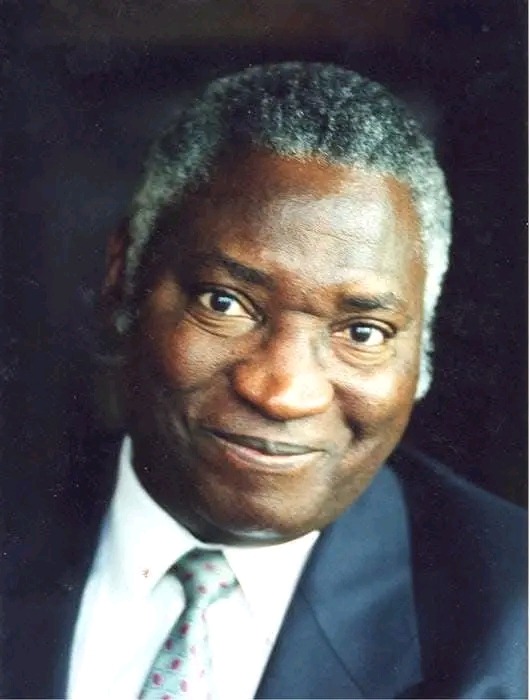
AMUSAA KATUNDA MWANAMWAMBWA—THE SPEAKER WHO OPENED THE DOORS
The man who spent 13 years occupying the Speaker’s chair and, in the process, decided that Parliament should actually be seen by the people who were paying for it.
Born in 1940 in Kalabo District. He attended Mukola Primary, Libonda Middle School, Lukona Upper Primary, Mongu Secondary (present day Kambule provincial STEM secondary school) and later Munali Secondary School, where he joined the Youth Brigade of UNIP.
After a stint at Zambia Information Services, he crossed the Atlantic in 1965 to study Political Science at Middlebury College, graduating in 1969. He returned to Zambia and embarked on a career spanning information, diplomacy, tourism and, eventually, politics.
He served as Information Attaché at Zambia’s Permanent Mission to the United Nations, Newspaper Manager at Zambia Information Services, Chief Tourist Officer and Managing Director of the Zambia National Tourist Bureau. He also obtained a Diploma in Tourism Planning from the University of Bradford.
Then came 1991, the year Zambia decided that the one-party political marriage had lasted long enough.
Mwanamwambwa joined the newly formed MMD and contested Liuwa, winning a seat in Parliament with 3,397 votes against his closest rival, UNIP’s Namushi Namuchana who got 343 votes.
And apparently, winning elections was not enough work. He went on to collect ministerial portfolios like some politicians collect titles: Deputy Minister of Tourism, Minister of Sport, Youth and Child Development, Minister of Legal Affairs, Minister of Information and Broadcasting Services, Government Spokesperson, Minister of Tourism, and finally Minister of Agriculture, Food and Fisheries.
In 1998, however, Mwanamwambwa pulled off one of the more unusual political career moves: he resigned from Cabinet and surrendered his parliamentary seat so he could be elected Speaker of the National Assembly.
And that is where he left perhaps his most enduring mark.
Between 1998 and 2011, Mwanamwambwa presided over Parliament during a period when Zambia was gradually dragging its legislature into the modern age.
Under his leadership, Parliament embarked on major reforms designed to bring the institution closer to ordinary Zambians a rather radical idea in a country where politicians traditionally become extremely interested in “the people” around election time.
In 2003, parliamentary sessional committees were opened to journalists and members of the public. He also championed the development of Parliament Radio, constituency offices around the country, and the Media and Visitors Centre at Parliament Buildings.
In other words, Mwanamwambwa helped turn Parliament from a place where politicians went to talk among themselves into a place where the public could actually watch them do it.
Mwanamwambwa also left his mark through parliamentary rulings on the relationship between Parliament and the Judiciary.
His guidance on sub judice reinforced the principle that Parliament should not debate matters actively before the courts.
Then came his 2010 ruling on parliamentary privilege and collective responsibility, after an MP sought to mobilise public petitions against the ZNBC Amendment Bill.
Mwanamwambwa reminded MPs that once the House had made a decision, members could not simply walk outside Parliament and announce that they had never met the people inside.
Apparently, democracy came with terms and conditions.
Mwanamwambwa was also associated with the development and institutionalisation of the Constituency Development Fund, an idea intended to take development resources closer to communities rather than leaving every constituency waiting for Lusaka to remember that they exist.
Today, CDF is one of the most politically familiar phrases in Zambia mentioned by politicians with such enthusiasm that you would think every pothole in the country was personally sponsored by it.
Mwanamwambwa retired as Speaker in June 2011 after 13 years in the chair.
He had served under the MMD governments of Frederick Chiluba and Levy Mwanawasa, survived cabinet reshuffles, political storms and the usual Zambian parliamentary theatrics and somehow managed to leave the Speaker’s chair without becoming the subject of a constitutional amendment named after himself.
Mwanamwambwa died on 21 October 2023 at Forest Park Hospital in Lusaka, aged 83.
He is remembered as a diplomat, cabinet minister, parliamentarian and, above all, a Speaker who pushed Parliament toward greater openness, accessibility and institutional reform.
In an era when political institutions often seemed determined to keep citizens at arm’s length, Mwanamwambwa’s philosophy was refreshingly simple:
If Parliament belongs to the people, perhaps the people should be allowed to see what happens inside.
And for Zambia, where politicians have historically been very generous with promises about “bringing government closer to the people,” Mwanamwambwa actually helped move the furniture.