ANCIENT JEWISH HISTORIAN RECORDED FIRST-CENTURY CLAIMS THAT JESUS APPEARED ALIVE AFTER CRUCIFIXION
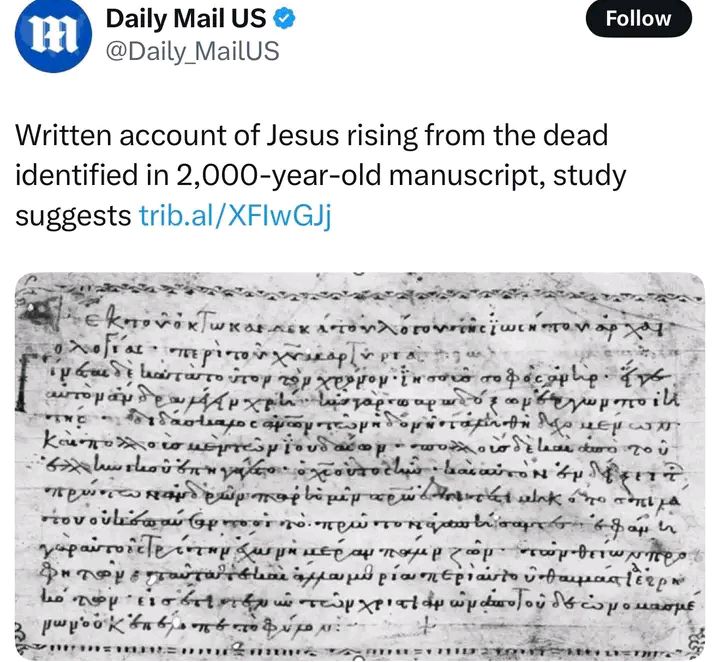
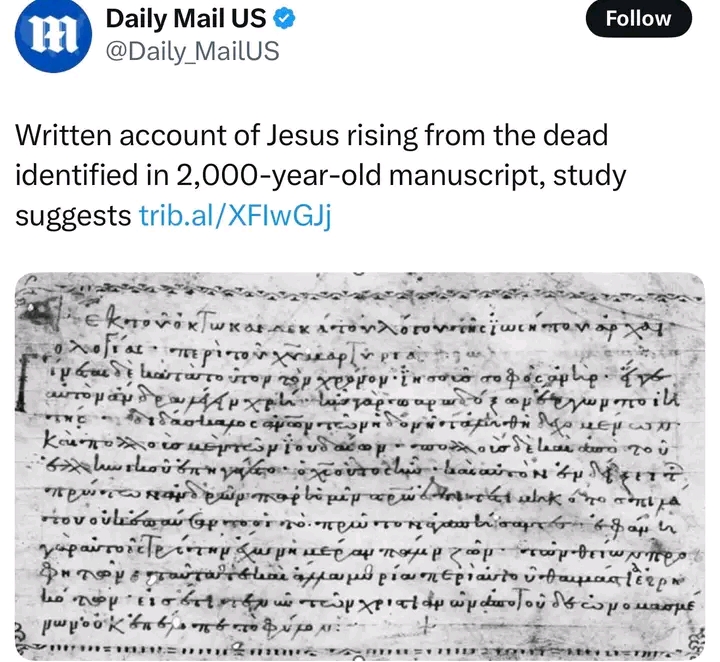
A nearly 2,000-year-old passage by the Jewish historian Flavius Josephus preserves a first-century report that Jesus’ followers claimed he appeared to them alive on the third day after his crucifixion.
The text, known as the Testimonium Flavianum, appears in Josephus’ Jewish Antiquities, completed around 93-94 AD. Josephus was not a Christian. He was a Jewish writer who recorded events of his own time.
Spanish independent researcher Jesús Fernández-Pedrera Correa compared the surviving Greek text with Latin, Arabic, and Syriac versions of the same passage. The Latin version, preserved by Jerome in the late fourth century, states that Jesus “appeared to them the third day alive.”
The Arabic version from the tenth century presents the appearance as something the disciples themselves reported. The Syriac version from the twelfth century likewise includes the claim that Jesus was seen alive after his death.
The standard Greek manuscripts include stronger language that links the appearance to fulfilled prophecy. Fernández-Pedrera Correa argues that the more cautious wording in the other lines better reflects what Josephus originally wrote.
In that earlier form, Josephus simply recorded what Jesus’ followers said they had seen, without endorsing the claim himself. This matches how Josephus treated other religious groups of his day. He described their beliefs without adopting them.
The study does not claim to have discovered a new manuscript. It examines differences among existing copies and translations to reconstruct the likely original wording. Scholars have long recognized that some phrases in the Greek text, especially the direct declaration that Jesus “was the Christ,” appear to be later Christian additions.
Origen, writing in the third century, stated that Josephus did not accept Jesus as the Messiah. The comparative evidence supports the view that Josephus reported the resurrection claim as the testimony of Jesus’ followers rather than as his own affirmation.
This leaves the core historical statement intact. A non-Christian Jewish historian writing within living memory of the events noted that Jesus’ disciples claimed he had risen and appeared to them.
The account sits alongside other early sources that document the same claim. The study is a preprint posted on Zenodo in August 2026 and has not undergone formal peer review. It offers a constrained reconstruction based on the pattern of wording across the different transmission lines.
Sources: Daily Mail, Zenodo preprint by Jesús Fernández-Pedrera Correa, SyriacPress, IBTimes UK.