

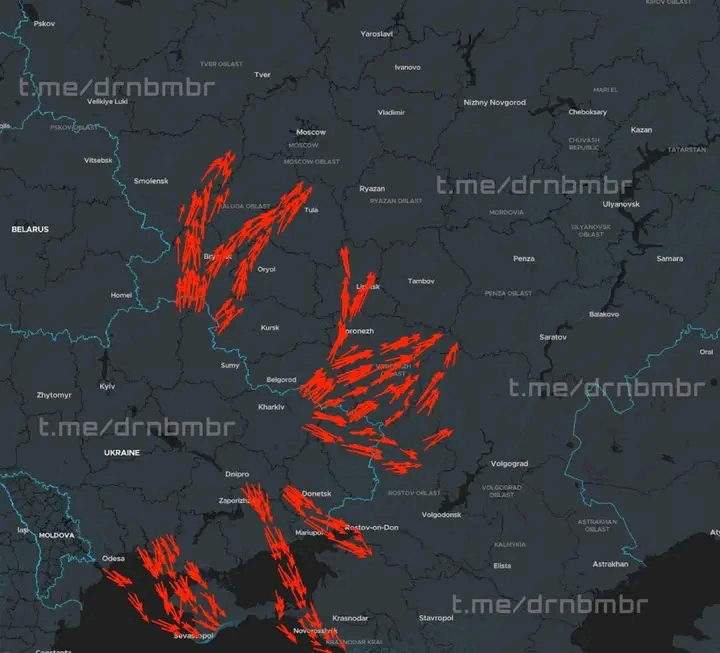
ANOTHER NIGHT BEGINS—UKRAINIAN LONG-RANGE DRONES ARE AGAIN ENTERING RUSSIAN AIRSPACE
Ladies and gentlemen, prepare for another long night.
After several nights of increasingly intense Ukrainian deep-strike activity, long-range drones are once again being reported inside Russian airspace. The campaign does not appear to be over.
Open-source monitoring shows several broad flight corridors. One runs north through Bryansk before separating toward Smolensk, Kaluga and Tula—the outer approaches to the Moscow region. Another crosses the Belgorod and Voronezh regions before continuing toward Lipetsk, Tambov and potentially targets deeper inside central Russia.
Farther south, drones have repeatedly moved through Rostov and across the Sea of Azov. Other routes pass over occupied Crimea and the Black Sea toward Krasnodar and Novorossiysk, placing Russian airfields, ports, fuel infrastructure and military logistics under pressure.
These trajectories are approximate. They are reconstructed from regional alerts, Russian air-defense activity and reported sightings rather than official Ukrainian flight data. They show the scale and direction of the operation but do not confirm tonight’s intended targets.
The past two nights provide a clear picture of what Ukraine has been pursuing.
The Progress rocket and space center in Samara was struck by Ukrainian Flamingo missiles. The facility produces Soyuz-2 launch vehicles and technology connected to Russia’s military and satellite programs. Ukraine also confirmed a strike against the Savasleyka airfield in the Nizhny Novgorod region.
Near Moscow, a major Wildberries logistics center in Koledino was engulfed in flames, while another logistics facility in Domodedovo was also hit. Ukraine has accused the Wildberries network of distributing sanctioned electronics, drone components and military-related equipment.
In the Rostov region, Ukraine struck the Kamensky Combine, a military-industrial facility producing solid rocket propellant for Uragan, Smerch and Tornado-S ammunition, as well as other Russian missile and aviation weapons.
Occupied Crimea, Moscow’s wider logistics network and Russian industrial facilities have also remained under sustained pressure. Russian authorities claimed hundreds of drones were involved in the latest wave, although Moscow’s interception figures remain impossible to verify independently.
What is unfolding is no longer a collection of isolated attacks. Ukraine appears to be conducting a sustained campaign across multiple corridors, forcing Russia to defend Moscow, its southern military infrastructure, occupied Crimea and its industrial interior simultaneously.
The first drones are now moving again. Where they ultimately turn—and what burns before morning—remains to be seen.