

🇿🇲 VIEWPOINT | Are Hichilema’s 7 Targets Achievable?
The launch of the UPND Alliance manifesto on Thursday at the Mulungushi International Conference Centre has finally given Zambia’s election season something concrete to debate. Until now, much of the political conversation has revolved around personalities, slogans and accusations. A manifesto changes the narrative. It creates a document voters can interrogate, challenge and measure. Whether one agrees with the UPND or not, the ruling party has become the first major contender to place specific targets before the electorate.
Critics have already dismissed the HH7 agenda as another collection of political promises. That scepticism is understandable. Every election cycle produces ambitious pledges. But serious analysis requires a deeper question: are the targets grounded in economic reality, or are they simply campaign rhetoric?
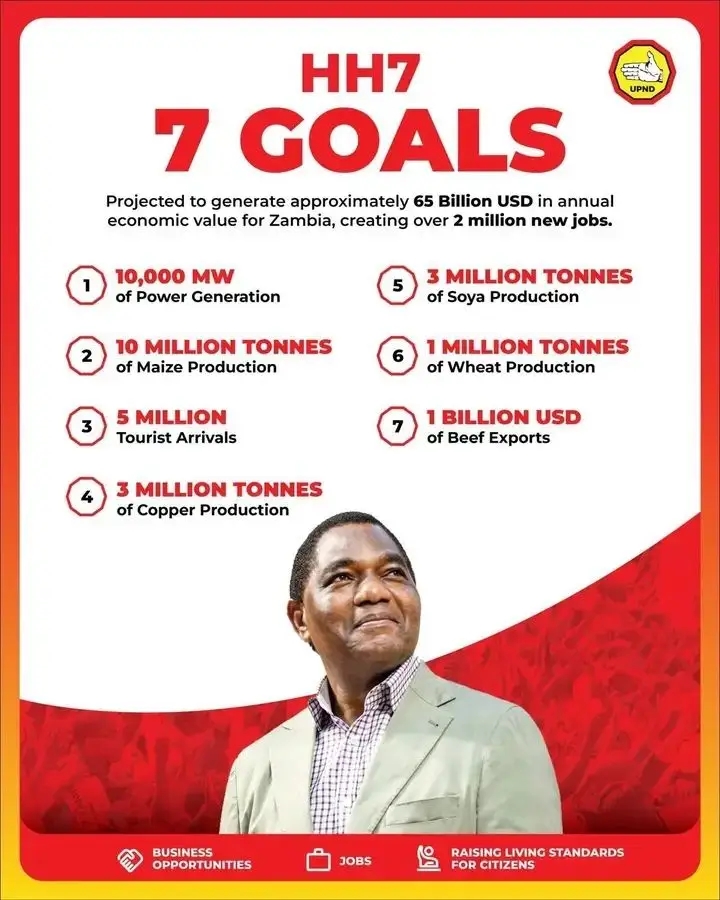
The UPND is promising seven headline outcomes by 2031: 10,000 megawatts of electricity generation, 10 million tonnes of maize production, three million tonnes of copper production, three million tonnes of soya output, one million tonnes of wheat production, five million tourist arrivals and US$1 billion in beef exports. Government estimates these goals could generate approximately US$65 billion in annual economic value and create more than two million jobs.
Those numbers sound ambitious because they are. The more important issue is whether Zambia is starting from a position that makes such ambitions conceivable.
A useful place to begin is inflation. When the UPND took office in August 2021, annual inflation stood above 24 percent. Today it has fallen to around 6.6 percent. Economists understand what this means. Inflation is the silent tax that erodes purchasing power. Lower inflation does not instantly make citizens rich, but it creates price stability, improves planning for businesses and reduces uncertainty across the economy. No farmer, investor or manufacturer expands production in an environment where prices are spiralling out of control.
Another overlooked indicator is Zambia’s foreign exchange reserves. The country now holds more than US$6 billion in reserves, the highest level recorded in modern Zambian history. Many citizens understandably ask why reserves matter when food prices remain high. The answer is simple. Reserves provide confidence to investors, protect the currency from external shocks and strengthen Zambia’s ability to meet international obligations. Countries with weak reserves often face currency collapses and financial instability. Countries with strong reserves enjoy greater economic flexibility.
The kwacha tells a similar story. Much of 2025 was dominated by anxiety over currency weakness. Yet 2026 has produced a different picture. Supported by stronger copper prices, rising investor confidence, improved reserves and debt restructuring gains, the kwacha has staged one of its strongest recoveries in years. A stronger currency lowers the cost of imported fuel, machinery, medicines and industrial inputs. Citizens may not always connect currency performance to daily life, but businesses certainly do.
Debt restructuring may be the most important economic development of the entire first term. Zambia entered office carrying an unsustainable debt burden after becoming Africa’s first pandemic-era sovereign default in 2020. The restructuring process unlocked billions of dollars in debt-service relief and restored confidence among international lenders and investors. Government officials estimate the restructuring has created approximately US$1.4 billion in annual fiscal space. Put differently, money previously earmarked for debt payments can now be redirected toward schools, hospitals, roads, energy projects and social programmes.
Copper provides another reason the manifesto targets deserve serious attention. When the UPND entered office, annual copper production stood at roughly 800,000 tonnes. Major investments announced at Lumwana, Kansanshi, Mopani and other operations are expected to push output significantly higher over the coming years. Reaching three million tonnes remains a demanding target. Yet it is no longer a theoretical conversation. Large-scale capital investment is already flowing into the sector.
Energy follows the same logic. Zambia’s painful experience with load-shedding exposed decades of underinvestment in power generation. The government’s response has involved a mix of solar projects, private sector participation, transmission upgrades and new financing models. Recent debt-for-energy arrangements and grid investment programmes suggest energy expansion is moving from policy discussion into implementation. Achieving 10,000 megawatts will require sustained execution, but the foundations are visibly stronger than they were five years ago.
None of this means the UPND should receive a free pass. Citizens still face high living costs. Youth unemployment remains a serious concern. Corruption allegations continue to surface. Economic growth must translate into household prosperity if voters are to feel its benefits. Recovery and transformation are not the same thing.
Yet honest analysis requires acknowledging where Zambia stands today. A country emerging from default, reducing inflation from over 24 percent to below seven percent, building reserves above US$6 billion, stabilising its currency and attracting billions in mining investment is not occupying the same position it did in 2021.
The real debate is no longer whether Zambia has recovered. The real debate is whether recovery can be converted into production, jobs, exports and higher living standards.
This is the test facing the HH7 agenda.
And it is the debate voters should demand from every presidential candidate between now and August 13.
© The People’s Brief | Ollus R. Ndomu