BOZ INTRODUCES NEW RULES FOR FOREIGN CASH EXPORTS AND IMPORTS
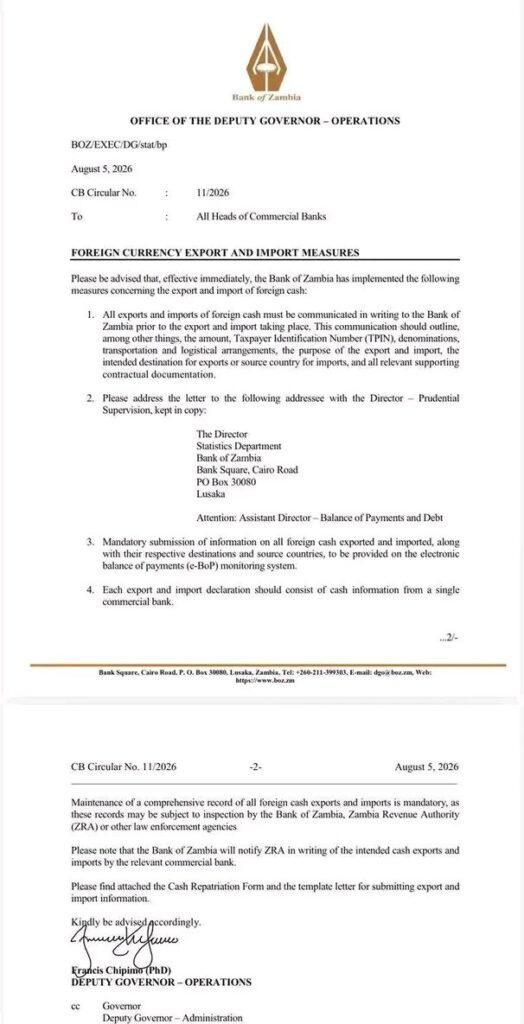
The Bank of Zambia (BoZ) has introduced new measures requiring commercial banks to notify the central bank in writing before exporting or importing foreign currency cash.
The measures, announced in Circular No. 11/2026 dated August 5, 2026, took effect immediately and are aimed at strengthening the monitoring and documentation of foreign cash movements into and out of the country.
Under the new requirements, all commercial banks must submit written notifications to the Bank of Zambia before any foreign cash is exported or imported.
The notifications must include the amount of cash involved, the Taxpayer Identification Number (TPIN), denominations, transportation and logistical arrangements, the purpose of the transaction, the destination country for exports or source country for imports, and relevant supporting contractual documentation.
The central bank has directed that the notifications be addressed to the Director of the Statistics Department at the Bank of Zambia, with the Director of Prudential Supervision copied in.
Commercial banks are also required to submit information on all foreign cash exports and imports, including their respective destinations and source countries, through the electronic Balance of Payments (e-BoP) monitoring system.
The circular further stipulates that each export or import declaration must contain cash information relating to only one commercial bank.
The Bank of Zambia has made it mandatory for commercial banks to maintain comprehensive records of all foreign cash exports and imports, warning that the records may be inspected by the central bank, the Zambia Revenue Authority (ZRA) or other law enforcement agencies.
The central bank will also notify ZRA in writing of intended cash exports and imports by the relevant commercial banks.
To facilitate compliance, the Bank of Zambia said it had attached a Cash Repatriation Form and a template letter for submitting information on foreign cash exports and imports.
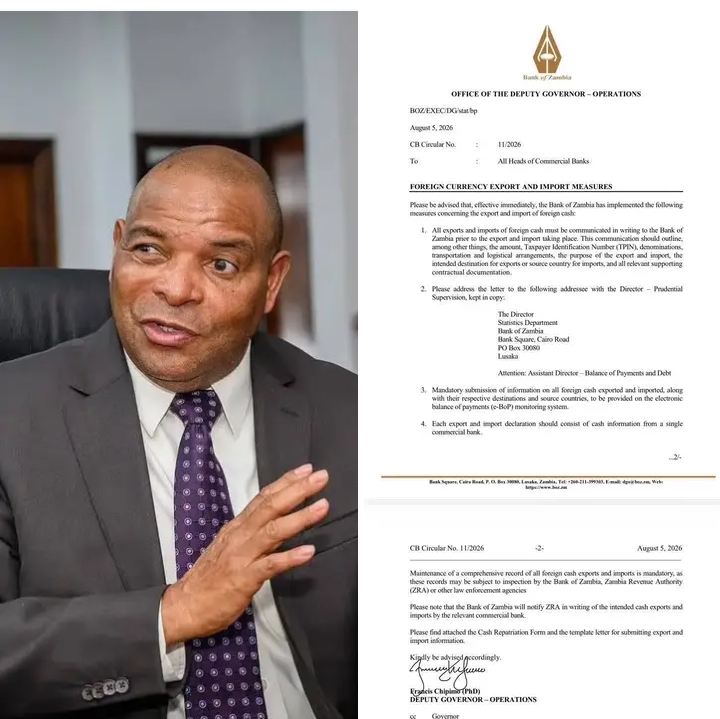
The circular was signed by Deputy Governor–Operations, Francis Chipimo, who advised commercial banks to comply with the new requirements.