By Deeleslie Mondoka
NKANI YAMA ELECTION PETITION
Picture this:
You lose an election and you are convinced something went wrong. So you call your lawyer and say, “Counsel, please take these people to court!”
The lawyer prepares the election petition, signs it and files it within the required 30 days. Everything looks ready for battle.
Then someone looks at the papers and says, “But where is the candidate’s signature?”
And suddenly, the whole party is over. 😂
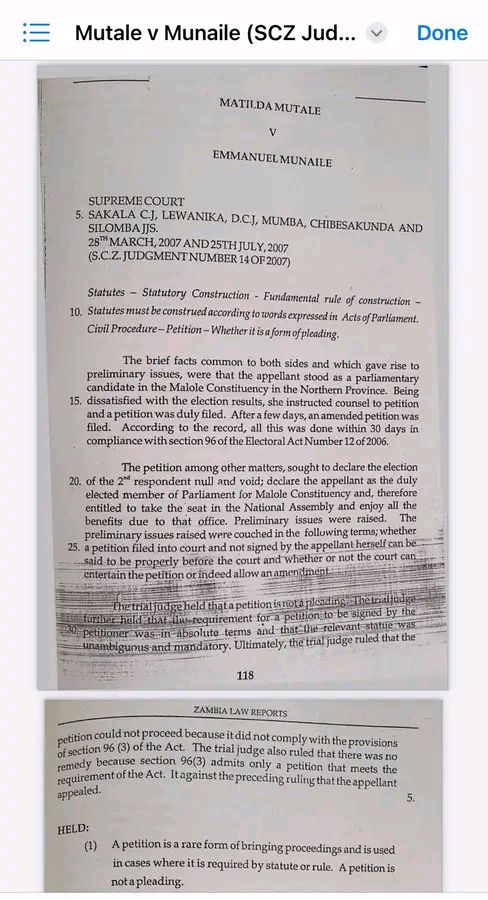
This is what happened in Matilda Mutale v Emmanuel Munaile.
The big question before the Supreme Court was simple: Can a lawyer sign an election petition on behalf of the person challenging the election?
The Supreme Court said no.
The law said an election petition “shall be signed by the petitioner.” The Court said Parliament meant exactly what it said. The person challenging the election must personally sign the petition. A lawyer can prepare it, file it, argue it and probably drink enough coffee to survive the case, but he cannot put his own signature where the law requires the candidate’s.
Why so strict?
Because an election petition is not just an ordinary court document. It is a special legal process created by statute. Parliament set the rules, and the Court said those rules must be followed.
So, what does this mean for the ordinary citizen?
It means that when you challenge an election, having a strong complaint is not enough. You must also follow the legal procedure properly. In court, sometimes the small things are not small things at all.
It is like going to an ECZ office with everything ready: ID, forms, passport photos, photocopies and then discovering you forgot the one document they specifically asked for. You can explain until tomorrow, but the officer will still say, “Ba boss, come back with it.” 😂
Moral of the story?
In law, never underestimate the smallest requirement. Sometimes one missing signature can carry a bigger hammer than a truckload of arguments. You may have the votes, the evidence, the lawyer and even righteous indignation, but if Parliament says “sign here,” you must sign there.
Otherwise, like a Zambian arriving at the airport for a flight ✈️ to London 20 minutes after the gates close… you may have a perfectly good explanation, but you are still not gonna be allowed to board and fly out.
Disclaimer:
My commentary on this issue is no more a legal critique than a campfire tale is a treatise on thermodynamics. It is, rather, a dramatized retelling, a lively reenactment if you will, of the judicial clash, unburdened by the solemn drudgery of analysis and delivered with the unapologetic zest of a storyteller who knows a good duel when he sees one.
You can read the entire judgment from here 👇:
https://zambialii.org/akn/zm/judgment/zmsc/2007/188/eng@2007-07-25