

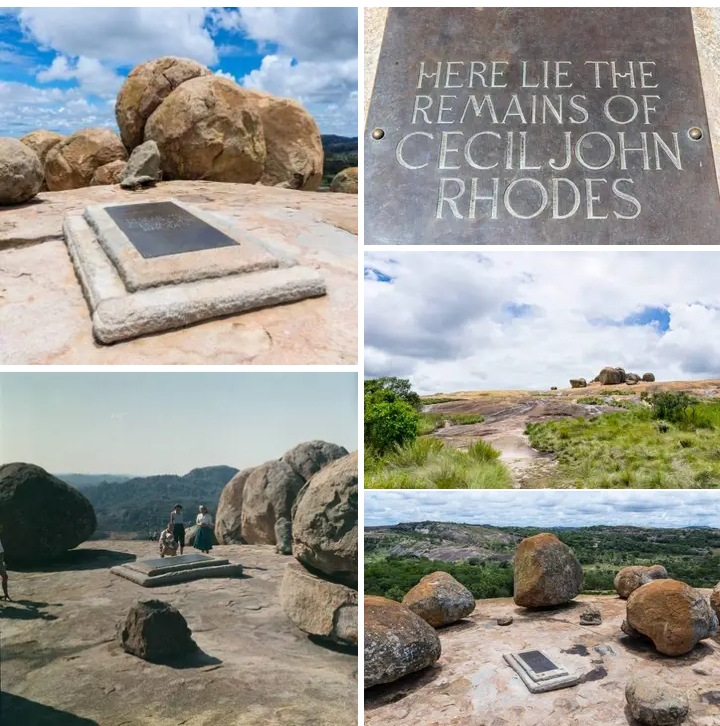
CECIL RHODES’ UNIQUE BURIAL NEXT TO A KING, 5 STONE CUTTERS EMPLOYED AND RECEIVED THE ROYAL SALUTE BAYETE
100 chiefs attended burial
By Fanuel Viriri
Cecil John Rhodes, empire builder and architect of Rhodesia, did not want a churchyard or cemetery.
He wanted a grave cut from bare granite, high on a hill in the Matopos, where he could lie next to a Ndebele king and look out over the country he claimed. Rhodes chose a hill called Mwalindidzimu (a hill of ancestral spirits in Kalanga) for his final resting place.
What made his funeral special was how it blended imperial ceremony with African ritual on a site he had chosen himself years earlier during a lonely ride.
The place he called “World’s View” in the Matopos Hills, about 8 miles from his farm and 26 miles south of Bulawayo, sat on a granite summit ringed by a circle of huge isolated boulders 20 to 40 feet high, arranged like a Druidical temple, and commanding a view for many miles across a sea of rugged rock.
Getting him there was an ordeal. When H.M. Hole, Civil Commissioner of Bulawayo, first went out a fortnight before, the road was in a ghastly state.
He sent men to explore 3 other routes but adopted the one he saw himself, and secured 400 natives at once to put it in repair. The sinking of the grave took 5 stone cutters and a large number of boys 10 days and nights to cut into solid granite, and a large granite slab was hewn out to cover the remains.
Moving the heavy coffin to the top was one of the first problems considered. Hole had blocks and hauling tackle arranged at two points, and a special carriage constructed on low wheels.
From the time the body arrived at 9 a.m. on Tuesday until the interment at noon on Thursday, all went off without a hitch. On Wednesday there was a formal funeral procession from the Mortuary Chapel to the outskirts of town, then the body was conducted privately under military escort to Westacre farm where it rested for the night in the large open hut he used as a dining room.
Before sunrise on Thursday, the coffin was moved on its gun carriage to World’s View, accompanied only by a military escort of 50 men. It reached the grave about 9.30 a.m., an hour before the enormous crowd of mourners arrived.
Around the grave stood the chief mourners: Colonel Frank Rhodes, Arthur Rhodes, Dr. Leander Starr Jameson, Thomas Smartt, L.L. Michell and Sir Charles Metcalfe. On the side of the mountain were stationed the natives who wished to see the interment. They came to the number of 100 chiefs and about 3,000 of their men. As the coffin went slowly up, the principal chief — Mjaan, who was Lobengula’s Commander-in-Chief — stood up and gave the Royal Salute “Bayete,” which was immediately taken up by the whole assembled multitude. This salute had never been given since the death of Moselikatzwe.
Six years earlier during the rebellion, Rhodes had learned that troops found the skeleton of Moselikatzwe, King of the Matabele, buried sitting in a cleft of granite about four miles away so that he might look after death at the country he founded. Rhodes told Hole, “It is a fine idea. There sits Moselikatzwe and there rests Rhodes too, looking out over the country we won for us.”
The service was conducted by the Bishop of Mashonaland. The coffin, with the Chartered Company flag and three faded wreaths from “The Queen,” “the Brothers and sisters” and “Dr. Jameson” still on it, was suspended on “sheer-legs” over the tomb and lowered with a rattle of chains to the depths.
After the oration the Bishop read Kipling’s moving poem to “C.J.R.” When he came to “Earth to Earth,” chips of granite were collected and thrown into the tomb. The covering slab was then moved with difficulty into place on wooden rollers, sealing the grave on the summit. Rhodes was buried in April 1902.