

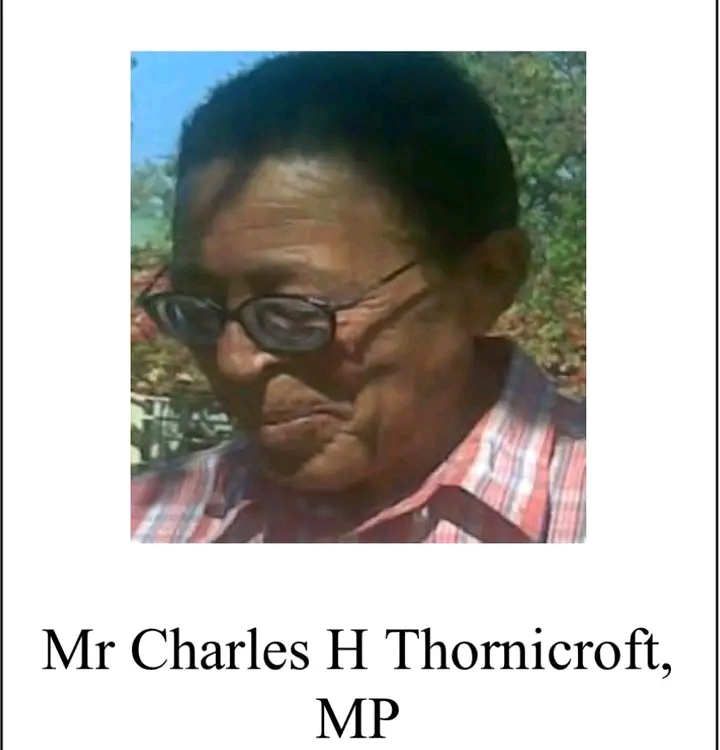
Charles Henry Thornicroft (1936–?) — The Teacher Who Went from the Classroom to Parliament, Where the Lessons Became Political
Thornicroft, sometimes spelt Thorncroft, was among the early political figures who helped shape Zambia’s post-independence government under President Kenneth Kaunda’s United National Independence Party (UNIP).
He was an educator turned politician, a man whose career reminds us that in the early days of independence, one could move from teaching pupils to helping govern an entire nation.
Whether the politicians learnt as much as their pupils is a question for history to mark.
Born in 1936 in Fort Jameson, present-day Chipata, in Northern Rhodesia, Thornicroft received his education at Trafalgar High School in Cape Town, South Africa.
He began his professional career as a teacher, a respectable calling that presumably prepared him for the difficult task of explaining things to people who sometimes had absolutely no intention of listening.
In 1962, he resigned from the Federal Ministry of Education during the Federation of Rhodesia and Nyasaland, as the political winds of the time were shifting and the prospect of a new political order was gathering momentum.
Before his rise to national politics, Thornicroft was active in community affairs. He served as secretary of the Coloured Club in Ndola and Fort Jameson and worked as secretary-manager of the Ndola Community Centre and Social Club. Clearly, his experience in administration and community engagement would prove useful in a country preparing to exchange colonial rule for self-government and all the opportunities, arguments and political gymnastics that came with it.
Thornicroft entered parliament during one of the most consequential periods in Zambia’s history. Independence had arrived, UNIP was consolidating its authority, and the new government was busy turning political promises into national policy.
In January 1964, he was appointed Parliamentary Secretary to the Ministry of Education, a position he held until 1967. He represented Katete, later known as Katete North, from 1964 to 1968 before moving on to represent Mkaika from 1968 to 1973.
Between 1967 and 1968, he served as Minister of State for Technical Education, overseeing a sector that was crucial to developing the skilled workforce needed by a newly independent country.
One particularly memorable episode occurred on October 23, 1967, when Thornicroft joined other government ministers in picking up shovels and pickaxes to dig the foundation for the University of Zambia library.
Yes, actual shovels and pickaxes.
Not a commissioning speech followed by a convoy of official vehicles. Not a ribbon-cutting ceremony where the scissors receive more attention than the project. Not a delegation arriving to inspect a foundation that somebody else had spent months digging.
The ministers reportedly got their hands dirty in a public demonstration of Zambian Humanism and self-reliance, the philosophy that citizens should contribute to national development rather than sit back and wait for somebody else to do the work.
Imagine that: politicians physically digging the foundation of a university. Today, the mere sight of a politician carrying a shovel might trigger a national debate over whether it was genuine labour, a photo opportunity or an elaborate campaign stunt. In 1967, however, the image captured the spirit of a young nation eager to build its own institutions.
The symbolism was powerful: the leaders were publicly associating themselves with the work of nation-building.
And what better place to demonstrate that commitment than at a university, a place where future generations would be trained to think critically, question authority and, occasionally, make life rather uncomfortable for the very people who built it?
Thornicroft belonged to a generation of politicians who served during Zambia’s formative years, when the country was establishing its institutions, expanding education and defining what independence should mean in practice.
His journey from teaching to parliamentary service, and from community administration to ministerial responsibility, reflects the varied backgrounds of the men and women who helped shape the early republic.
His participation in the UNZA library foundation-laying exercise also offers a glimpse into an era when nation-building was presented not merely as a government responsibility but as a collective undertaking.
Perhaps the greatest irony is that the university whose foundation he helped dig would go on to educate generations of Zambians who would later scrutinise the country’s political class. Some would become ministers themselves; others would become critics, analysts and social media commentators with very strong opinions about how the country ought to be governed.
You help build a university, and decades later, its graduates may use their education to explain, in considerable detail, where politicians went wrong.
Thornicroft: an educator who entered politics at a time when Zambia was still laying the foundations of its future, sometimes quite literally.