

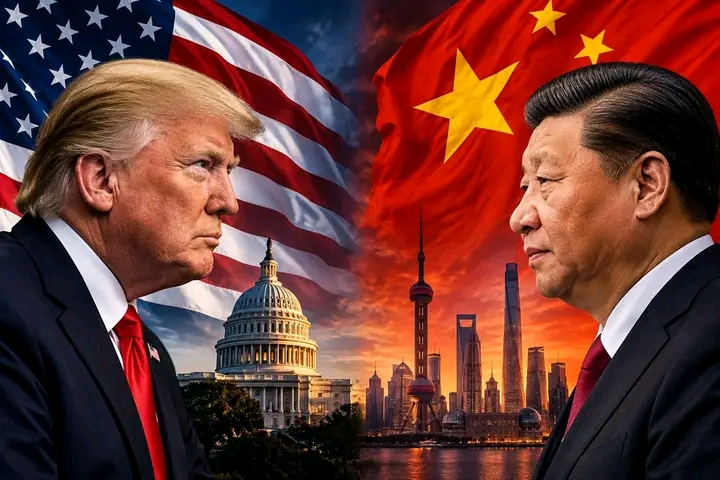
CHINA IS NO LONGER ON TRACK TO OVERTAKE THE UNITED STATES
For two decades the consensus held that China would soon become the world’s largest economy. Those forecasts have been revised downward again and again. The latest numbers from Oxford Economics show the gap is widening, not closing.
China’s nominal GDP reached roughly 77 percent of the US level in 2021. By 2025 it had fallen back to around 67 percent. The same firm now projects China will reach only about 84 percent of American GDP by 2040. That is a sharp reversal from earlier expectations that China would surpass the United States this decade or even sooner.
The comparison uses nominal GDP measured in current US dollars. Exchange rates matter. A stronger dollar and weaker renminbi have reduced China’s relative size even when real growth continues. Structural problems inside China reinforce the slower path. An aging population is shrinking the workforce. Productivity gains have slowed. The property sector remains a drag on household wealth and investment. Debt levels are high. These factors limit the pace of catch-up.
A Financial Times chart tracks the pattern of revisions. Successive forecasts from The Economist in 2010, Goldman Sachs in 2011, the OECD in 2018, the EIU in 2020, and Oxford Economics in 2026 all moved the crossover date further into the future. What once looked like an imminent shift in economic leadership has been pushed back by years.
The United States continues to grow from a much larger base. Deeper capital markets, technological leadership, and a flexible labor force give it advantages that pure manufacturing scale does not automatically overcome. China’s rise remains real, but the idea of inevitable overtaking has lost credibility.
Statements from the data are clear. China is no longer expected to overtake the United States as the world’s largest economy anytime soon. Earlier timelines have been repeatedly pushed back. The latest Oxford Economics projection leaves China well short of parity even in 2040.
SOURCES
Oxford Economics
Financial Times
Mario Nawfal reporting on the Oxford Economics and Financial Times data