

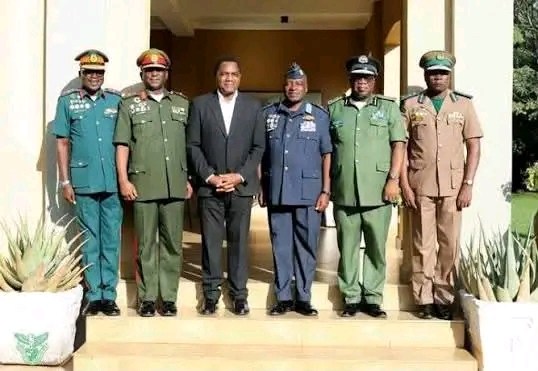
CIVILIAN INDISCIPLINE: TAKE YOUR POLITICS AWAY FROM THE UNIFORM
There is a form of indiscipline developing in our politics which Zambia must confront. I call it civilian indiscipline.
It is the growing tendency among politicians to speak contemptuously about professional men and women in uniform, to issue personal warnings to commanders, to threaten the Inspector General of Police, to attack military officers by name and to drag serving security personnel into political quarrels whenever a security operation produces an outcome they do not like. This must stop
Those of us who are old enough to remember the Zambia of the liberation wars grew up with a very different understanding of national security. As children, we knew that Zambia was surrounded by conflict. Ian Smith’s Rhodesia was hostile. There were military incursions and bombings associated with the liberation struggles of Southern Africa. Aircraft passing overhead could cause anxiety because ordinary people did not necessarily know immediately whether they were friendly or hostile.
We were taught security consciousness. We were taught what to do if we heard an explosion. We were taught to take cover. We understood that certain information was not to be carelessly discussed. Above all, we grew up with enormous respect for the men and women in uniform who stood between the Republic and those who might harm it.
This is one reason I have deliberately taken time to write about defence, intelligence and national security. A younger generation has grown up in a Zambia so peaceful that peace itself can easily be mistaken for the natural condition of the world. It is not. Peace is protected
I remember an incident a few years ago when I was waiting in a long queue at a Government office. I noticed a young Zambia Army private standing towards the back. I was only a few places from being served. I walked back, called the soldier and gave him my place. He appeared surprised. I was surprised that he was surprised. That is the Zambia in which I grew up. When we saw a man or woman in uniform, we understood that the person might be required elsewhere at short notice in service of the Republic. The uniform meant something.
This culture exists elsewhere too. In Israel, for example, society is organised around the reality that soldiers may need to move rapidly between civilian life and national duty. The sight of young men and women travelling in uniform is completely normal, and public life reflects an understanding that those serving the country carry responsibilities different from those of ordinary civilians. They are not superior human beings. They carry a different burden. A soldier may be ordered towards the very danger from which everybody else is running away.
That is why I become deeply concerned when politicians casually announce, “I am warning the Army Commander.” “I am warning the Air Force Commander.” “I am warning the Inspector General of Police.” NO! NO! NO! Let politicians debate politicians. If you disagree with Government defence policy, challenge the Minister responsible for Defence. If you disagree with Government policy on internal security, challenge the responsible political authorities. Parliament has oversight mechanisms. Courts have constitutional functions. The law provides mechanisms for accountability.
There is a reason professional security institutions are supposed to remain outside partisan political warfare. Do not force the uniform into the political arena. This does not mean that a soldier, police officer, intelligence officer or commander is above the law. Nobody is above the Constitution. It means that we must understand the extraordinary environment in which security professionals sometimes operate.
A civilian accused of wrongdoing can ordinarily explain his actions and disclose information necessary for his defence. A security officer may possess classified information which he cannot simply reveal publicly. He may have acted upon intelligence that cannot be exposed without compromising sources, methods, operations or national security. He may remain bound by secrecy even when disclosure could make his own position easier to explain.
That creates difficult questions for any mature constitutional democracy. Military justice already recognises that military service has characteristics requiring specialised procedures in appropriate cases. Where alleged conduct is purely civilian, ordinary criminal law must of course apply. Where genuinely classified operational matters are involved, however, our legal architecture must be sophisticated enough to protect both the rights of the accused and the security interests of the Republic
This discussion becomes even more important in the world we now inhabit. War no longer necessarily announces itself with tanks crossing a border. A hostile actor can attack electricity infrastructure through cyberspace. Financial systems can be targeted. Communications networks can be disrupted. Disinformation can be weaponised. Critical infrastructure can be sabotaged. Foreign intelligence services can operate through people who appear completely ordinary. A country can therefore be under attack long before most citizens realise that anything is happening.
This is why security consciousness matters. There is another principle politicians must understand. The State will sometimes know things that you do not know. This does not give the State unlimited power. It does not remove constitutional safeguards. It simply recognises an elementary reality of national security.
Intelligence services cannot publish every intelligence assessment. The Police cannot announce every person under surveillance. The military cannot publish every operational plan. Protective security officers cannot tell Facebook how they intend to secure visiting Heads of State.
As Zambia approaches major national events involving senior dignitaries and Heads of State and Government, security institutions will naturally be assessing threats, routes, locations, intelligence and contingencies that the public will never see. This is exactly how it should be.
Recent allegations concerning militia activity are serious precisely because authorities have described the matter not merely as an ordinary political disagreement, but as involving alleged weapons, military activity and threats to State security. Those allegations must ultimately be dealt with according to law, evidence and due process.
Politicians should therefore resist the temptation to turn every security development into political drama. Ask questions where questions must be asked. Demand accountability where accountability is required. Defend constitutional rights vigorously, but understand the line between democratic oversight and civilian indiscipline.
The Zambia Army is not a political party. The Zambia Air Force is not a political party. The Zambia National Service is not a political party. The Zambia Police Service is not a political party. Our intelligence institutions are not political parties. Their commanders should not become unwilling contestants in our daily partisan battles.
Governments will change. Ministers will change. Political parties will rise and fall. The Republic must remain. A mature democracy does not weaken its security institutions in order to prove that it is democratic. It subjects them to the Constitution, civilian authority and the law while preserving their professionalism, discipline and political neutrality.
There is a profound difference between civilian control of the security services and civilian contempt for the security services. Zambia must understand that difference. Let us recover our security consciousness. Let us recover our respect for service. Let us recover our respect for the uniform. These men and women are not props in our political arguments. They are guardians of the Republic.
Zambia Forward, TOGETHER in UNITY.
Saviour Chishimba
President
United Progressive People (UPP)
UPND Alliance Partner
I, totally agree with, you, 100%,0n this subject matter, Chishimba,,and from, the on set, it is cardinal to call out, the abitual,,critics, of our men & women in Uniform,
Fred Mmembe,,Harry Kalaba, & Peter Sinkamba,
These, above, have been,the most critics,of our Uniformed personel,
Please,take heed, of this timely advice.
Especially, in this period,of the aftermarth ,of our Elections,
Ordinarily,,majorty of We, the Zambian Citizens ,we love and support our,men & women, in uniforms,
After all ,these are, our very Own ,Sons & Daugthers, and they come from our own Civilian family set-ups
As no human being is born a Soldier,
So, this,issue, of disrespecting our Defence & security men & women,is more of Politicians nature, rather of ordinary Zambians
You are right on! How i wish nationsl service was reintroduced!
Saviuor chishimba has said it all.
civilians must learn to keep to their side of the
lane. When you warn and insult service people,
like the way mandubile did, did he expect the commanders and
officers to respond to him or was he just trying
to instill fear in them? The military operates in a solid
hierarchical structure. They do not accept to have their seniors
humiliated. Mandubile was offside by ordering the army, and police
chiefs to stop it, and warning that he was the incoming commnder in chief.
This must serve as a warning to all politicians who do not seem to
distinguish between civilian and military/ service life.