

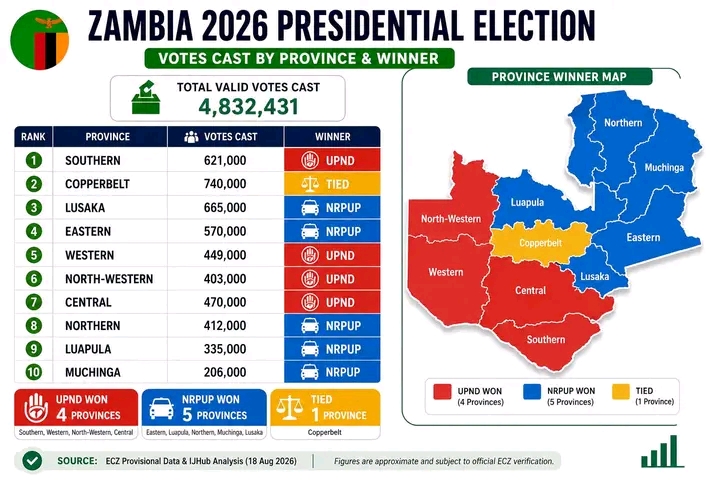
DID YOU KNOW THAT UPND ACTUALLY WON THE ELECTION WITH 4 PROVINCES MAJORITY VOTE: BUT WE HAD ALOT OF INDEPENDENTS WHO DIVIDED OUR VOTE.
By Dr Larry Mweetwa.
Copperbelt stands out as the most neutral voting block but our adoption system affected our performance.
I strongly believe that our primary adoption system for parliamentary candidates requires serious reform. An internal process intended to strengthen democracy should never become the very mechanism that divides party structures, creates resentment and sends wounded members into elections fighting one another.
“A good political system does not merely choose a candidate; it preserves the unity required to elect that candidate.”
We cannot realistically allow the political fate of an entire constituency sometimes comprising more than 54,000 voters—to be determined largely by the preferences of only a handful of constituency or provincial officials. Six people cannot always accurately represent the political mood of tens of thousands of citizens.
The fundamental question should be: Who can actually win the constituency?
Popularity among party officials is not necessarily popularity among voters. A prospective candidate may have tremendous grassroots support among youths, women, farmers, churches, traditional leaders, professionals and ordinary citizens while having limited influence within a small internal electoral college.
“When the gatekeepers become more powerful than the people, democracy begins to lose its purpose.”
There is also a deeper contradiction in the current process. A candidate can emerge victorious from the primaries and still have that victory overturned by the National Selection Committee. If the primary result is ultimately advisory rather than decisive, then we must ask whether subjecting members to a highly competitive internal election is worth the bitterness and division it sometimes creates.
The consequences can follow us into the general election. Those who feel unfairly excluded may contest as independents, supporters become divided, campaign structures fracture and votes that should naturally remain within the party are split. We have painfully experienced the impact of independent candidates, and that experience should become a lesson rather than merely a memory.
“Wisdom is not avoiding every mistake; wisdom is refusing to pay twice for the same lesson.”
I therefore believe we should seriously consider abolishing or fundamentally redesigning the current primary adoption system.
Let aspiring parliamentary candidates apply directly to the National Secretariat, after which a transparent and professionally managed assessment process can determine electability. This could combine independent constituency opinion polling, grassroots consultations, membership standing, community service record, integrity, competence, loyalty to party values, previous electoral performance and demonstrated ability to mobilise voters.
The National Selection Committee would then receive objective evidence showing who the people actually prefer, rather than relying excessively on the preferences of a very small number of officials.
This is not about weakening party structures. It is about protecting them.
“The strongest candidate is not necessarily the person with the loudest supporters in the meeting room, but the person whom the greatest number of voters are prepared to follow to the ballot box.”
After adoption, everyone should leave the process feeling that although their preferred candidate may not have succeeded, the procedure was fair, transparent and evidence-based. That is how we minimise independent candidatures, reconcile competing camps and enter the general election as one party behind one candidate.
Our objective must never simply be to win the primaries. Our objective must be to win the constituency while preserving the party.
A nomination system that produces a candidate but destroys the structure that must campaign for that candidate has defeated its own purpose