Deeslie Mondoka writes:
DOES FINGER PENETRATION COUNT AS “CARNAL KNOWLEDGE” UNDER OUR LAWS?
Picture this:
You are playing football in Matero. The referee blows the whistle and says, “No hands!” You pick up the ball with your elbow and score.
Then you tell the referee, “But ba referee, I never used my hands!”
The referee will probably tell you, “My brother, you have understood the English but missed the football.”
Something similar happened in this case.
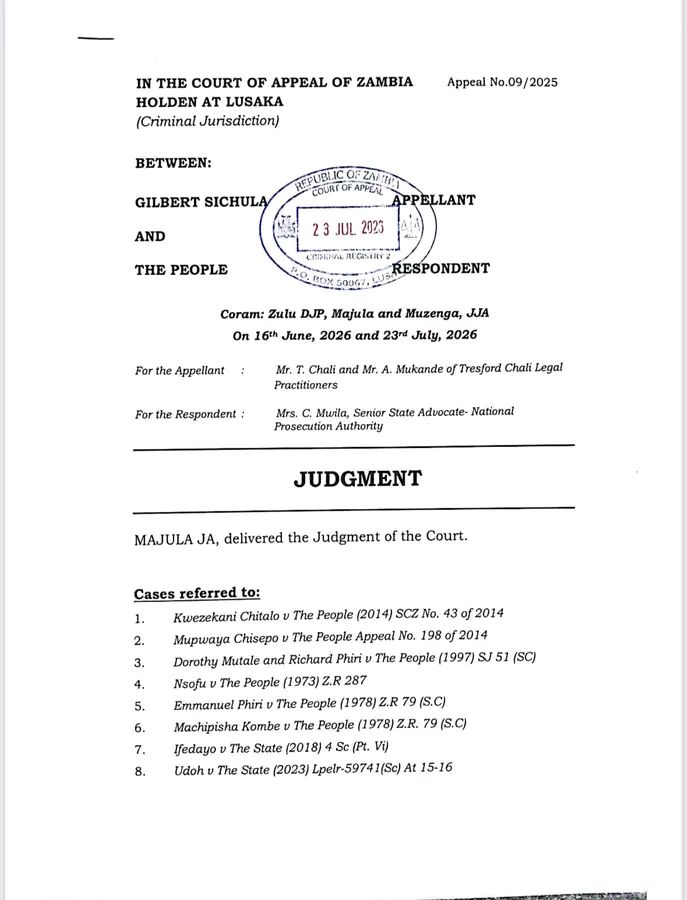
GS was convicted of an unnatural offence under section 155(a) of the Penal Code and sentenced to 25 years in prison. The trial court found that he had “digitally penetrated” a ten-year-old boy.
For context “Digital penetration” simply means penetration using a finger or fingers. The child was also found to have an injury to the anus.
But when the case reached the Court of Appeal, the judges asked a simple but very important question:
Did the prosecution actually prove “carnal knowledge” as required by section 155(a)?
The answer was no.
Why?
Because the Court explained that, under section 155(a), “carnal knowledge” requires penile penetration. In other words, the prosecution had to prove penetration by the penis.
The evidence accepted by the trial court, however, was that the penetration was by a finger.
The Court was therefore saying, in simple terms: Yes, the conduct may have been wrong and serious. But that is not the same thing as proving the particular offence with which the person was charged.
And here is where the law becomes like your strict Zambian auntie at a family meeting:
“We are not discussing what you think happened. We are discussing exactly what the law requires you to prove.”
The medical evidence showed an injury, but an injury alone could not prove what caused it or that there had been penile penetration.
So, the Court held that the prosecution had failed to prove an essential part of the offence beyond reasonable doubt.
The conviction was quashed. The 25-year sentence was set aside. GS was acquitted.
WHAT DOES THIS MEAN FOR THE ORDINARY CITIZEN?
It means that in a criminal case, the prosecution must prove the exact offence charged not just prove that something bad happened.
Moral of the story?
In criminal law, close enough is not good enough.
“If I ask for nshima, don’t bring me rice and say, ‘But ba boss, both are carbohydrates.’”
The law has ingredients. Leave out an essential one, and the legal recipe fails.
Disclaimer:
My commentary on this decision is no more a legal critique than a campfire tale is a treatise on thermodynamics. It is, rather, a dramatized retelling, a lively reenactment if you will, of the judicial clash, unburdened by the solemn drudgery of analysis and delivered with the unapologetic zest of a storyteller who knows a good duel when he sees one.