

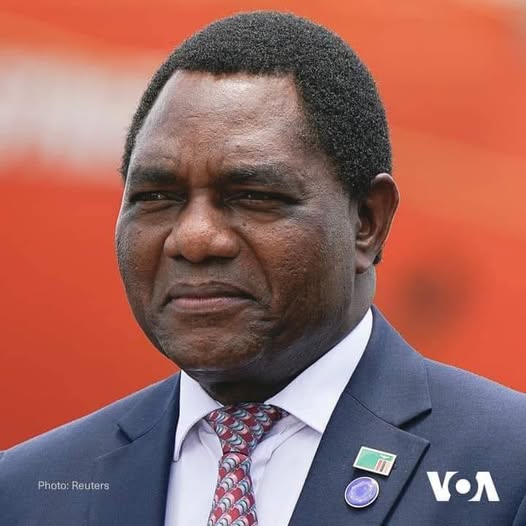
DOES ZAMBIA STOPS BEING A DEMOCRACY IF HH DECIDES TO GO FOR A THIRD TERM?
I am not saying that HH wishes to run for a 3rd term, this is just appreciating academia.
The first question though should be, what is democracy according to Zambia? Is it fully attainable? Was it attained under KK? FTJ? Mwanawasa? RB? M.C. Sata, or ECL? I remember FTJ calling Mwanawa’s fight against corruption a political “witch hunt”. It’s on record.
Anyway, Is there a term limit in the definition of democracy? How did the presidential term came about? How old and matured is our democracy? Can we compare the democracy of Zambia, a country born only in 1964 to the democracy of USA which got its independence in 1776? How did we end up having political parties/partisan politics? How does region, policy direction or tribe influence politics?
As you are brainstorming, let’s look at how presidential terms came about in the USA and generally.
The first presidential election in the United States was held in 1788.
George Washington – the commander of the Continental Army in the American Revolution – had recently announced his return from retirement, whereupon he agreed to run for President. As the Constitution was still being ratified by the states, the inner workings of the new American government were not completely defined. Because of this, Washington did not select a running mate, as such a concept did not yet exist.
The tallied votes determined that Washington had unanimously won the election with a total of 69 electoral votes. John Adams – a fellow Founding Father who served as an American diplomat to Europe in the Revolution – earned the second-highest number of votes, making him the nation’s first vice president.
Washington and Adams were both re-elected into their respective offices in the 1792 election, after which they stepped down when their second terms were completed.
One of the major long-term effects of the Washington-Adams presidency was the unofficial creation of the “two-term tradition,” that being where a sitting president was expected to willingly step down after two full terms, even though no such law mandating such was enacted until the Twenty-second Amendment in 1951.
America’s first presidential administration was also notable for not having any explicit partisan affiliations. Although the 1790s saw the rise of the first two major political parties in the United States, Washington identified himself as politically-independent, going so far as to condemn partisanship in his 1796 “Farewell Address.”
In spite of his disapproval of political parties, the very next presidential election would see the rise of them to national prominence, brought about in part by his own Vice President, Adams.
John Adams ran for president in the 1796 election against Thomas Jefferson, a fellow Founding Father who co-authored the Declaration of Independence in 1776.
Keeping with his previous political affiliation, Adams ran on the Federalist Party’s platform. From 1788 to 1801, the Federalists were the dominant political party in the United States. Led by major political figures such as John Adams and Alexander Hamilton, their supporters were largely centered among industrialized groups, the merchant class, and banking institutions in the New England states.
Their platform advocated for a strong, centralized federal government that would form economic alliances with the Kingdom of Great Britain.
During the Washington-Adams administration, the Federalist Party defended Hamilton’s economic policies. As the nation’s first Secretary of the Treasury, Hamilton supported having the federal government pay off the states’ debts, raising money through securities bonds, giving American businesses government subsidies, and imposing protectionist tariffs on imported goods from abroad. Opposing Adams in the election was Jefferson, running for president with the Democratic-Republican Party. Otherwise known as the Jeffersonian Republican Party, it was the first opposition party in the United States.
Under the leadership of Thomas Jefferson, James Madison, and James Monroe, the party was largely supported by middle class artisans, farmers, merchants, and wealthy slave owners in the southern states. Their platform was highly critical of the positions held by the Federalists.
I want you to create your own conclusion, but as you do so: the truth is that the democracy for USA took 250years of perfection to be where it is today. Their two party political system is more civilized than our Zambian multiparty democracy which is possibly in need of more defining and refining. If anything, our constitution needs continuous improvements. We can also see that if we were to remove tribe from Zambian politics: people generally vote according to their needs in a particular region-the tribalism topic in Zambia is more louder than it is practiced.
Shipungu | September 14, 2026
I doubt HH himself would agree to this. Politics is just a by the way for HH. He is making serious money from his businesses, particularly cattle ranching. I doubt he will want to continue being insulted by entitled idiots and career criminals.
That said, you make relevant observations.
We just need shift our system towards a meritocracy rather than a democracy. The American system that you are quoting currently has a college specifically established to identify performance. In this college, not every Jim and Jack in the country can vote. They have primaries from which those who make it undergo further scrutiny.
We can not continue to have non-performing elements like JJ, Munir and Freedom Sikazwe in the house of parliament. They are evidence of a failed system.
We also need to upgrade to a fully electronic voting system based on an upgraded electronic national registry. The system can be secured by the blockchain technology that is used in bitcoin. There are African countries already using such a system.
Yes,if you check American congressmen CVS, they are all highly educated capable of researching issues of law they table at Congress
Freedom Skazwe is a bush mechanic.He doesn’t even know what a crankshaft is made of.He parliament,Munir Zulu was just a bum
I repeat. It would be extremely foolish of President Hichilema to go for a third term. It will totally ruin his standing and bring shame upon his name. It is not worth it.
Others tried, to their shame. FTJ Chiluba, Edgar Chagwa Lungu. It does not matter how well he performs in his second term. He must leave office after 2031. It is an established fact that the more one hangs on to power, the more difficult it gets to leave and the more they have to resort to brute force to remain in power.
Power has a way of corrupting even the best of us. The two term limit is an effective control measure. Dr. Kaunda started very well in 1964 up to 1974. Then he dreamed of the one party state in 1972. The rest like they say is history. Those who lived through the nightmare of the last days of UNIP know what I am talking about.
It doesn’t matter whether one is educated or not. Academic intelligence must not be confused with emotional intelligence, the ability to understand people and act WISELY. There are lots of people who are academically gifted but social misfits.
I repeat. It will be extremely foolish for President HH to go for a third term. These sentiments people are beginning to express about the third term so soon after the elections must not be taken lightly. I get the feeling that someone is testing the waters.
Let us begin to prepare to resist any such attempts. Forewarned is forearmed.